


Florida’s bedrock formed millions of years ago from the compressed skeletons of prehistoric marine life. Limestone has one trait that changes everything: it dissolves. Rainwater picks up carbon dioxide from the air and from decaying leaves as it falls, turning into a mild carbonic acid. That acidic water seeps through cracks in the limestone for years, slowly widening them into a honeycomb of underground channels, sinkholes, and caves. Geologists call this karst topography, and Florida has one of the largest karst landscapes in the country. When pressure builds up enough in that underground plumbing, and the layer of clay or rock above it is thin enough or breached, the water has nowhere to go but up. That’s how a spring is born.
Most of that water is homegrown. Some does arrive from recharge areas in southern Georgia and Alabama, where the same limestone formation dips underground and flows south. But most of it is ordinary Florida rain, an estimated 150 billion gallons a day statewide, and most of that evaporates or runs off before it ever reaches the aquifer. What does soak in takes its time. A U.S. Geological Survey study of springs in the Suwannee River basin used chemical tracers, a way of dating water by its dissolved gases, and found that groundwater typically spends ten to twenty years underground before resurfacing at a spring. The biggest springs tend to hold onto their water the longest. That’s the ordinary answer. In deeper, more isolated pockets of the aquifer, some water has been dated at 26,000 years old. Some of what bubbles up in Florida today started as rain during the last Ice Age.
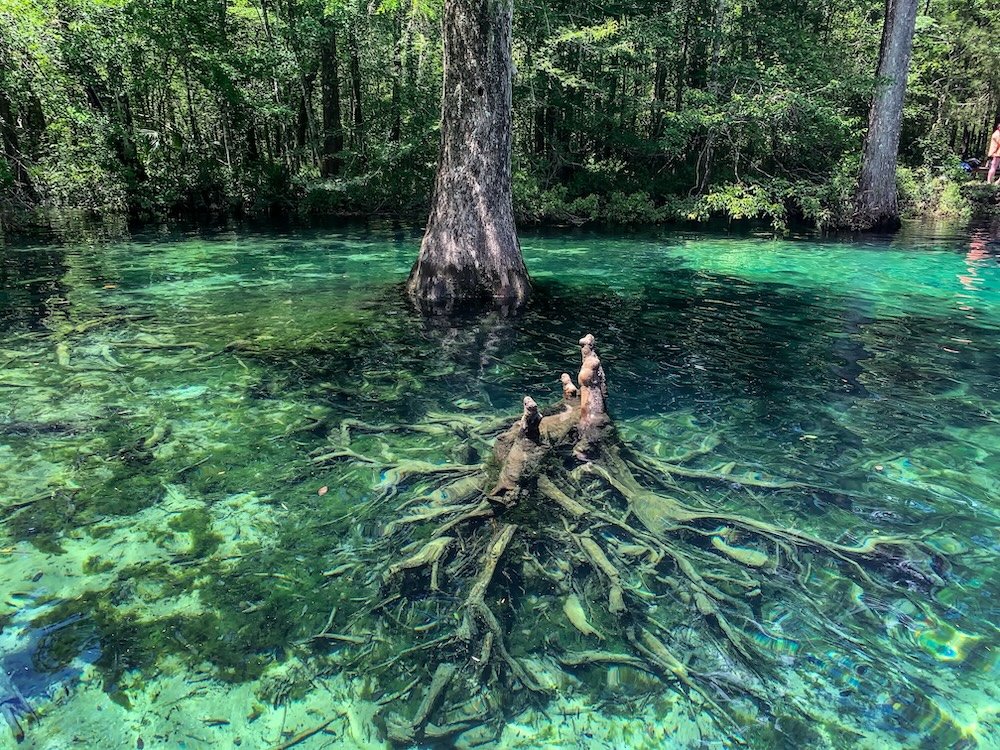
Hydrology, the science of water, provides a unit of measurement called “magnitude” to tell them apart. First-magnitude springs have a minimum discharge of 65 million gallons a day, or 100 cubic feet per second. Second-magnitude springs have a discharge of 6.5 to 65 million gallons a day, and third-magnitude springs have a discharge of 0.65 to 6.5 million. Florida has more than 30 first-magnitude springs, and as many as 700 freshwater springs of all magnitudes, more than any other state. As you drive through Florida, you have many excellent opportunities to visit the state’s freshwater springs and their accompanying wildlife. Here are some of the most interesting.
OCALA NATIONAL FOREST: ALEXANDER AND JUNIPER SPRINGS
Second-magnitude Alexander Springs in Lake County moves 70 to 80 million gallons of water a day that’s so clear and blue-green it looks retouched in photographs and feeds a four-mile-long spring run that winds through thick subtropical forest before draining into the St. Johns River, where alligators bask on the banks and river otters play in the shallows. It’s popular enough with paddlers that renting a canoe there on a Saturday morning has become close to a local tradition.

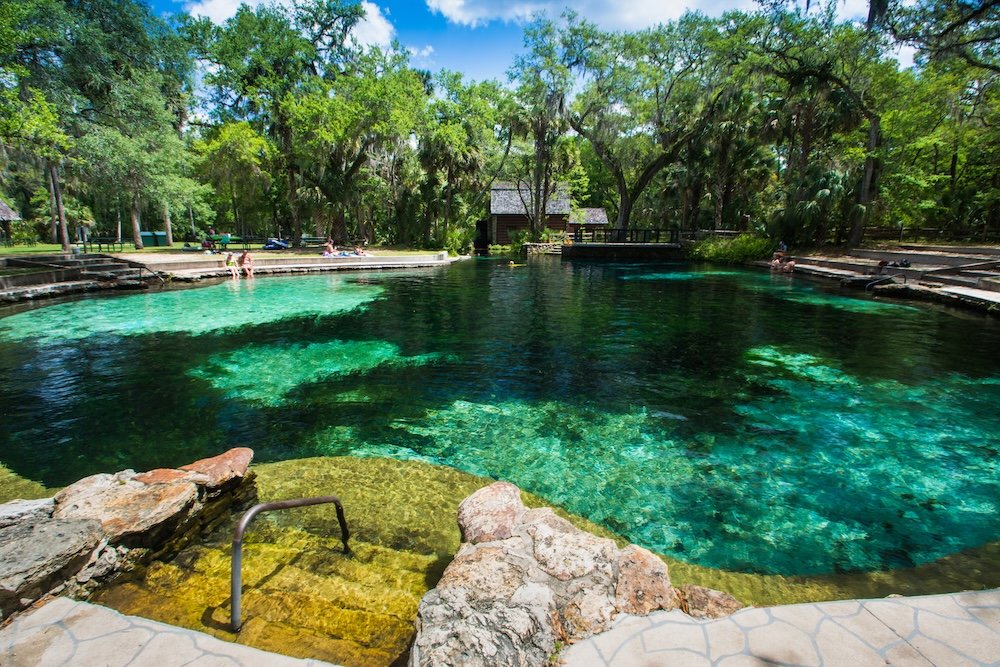
A short distance north, Juniper Springs offers a second-magnitude spring discharging some 13 million gallons a day into an emerald pool surrounded by a stone wall constructed by the Civilian Conservation Corps by hand in the 1930s. Juniper Spring meanders for seven miles, and in some places so tight paddlers have to crawl under overhanging branches, through wilderness that is serious enough that outfitters recommend against it for beginners.
THE ST. JOHNS CORRIDOR: BLUE SPRING AND DE LEON SPRINGS
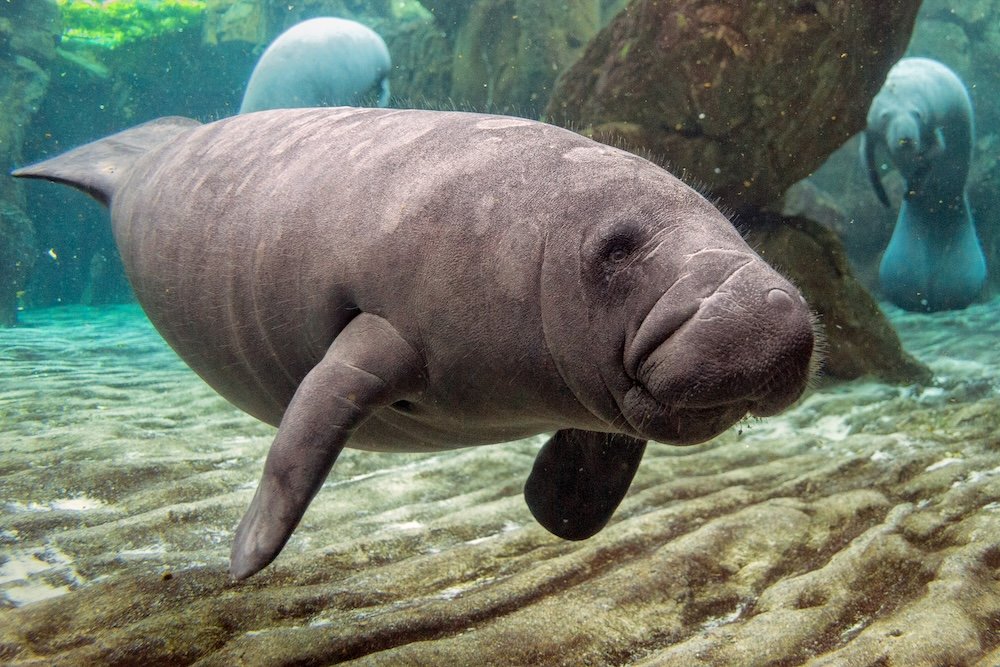
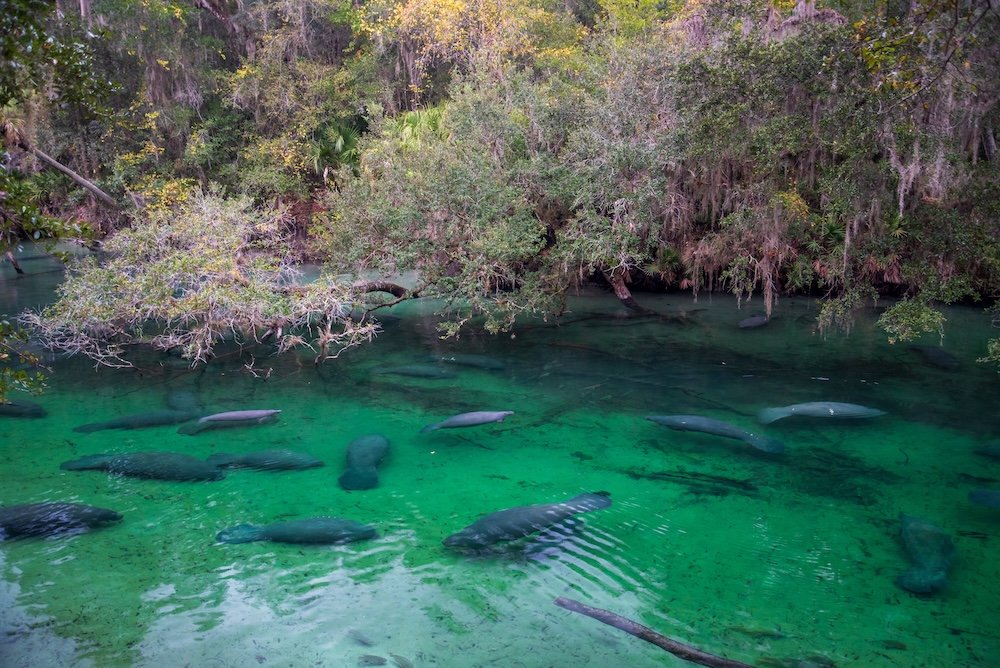
Traveling south from Jacksonville on the St. Johns River, the springs also become wildlife refuges. Second-magnitude Blue Spring in Orange City moves some 100 million gallons of water a day to a river that’s a winter address of choice for West Indian manatees. These endangered species can’t tolerate cold water, and park staff counted 932 manatees packed into the spring run at once on January 21, 2024, setting a state record the same week temperatures throughout Central Florida fell into the 30s. The view of that many enormous, docile animals lined nose to tail in eighteen inches of water is the kind of thing you don’t quite believe until you are there.
Not far away in De Leon Springs State Park, the springs themselves share the stage with a genuinely bizarre local landmark: the Old Spanish Sugar Mill Restaurant, which was built around a mill that actually ground real sugar cane in the 1830s before Peter and Marjorie Schwarze stepped in and saved the crumbling structure from destruction in 1961 and turned it into a restaurant where every table comes equipped with its own built-in griddle and diners get a pitcher of batter and cook their own pancakes while alligators and wading birds go about their business in the spring outside the window, which may be the only place in Florida where wildlife watching and breakfast can occur at the same table.
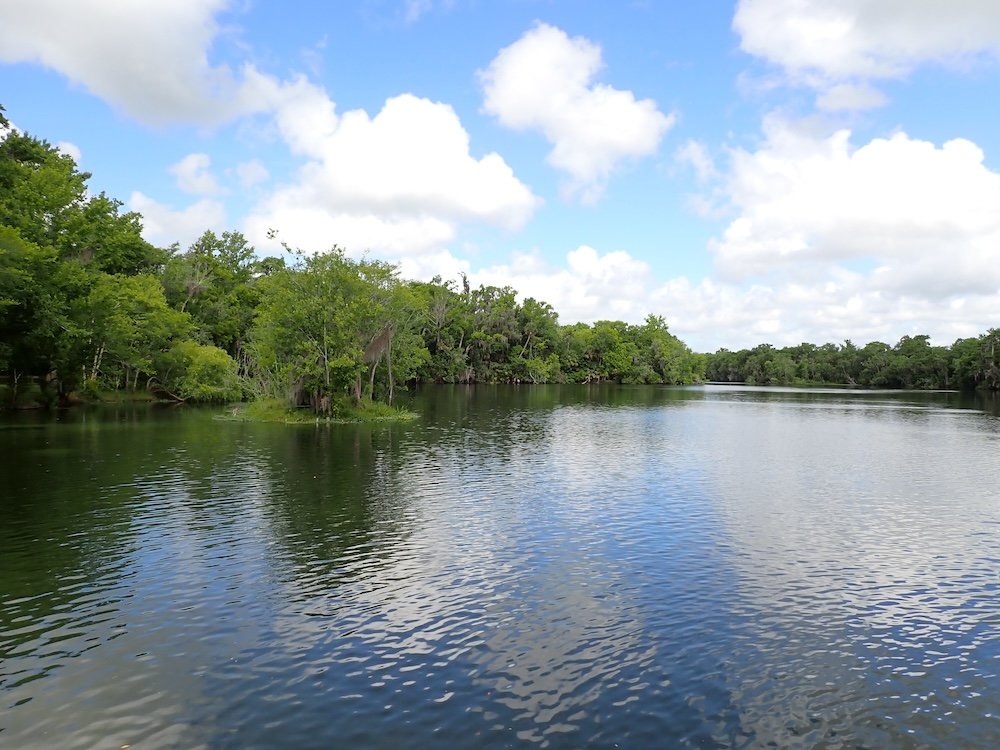
THE ?GULF ?COAST ?MANATEE BELT: CRYSTAL RIVER, HOMOSASSA, AND WEEKI WACHEE
Heading out to the Gulf Coast, the waters warm up, get fluffier, and more manatee-friendly. Technically a group of springs rather than a single spring, Kings Bay in Crystal River draws water from some 50 named vents to move more than 500 million gallons of 72-degree water per day. It is the only place in the United States where swimming with wild manatees is legal. You must watch quietly. You cannot chase, poke, ride, hold, or surround a manatee. Scores of manatees gather there over the winter, and the ecotourism built around them (kayak outfits, snorkelers, dawn boat excursions) has become the town’s entire economic identity.

Just a short drive south of Crystal River is Homosassa Springs Wildlife State Park, which features its own first-magnitude spring (moving 65 million gallons a day) and a piece of truly bizarre roadside history: the park’s underwater “fish bowl” observatory began as a repurposed iron tank with a couple of tiny windows cut into the sides (decades before anyone thought to design aquariums with comfort in mind), and the park served as the home of Lu, a hippopotamus that was brought in 1966, appeared on the 1960s TV shows Daktari and Cowboy in Africa, and lived long enough to become the oldest hippo in the world before dying in 2025.
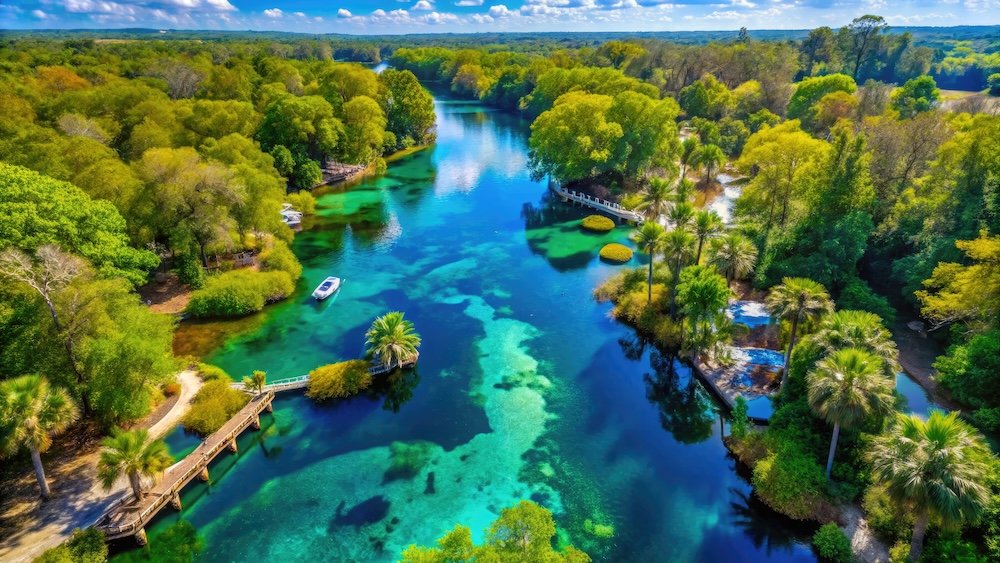
A little further up the coast in Hernando County, Weeki Wachee Springs moves a first-magnitude 117 million gallons a day, and has been running underwater mermaid shows since October 13, 1947: a former Navy frogman-trainer named Newt Perry wanted a way to have swimmers stay underwater without an obvious air tank, so he set up a hose powered by a compressor on shore, and the theater he built into the limestone has been putting performers in fins and routines ever since, making it one of the oldest continuously-running tourist attractions in the state.
MARION COUNTY’S ORIGINAL SPRINGS: SILVER SPRINGS AND RAINBOW SPRINGS
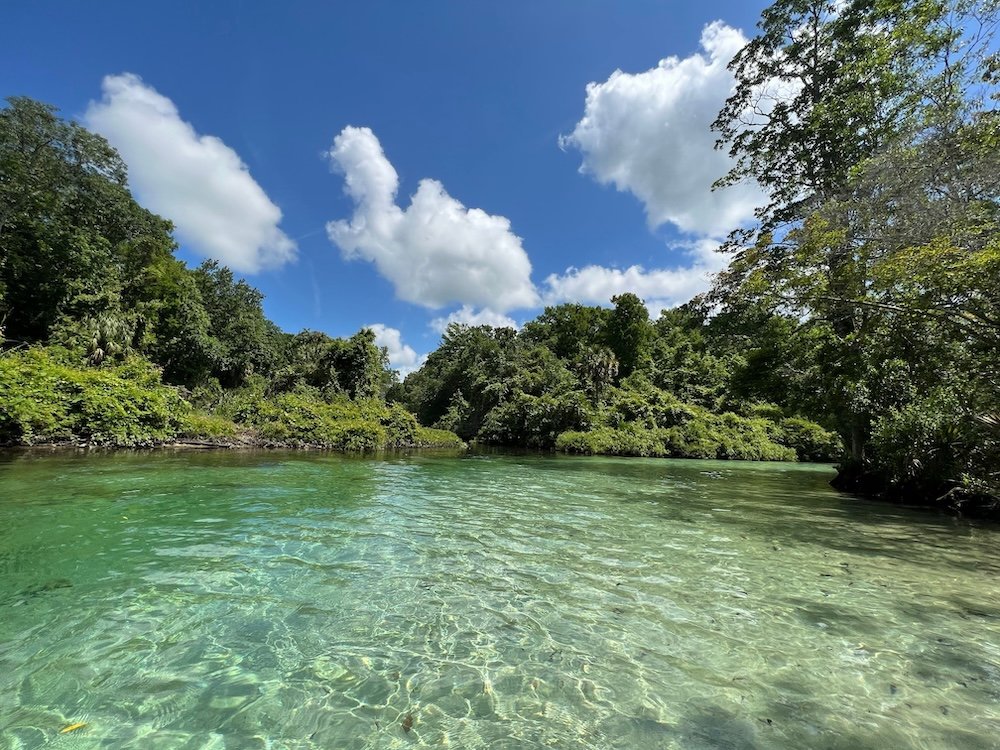
Meanwhile, Marion County is home to two springs that helped establish Florida as a tourist destination. Silver Springs, just outside Ocala, welcomed Northern steamboat passengers as early as the 1870s. When a local hunting guide named Hullam Jones bored a hole in the bottom of his rowboat and dropped a sheet of glass into it (by accident creating the glass-bottom boat tours that still operate today), it was allegedly in Silver Springs in the late 1870s. In the 1930s, Colonel Tooey released a pack of rhesus monkeys on a river island to attract tourists, apparently not bothering to realize that rhesus monkeys can swim; they scattered within days, and their descendants still roam the surrounding forest and have been seen hundred of miles away in Florida’s panhandle region. Hollywood realized Silver Springs’ waterspout had excellent clarity and began filming Tarzan movies here in the 1930s; it was later used again for the television series Sea Hunt from 1958 to 1961. Once moving as much as 550 million gallons a day, Silver Springs has been reduced to more than a third of that by decades of regional groundwater pumping.
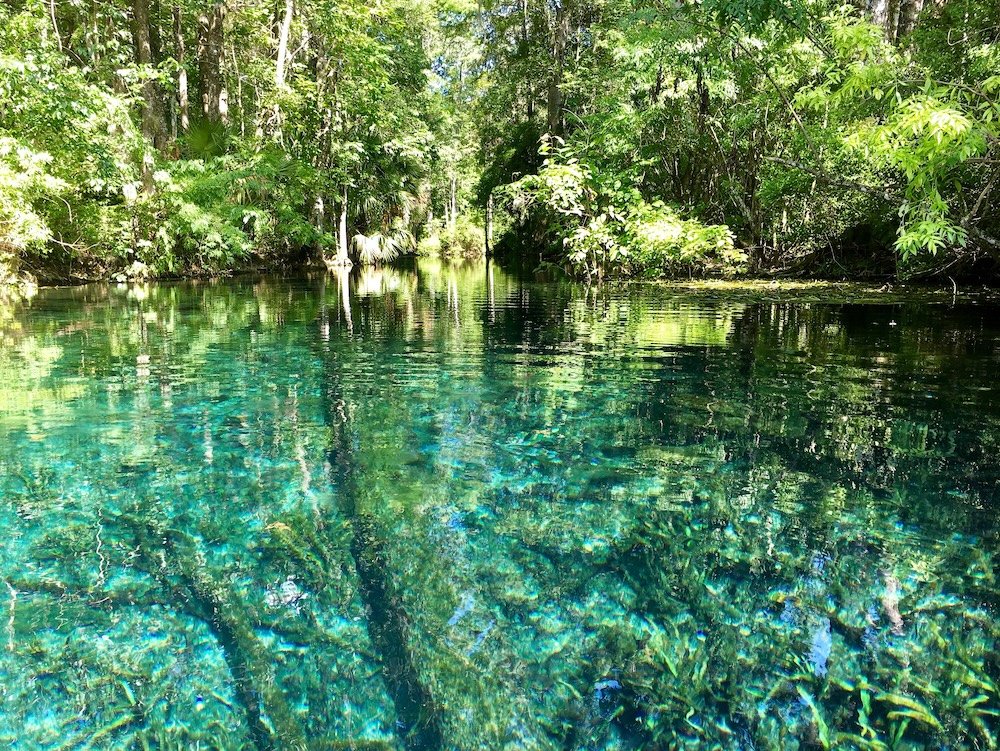
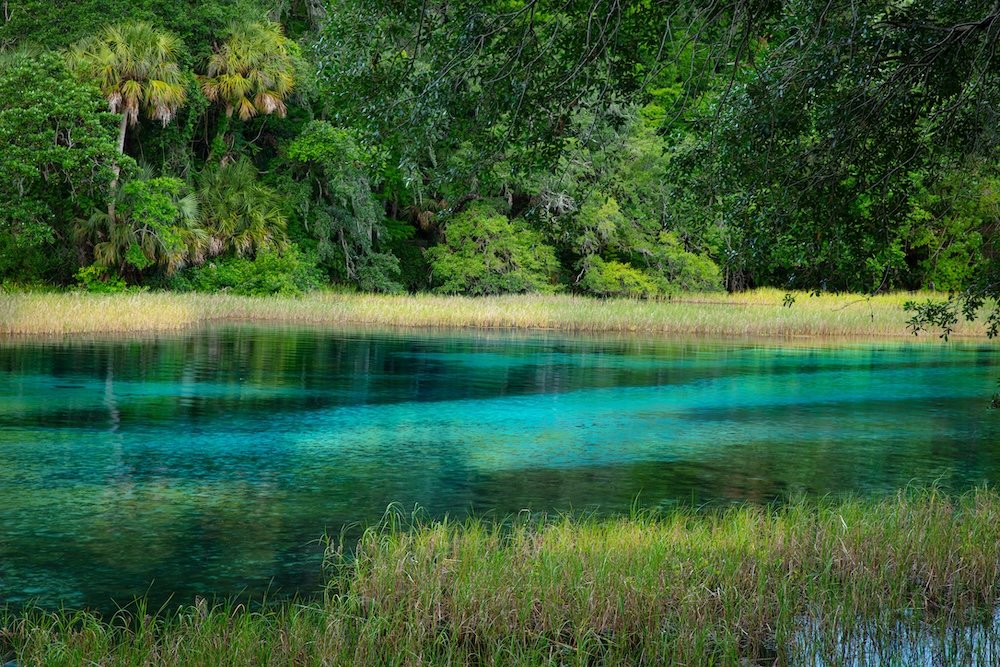
A few miles west of Silver Springs is Rainbow Springs, which follows the same basic narrative (once known as Blue Spring, it was branded and commercialized in the 1930s with glass-bottom boats and, for a portion of the 1950s, its own mermaid shows competing directly with Weeki Wachee’s before closing in the 1970s and being taken over by the state as a park), but with a more bizarre middle section: its first-magnitude spring can move as much as 600 million gallons a day, its artificial waterfalls (built during the height of its commercialization) are one of the more unexpected features of inland Florida, and its spring run, the Rainbow River, is now one of the state’s most popular spots for tubing and kayaking.
THE BIG BEND’S LARGE NUMBERS: WAKULLA
Saving the biggest numbers for last in the Big Bend south of Tallahassee is Wakulla Springs, which reaches depths of at least 350 feet (making it one of the deepest and largest freshwater springs in the world) and moves somewhere between 200 and 300 million gallons a day (though a single measurement in 1973 found it moving the equivalent of 1.2 billion gallons per day), and whose depth and clarity lured Hollywood before CGI was even a thought: MGM began filming Tarzan’s New York Adventure and other Tarzan films here starting in 1938, and Creature from the Black Lagoon (1954), the classic monster movie, used Wakulla Springs’ underwater caves for some of its most iconic footage.
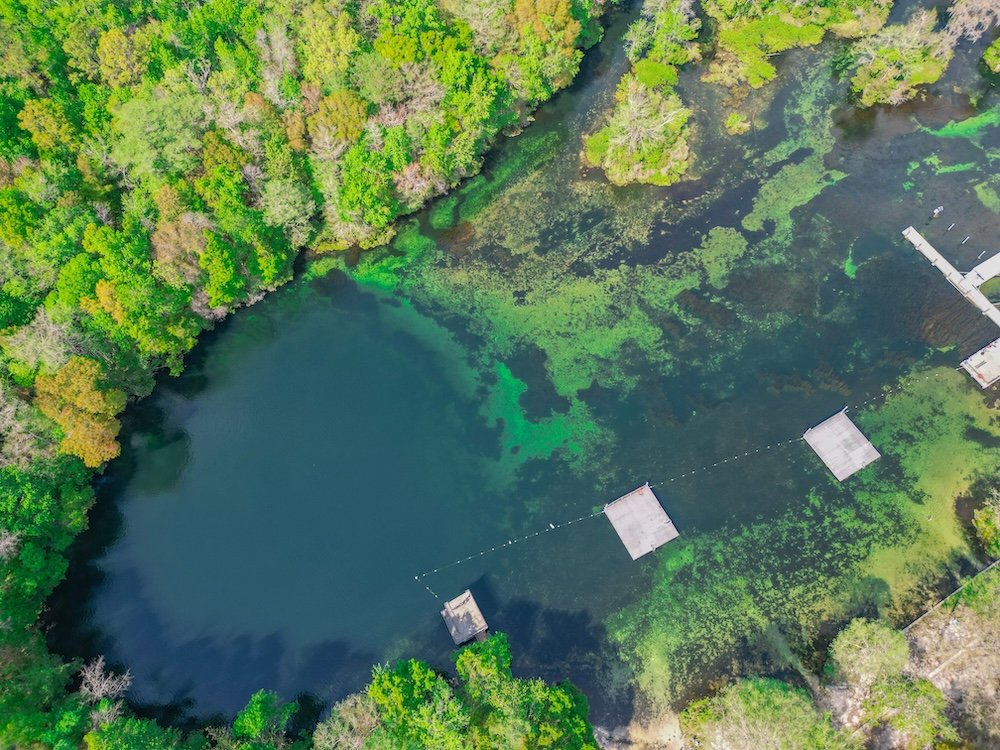
The same caves that hosted film reels have also produced something much more ancient: a Florida woman named Sarah Smith reportedly spotted mastodon bones on the bottom of the spring as early as 1850, and state geologist Herman Gunter led excavations that began in 1930, uncovering a mastodon skeleton now on display at the Museum of Florida History, as well as evidence (found decades later) that early humans were using stone tools in the area during the last Ice Age.