


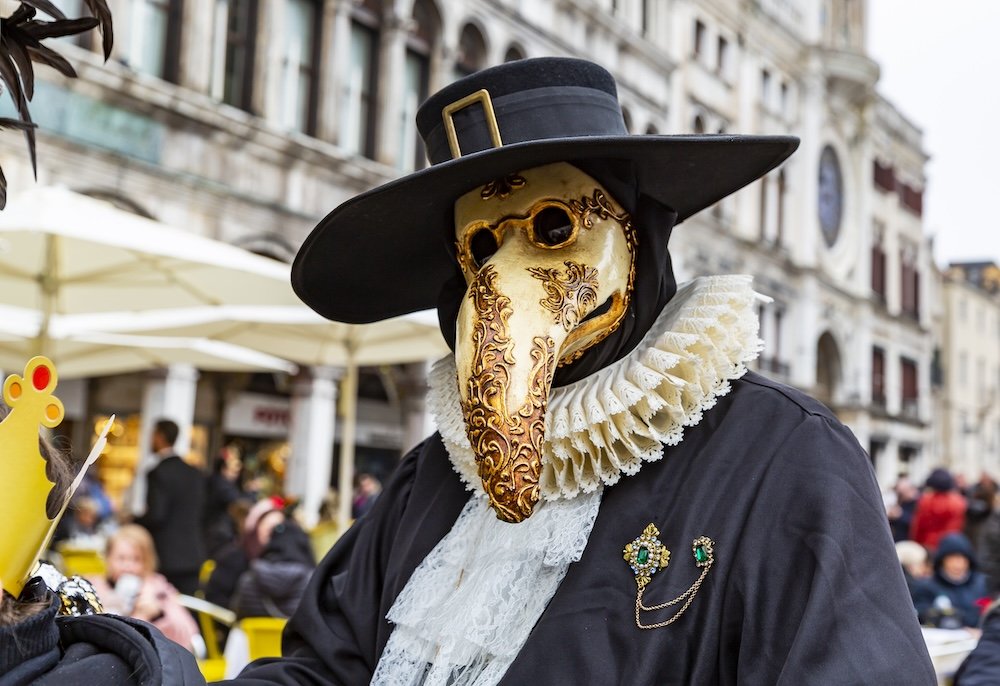
For eleven days every winter, Venice turns itself into the world’s most elaborate costume party. Step into St. Mark’s Square on a Saturday afternoon during Carnevale, and you might spot a courtier in a gold-beaked plague mask posing beside the Basilica. A woman in a hooped gown the color of crushed raspberries glides past a café, entirely unbothered that hooped gowns and narrow Venetian bridges were never meant to coexist. Nobody is in a hurry. That, more than the masks or the confetti, may be Venice’s truest costume each year: the look of a place with nowhere else to be.
The 2027 edition of Venice Carnevale runs from January 30 to February 9, closing, as it always does, on Shrove Tuesday, the last blowout before Lent’s forty days of restraint. The word “Carnevale” comes from the Latin carne levare, meaning “to remove meat.” A “pre-carnival” has slipped onto the calendar in recent years, mostly to stretch the tourist season a little further, and the only piece with any real claim to genuineness is a half-hour parade of traditional Venetian boats down the Grand Canal. The real Carnevale (“Carnival” in English), the one worth the trip, is when the streets themselves become the stage: no single procession to catch and no bleacher seat to book. The spectacle happens, all over the city, all day, for a week and a half.
FROM A BULL’S RANSOM TO A DOGE’S BALCONY
Venetians will tell you Carnival is nearly a thousand years old, and depending on which chronicle you trust, they may be underselling it. Public records show the entertainment as early as 1092, but the party that actually stuck around dates to 1162, when Doge Vitale Michiel II’s fleet defeated Ulrich II, the Patriarch of Aquileia, after Ulrich had the poor judgment to seize Venetian territory near Grado. Venice took Ulrich, twelve of his vassals, and several hundred of his soldiers prisoner. The ransom that finally freed them was oddly specific: one bull and twelve pigs a year, delivered to Venice forever, along with three hundred loaves of bread. For centuries afterward, on the Thursday before Lent, that tribute was reenacted in Campo San Polo as a full-blown bull hunt, the animals herded and, eventually, ceremonially beheaded before a roaring crowd.
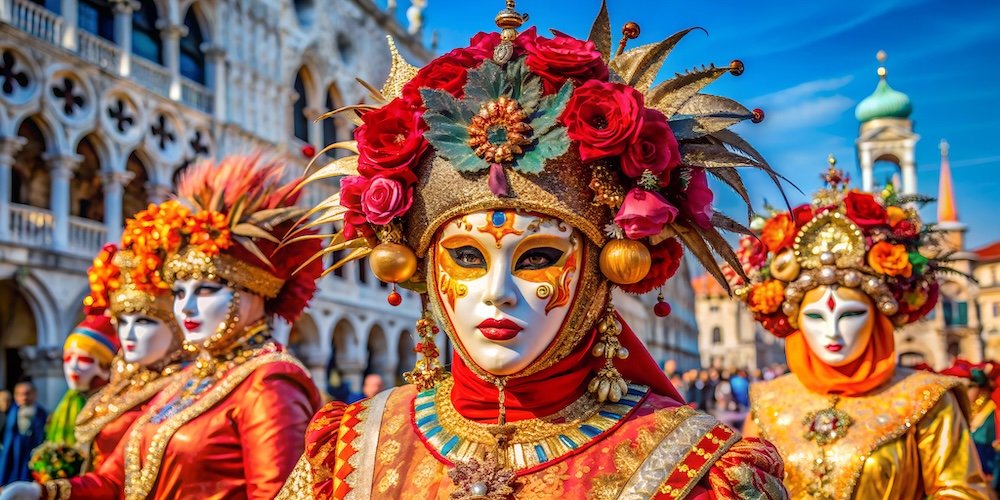
What followed was less a single decision than a slow accumulation of habit and law. By 1268, the Great Council was already annoyed enough by masked revelers lobbing perfumed eggshells at passing women to ban the practice outright, which tells you the custom of masking had been around for a while. A 1339 statute went further, forbidding masked visits to convents and outlawing false beards, painted faces, and wigs, evidently hoping to keep Carnival’s mischief within some bounds. It rarely stayed there. From the mid-1400s, groups of young Venetian noblemen known as the Compagnie della Calza, named for the parti-colored hose that marked their membership, took over the job of staging the city’s festivities, and by the height of the Baroque era Carnival had grown into a fixture of the European social calendar, drawing pleasure seekers from every court on the continent. Then, on May 12, 1797, Napoleon’s troops marched into Venice, the Republic’s last Doge abdicated, and Carnival was banned along with most everything else that made Venice Venice. It survived for a while in scattered private palazzo parties. Still, as a public event it went quiet for most of two centuries, briefly resurrected under Mussolini’s National Recreation Club in 1933 before being shut down again. When Venice finally brought it back for good in 1979, the organizers marked the occasion by burning an effigy of Pantalone, the miserly old merchant of the commedia dell’arte, in St. Mark’s Square, a fittingly theatrical way to declare that the party was, once again, officially on.
BEHIND THE MASK: LITERATURE’S OLD CRUSH ON CARNIVAL
Writers have never quite gotten over Venice’s talent for turning identity into a costume change. Giacomo Casanova, the city’s most famous native son, filled thousands of pages of memoir with Carnival intrigue, describing how an ordinary bauta mask let a penniless charmer mingle with senators and how a Pierrot costume once got him past the gates of a convent on Murano to meet a nun who was, by his own account, the great love affair of his life. He later staged an escape from the Doge’s Palace prison known as the Leads, and it is hard not to suspect that a man who had spent so much of his youth in disguise found the whole business of vanishing rather less difficult than most.
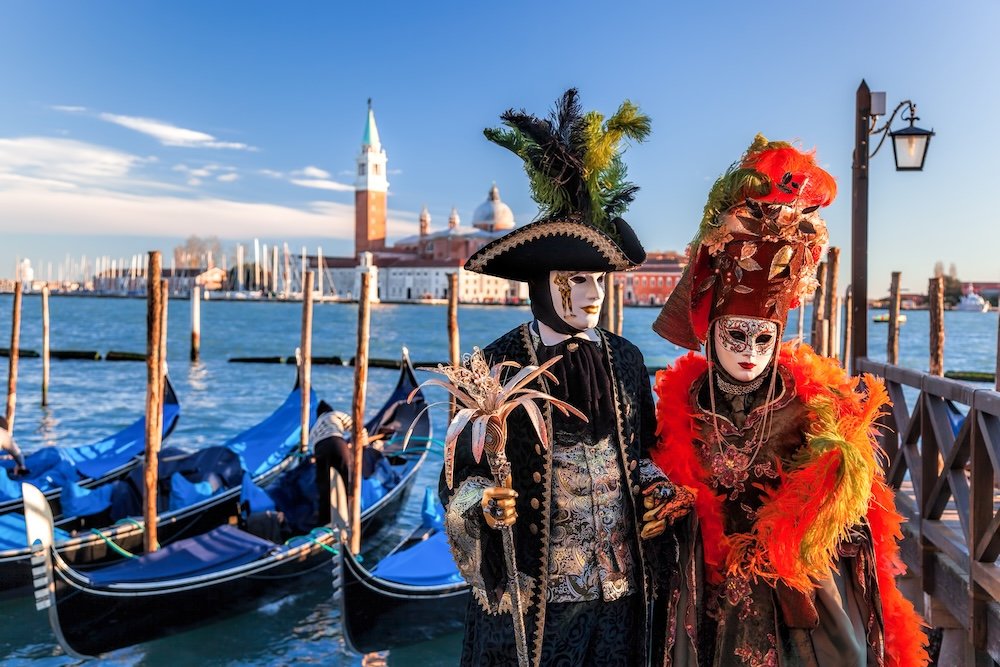
Lord Byron, who lived in Venice for several years and by his own admission behaved rather like a man on permanent Carnival leave, set his 1818 comic poem “Beppo: A Venetian Story” squarely in the middle of the festivities. Written in the bouncy, self-interrupting stanza form called ottava rima, it tells of a Venetian wife who has more or less accepted her husband’s death at sea, only to spot him staring at her across a crowded Carnival ball, dressed as a Turk. Byron’s opening lines, still quoted by Venetians proud of their city’s reputation, call Carnival the season when “Prudery flings aside her fetter” and note, with evident approval, that everyone wears a mask “and did no harm.”
It is Venice’s oldest argument for itself, made in verse: that a city willing to let its people become someone else for a week or two is, on the whole, a kinder one.
THE RITES OF THE SEASON
Modern Carnival opens, in theory, with the Feast of the Marys. This festival traces to a legend from the 900s, when Dalmatian pirates are said to have raided a mass wedding at the church of San Pietro di Castello and made off with twelve brides and their dowries. The Doge gave chase, the brides were recovered, and the pirates were dumped unceremoniously into the sea near a harbor still called Porto delle Donzelle, the Port of the Maidens. Venice honored the rescue for centuries by dowering twelve poor girls each year in the brides’ memory, a tradition that lapsed and was finally revived in 1999. Today, twelve young women in Renaissance dress process by gondola to St. Mark’s Square, where one of them is crowned Maria of the Year.
The Flight of the Angel is Carnival’s closest thing to a headline act, though the current version is considerably safer than the first version. In the mid-1500s, a Turkish acrobat tightroped from a boat moored in the lagoon up to the bell chamber of St. Mark’s Campanile, a tower that still stands 323 feet over the square, before descending to present the Doge with a ceremonial gift. The stunt, nicknamed the Turk’s Flight, became an annual fixture until 1759, when a performer fell to his death in front of the crowd, and the city swapped the acrobat for a large wooden dove. These days, the previous year’s Maria makes the descent, harnessed and considerably better insured, sailing down over a square full of upturned, delighted faces.
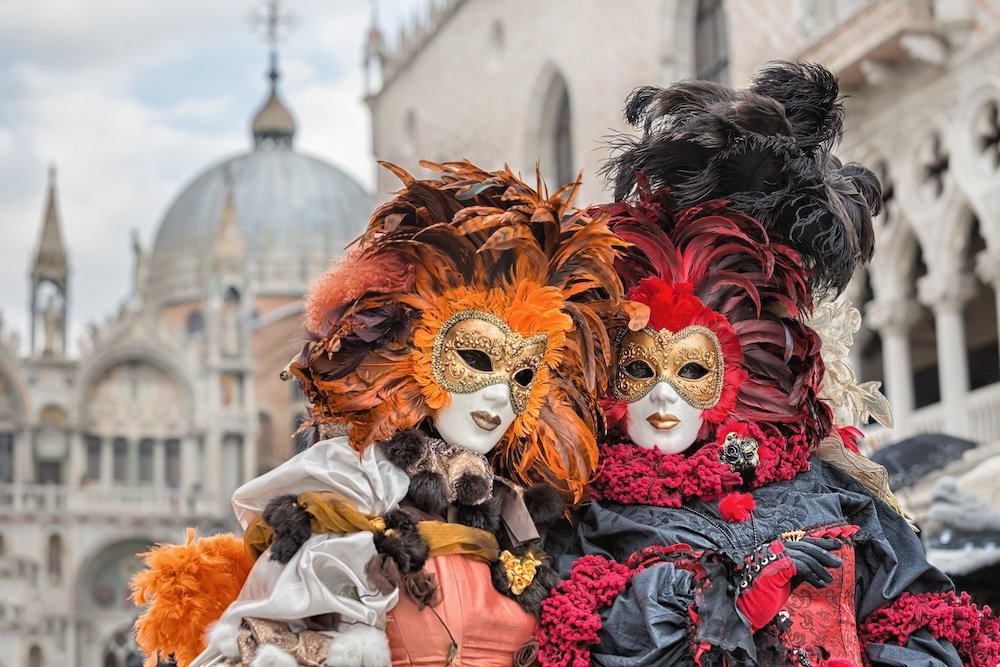
Around those two set pieces, Carnival fills in with everything Venice does best: costume parades several times a day in St. Mark’s Square, a jury-judged contest for the finest handmade mask and gown, free street theatre and clowning in campi across the city, chamber concerts of Vivaldi under painted ceilings, and masked balls in private palazzi that range from an affordable evening cocktail to a four-figure dinner in a room decorated with Murano glass chandeliers. Out on Burano, the lagoon’s most colorful island throws its own smaller, rowdier Carnival each weekend, heavier on local families and lighter on selfie sticks. Ninety-five percent of what makes the festival worth seeing, as Venetians like to point out, is other people’s costumes; the city supplies the backdrop and lets its visitors supply the show.
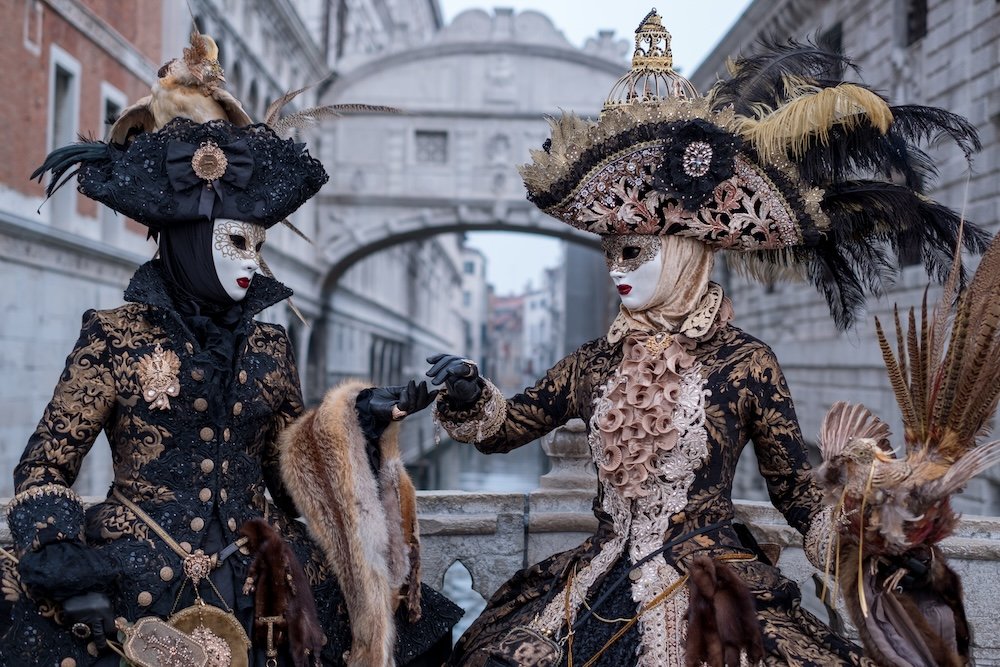
Carnival lasts in Venice because it does something the city’s museums and gondola rides cannot: it puts the past back on its feet and lets it walk around in public. A festival born from a hostage exchange with a defeated bishop, and kept alive, on and off, through plague, empire, and two world wars, has no obvious reason to be still filling St. Mark’s Square with strangers in masks every February. It does so anyway, largely because Venice has never quite lost its old suspicion that a life lived entirely as oneself, without a single afternoon spent as someone else, is a life only half enjoyed. Step into that square during Carnival, mask or no mask, and it is easy to agree.