Although the bus leaving the airport does not stop at Fairy Bridge, the small stone bridge spanning the stream on the main road to Douglas, the passengers still speak up. “Hello, fairies,” says one person, and a few more join in, partly in jest and completely sincerely. The trees along the bank are decorated with ribbons, photographs, and handwritten wishes, some faded by the weather while others were tied that morning. Taxi and coach drivers take the trouble to teach new visitors this greeting since, according to Manx folklore, if you ignore “Themselves” as the fairies are politely known, you will bring upon yourself bad luck, and the kind of bad luck that is most common these days is a car which won’t start. Playing it safe is almost always a strong strategy.
Why the Isle of Man
The Isle of Man is a self-governing Crown Dependency, about 30 miles long and situated roughly between England, Scotland, Wales, and Ireland. Although it is under the jurisdiction of the British Crown, it is not part of the United Kingdom and, for over a thousand years, has refrained from being treated as a mere footnote. The argument for joining is density: in just one hour’s drive, a tourist can take a Victorian electric tram to the island’s only mountain, enter a castle built for a Norse king, and watch the sun set behind a ruined cathedral on a tidal islet. In 2016, UNESCO designated the whole island as a Biosphere Reserve, making it the only entire nation with that status, and it has 26 official Dark Sky Discovery Sites that offer stargazers some of the clearest skies in the British Isles.
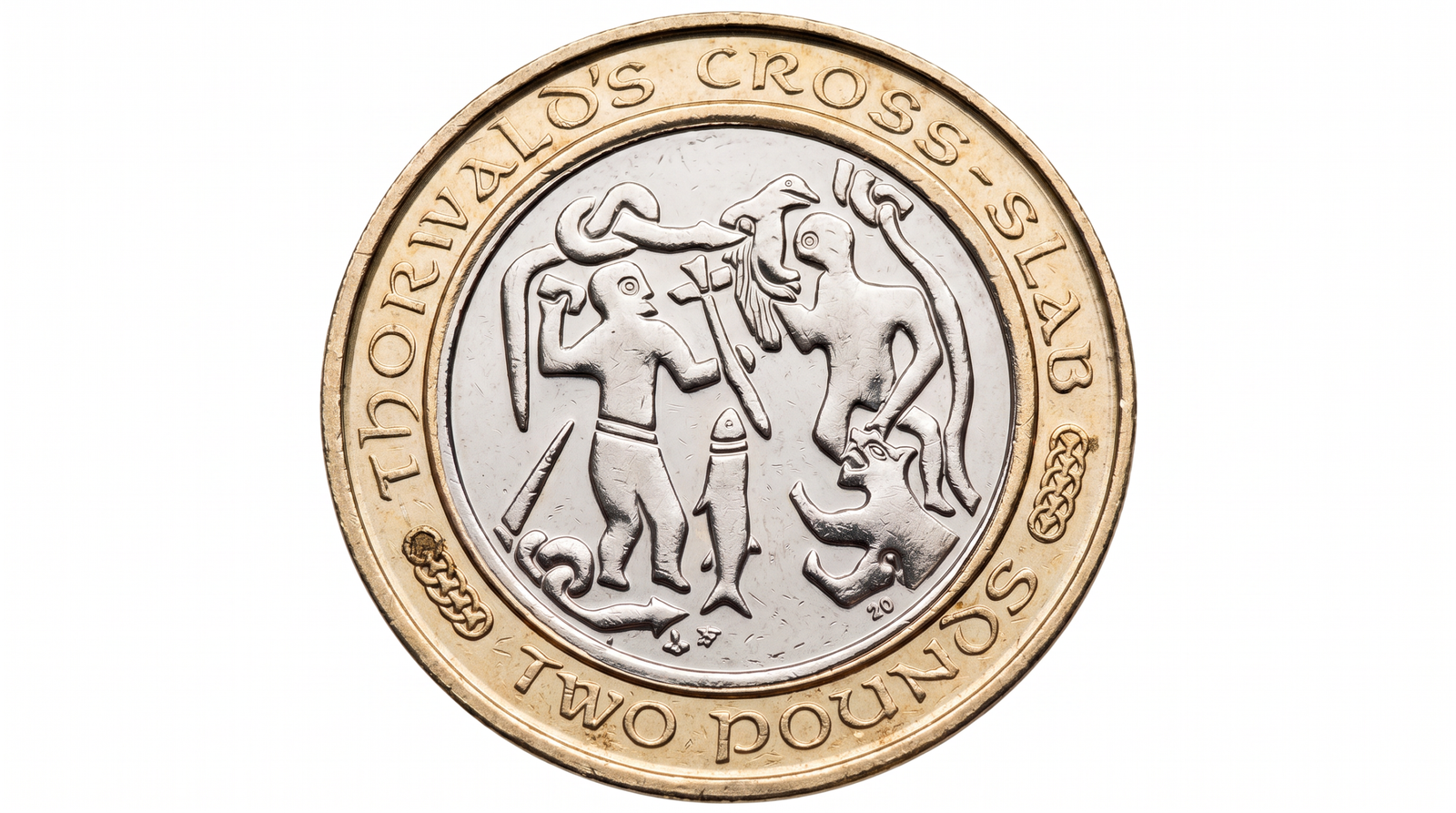
Visitors often arrive expecting either a Celtic island or a Viking one. Its language, Manx, is a Gaelic tongue closely related to Irish and Scottish Gaelic, yet its parliament carries a Norse name, Tynwald, from the Old Norse for an assembly field. Viking gold has been uncovered in large quantities. The landscape is split the same way. Laxey means “salmon river” in Old Norse, Snaefell “snow mountain” and Ramsey “wild garlic river,” and linguists have noticed that most Norse place names belong to landmarks visible from the sea, the ones a sailor would steer by. Inland and at home, Gaelic held on. Norse settlers married local women, whose children grew up speaking Manx, and roughly two-thirds of traditional Manx surnames, the Quayles, Kellys and their neighbors, have Celtic roots. The stones tell the same story. The island holds 26 surviving Viking Age runestones, a remarkable number for its size, born when the Norse habit of carving runes met the local Celtic tradition of raising high crosses. Some inscriptions remember Norse men alongside wives with Gaelic names. The finest, Thorwald’s Cross in the northern village of Andreas, shows a bearded figure with a raven at his shoulder being swallowed by a wolf, usually read as the god Odin meeting his end at Ragnarök, carved in the 10th century on a Christian cross. Whoever commissioned it apparently saw no reason to pick one faith, and the island has kept that habit ever since. During the Middle Ages, the Isle of Man earned a reputation across the British Isles for its connection to magic and pagan beliefs.
Thorwald’s Cross on a 2003 Isle of Man coin
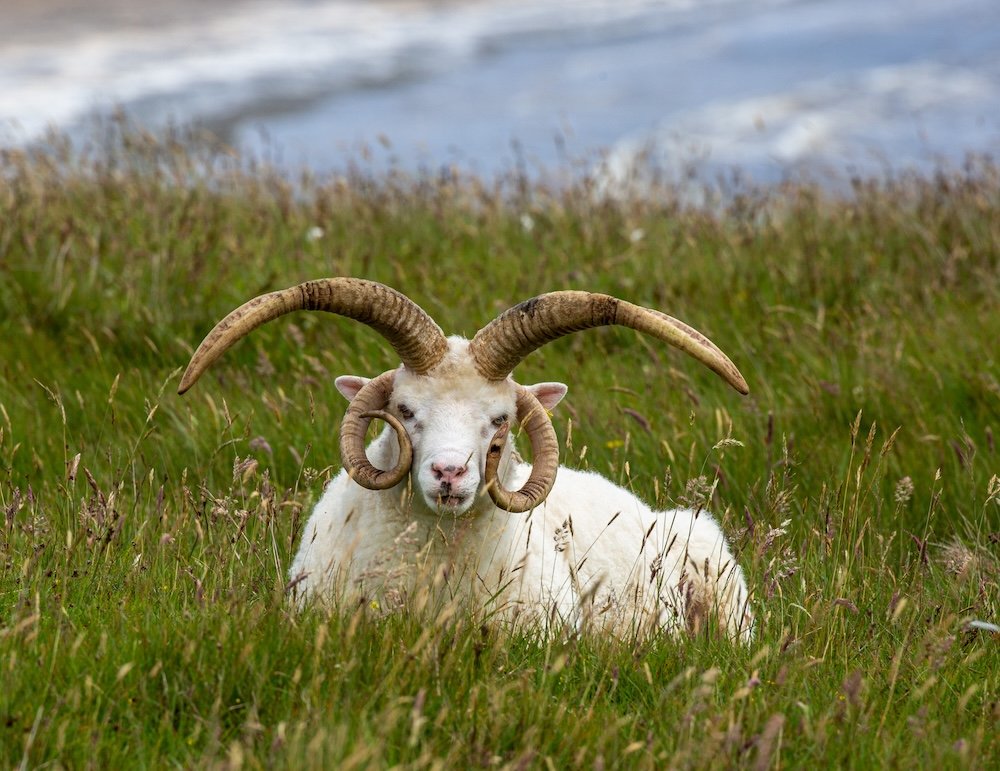
Rail fans particularly value the Isle of Man, as do those interested in history, walking, birdwatching, and families, because children under 18 can enter the Manx National Heritage sites for free. Motor sport fans know it because the TT races take place on the island for two weeks every spring. During the rest of the year, the area is quiet enough that the noisiest thing you might hear on a country lane is a car horn clearing the road of a four-horned sheep.
Isle of Man four horn Sheep
Douglas
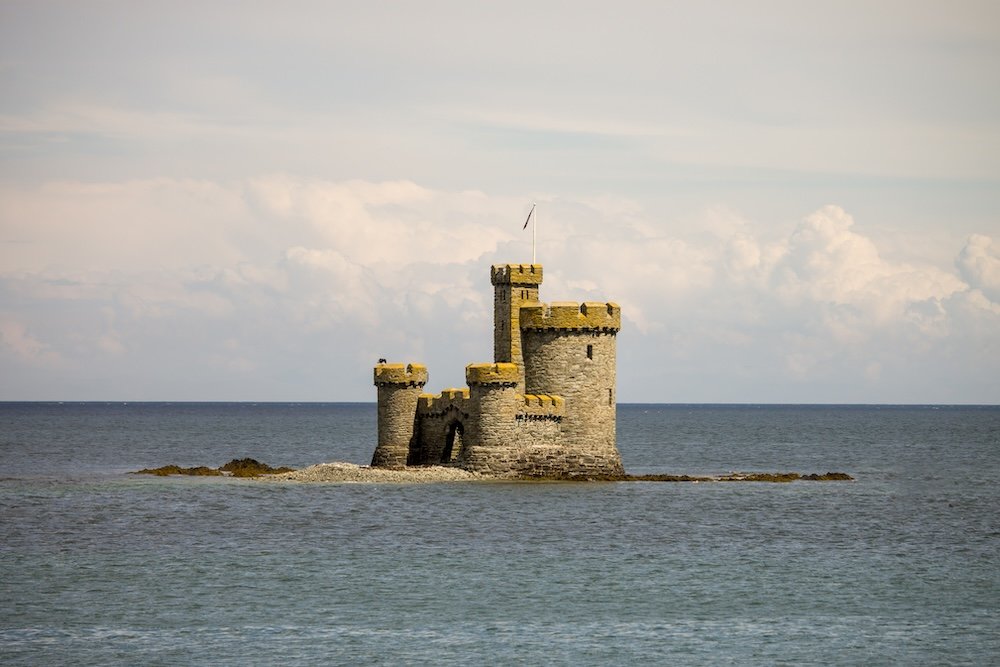
The capital is where most visitors arrive, by ferry at the Sea Terminal or by bus from the airport, and it remains a Victorian seaside town at heart, its long curve of promenade hotels facing the bay. The Douglas Bay Horse Tramway clops along that seafront, as it has since 1876, pulled by heavy horses the locals call “trammers,” and it connects at Derby Castle, at the promenade’s northern end, with the Manx Electric Railway to Laxey and Ramsey. Out in the bay sits the Tower of Refuge, a small castellated shelter built on Conister Rock in 1832 by Sir William Hillary, the founder of the RNLI, Britain’s lifeboat service, after the 1830 wreck of the St George on the same reef; it held a bell for stranded sailors to summon help, and William Wordsworth later wrote lines in its honor.
The Tower of Refuge in Douglas Bay
Up the hill, the Manx Museum is free and makes a great first stop on the island, with Viking silver, a TT gallery, and the National Art Gallery. The Gaiety Theatre, designed by the celebrated Victorian theatre architect Frank Matcham, opened in 1900 and still stages musicals, drama and opera after a long restoration to its 1900 appearance; it also keeps the only working Corsican trap in the world, a Victorian stage device built to make a ghost rise and glide across the boards. For dinner, start with “queenies” at Little Fish Café on North Quay, the island’s small, sweet queen scallops.
Laxey
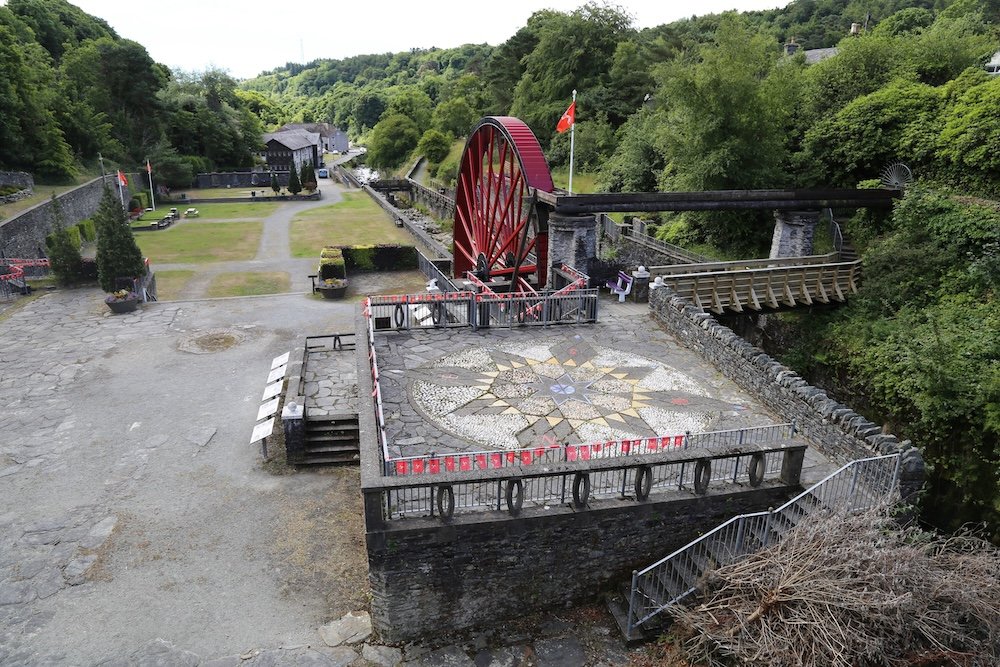
This east-coast village sits in a steep valley that once held one of the major lead and zinc mines in the British Isles, and the hillside still shows it. The Great Laxey Wheel, 72 feet 6 inches across and built in 1854 to pump water from the mine, is the world’s largest working waterwheel; visitors climb to the platform at its top, walk the mines trail, and step into an adit, a tunnel cut into the hill. Adults pay £15.50, about $21, and under-18s go free. A smaller survivor, the 50-foot Snaefell Wheel from 1865, turns above the railway station, where the Great Laxey Mine Railway, a reconstruction of the miniature line that hauled ore out of the mountain, carries passengers through the old workings.
The Lady Evelyn Waterwheel at Laxey
Laxey Station is also where the Snaefell Mountain Railway begins its 30-minute climb to the island’s highest point. Down by the river, Laxey Woolen Mills, founded in 1881 by Egbert Rydings with the support of the art critic John Ruskin’s Guild of St George, still weaves tweed and tartan on pedal looms and is the only mill in the world weaving cloth from the undyed brown wool of the four-horned Manx Loaghtan sheep. Old Laxey, at the bottom of the valley, has winding lanes, a small harbor and a beach.
Castletown
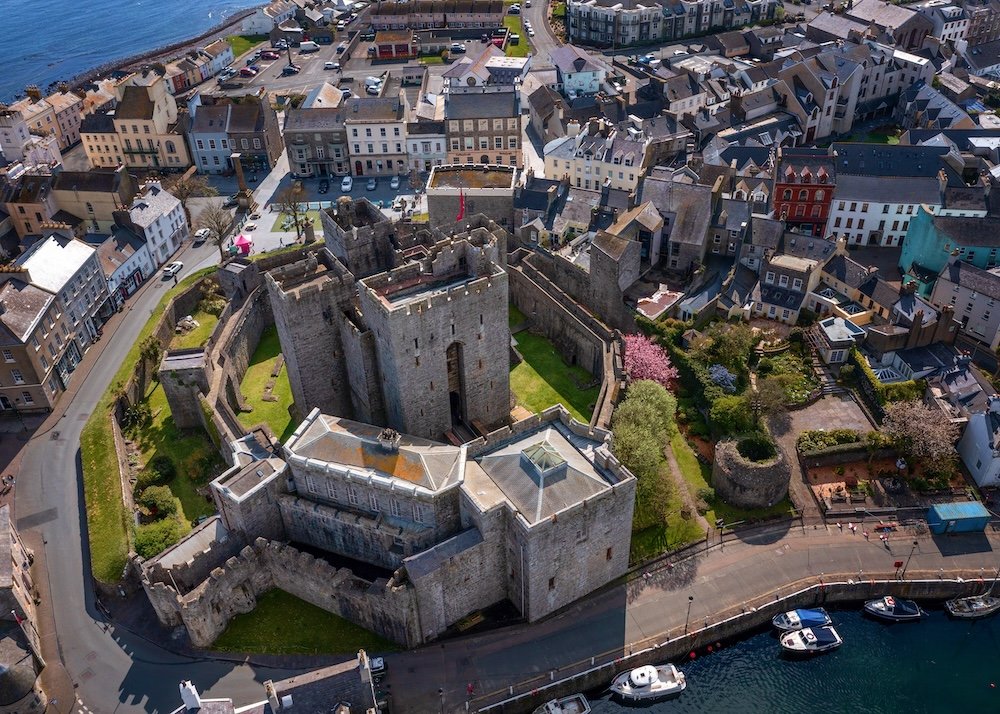
The island’s former capital is compact, gray-stoned and quiet, built around a harbor and a market square that Castle Rushen fills almost entirely. The castle, raised around 1200 for a Norse king and later used as a royal residence, a mint and a prison, is one of the best-preserved medieval castles in the British Isles, and its spiral stairs lead to a roof with views over the town; admission is £14, about $19. Across the square, the Old House of Keys housed the island’s elected parliament from 1821 until it moved to Douglas in 1874. Today visitors take a seat in the restored debating chamber and vote, with the help of a costumed “secretary,” on historic questions such as whether women should have the vote or motor racing should be allowed on public roads; tickets are £11. Nearby, the Nautical Museum tells the story of George Quayle, an 18th-century merchant and inventor, and his boat Peggy, the earliest known example of a British armed yacht, preserved in the private dock Quayle designed for her. Just outside town, Hango Hill is where Illiam Dhone was shot in 1663, and a small crowd gathers there every January 2 to remember him.
Castle Rushen
Peel
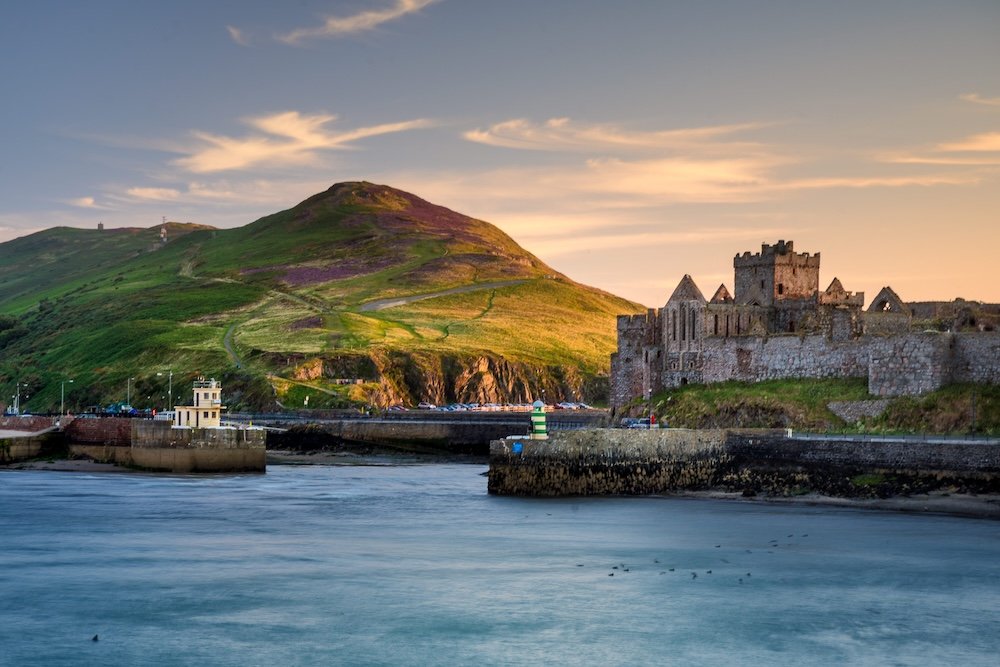
The west coast’s fishing town is the island’s sunset capital, which is why it goes by the nickname “Sunset City.” Peel Castle fills St Patrick’s Isle, a rocky islet joined to the town by a causeway, with a curtain wall about 2,300 feet long enclosing a round tower some 900 years old, a ruined cathedral with a crypt and the reputed haunt of the Moddey Dhoo, a ghostly black dog; admission is £11, about $15. On the quay, the House of Manannan walks visitors through Celtic, Viking and maritime history and houses Odin’s Raven, a replica Viking ship sailed over from Norway in 1979. Above the town, Corrin’s Folly, a stone tower on Peel Hill, rewards a short climb with views over the castle and the Irish Sea, and Fenella Beach, a small sheltered cove, sits in the castle’s shadow. The town also claims the island’s smallest museum, which, fittingly, displays the world’s smallest production car: the Peel P50, just 54 inches long, that was built on the island in the 1960s. Davison’s ice cream parlor on the beachfront and Devereau’s oak-smoked kippers are the local treats.
Peel Castle on St Patrick’s Isle
St John’s
This small village in the island’s central valley is the Isle of Man’s ceremonial heart. Tynwald Hill, a four-tiered mound about 12 feet high said to contain soil from all 17 ancient parishes, is where the parliament gathers in the open air every July 5 to proclaim the year’s new laws in English and Manx. The Royal Chapel of St John the Baptist, consecrated in 1849, stands at the other end of a rush-strewn path, its wide aisle designed to accommodate the Tynwald procession. Next door, the Tynwald National Park and Arboretum covers more than 25 acres of trees and lawns, and Culture Vannin’s exhibition center explains the island’s language, music and parliament. The village is also home to the Bunscoill Ghaelgagh, the primary school that has taught entirely in Manx since 2001.
The Parliament That Meets on a Hill
The Vikings arrived here in the late 700s and never really lost their grip on the place, even after they stopped ruling it. What they left behind was Tynwald, the island’s parliament, whose name comes straight from the Old Norse thingvollr, or assembly field, and which still meets every July 5 on the same stepped, artificial mound in St John’s where Norse settlers once gathered to hear judgments read aloud. Iceland’s Althing is older, founded in 930 AD at Þingvellir, making it the oldest legislative body by original establishment. However, royal decree suspended it from 1800 to 1844, so it does not have an unbroken history. The Isle of Man’s Tynwald dates to the late 10th century, around 979 AD, making it the oldest parliament in the world in continuous, unbroken operation.
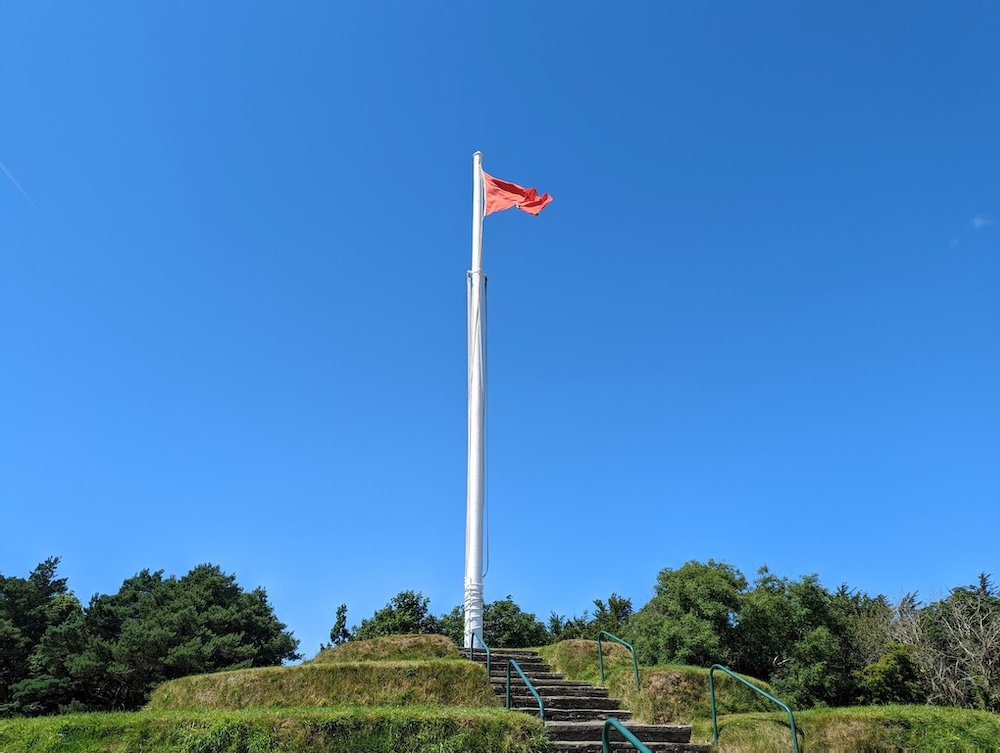
On July 5, or, if that date falls on a weekend, the following Monday, Tynwald leaves the chamber in Douglas and gathers openly in St John’s, a village in the middle of the island. The meeting takes place on Tynwald Hill, a terraced mound approximately 12 feet high, constructed in four circular stages and said to include soil taken from each of the island’s 17 ancient parishes. The hill’s name comes from the Old Norse word for an assembly field. The officials walk along a path made of rushes, a tradition said to originate in offerings previously made to the sea god Manannan on Midsummer’s Eve. From the hill, the titles of all the laws passed in the previous year are read out aloud, first in English by the First Deemster and then in Manx by the Second. Islanders can also submit petitions for redress in person. The ceremony is not merely decorative, since any act not proclaimed on the hill within 18 months ceases to have effect.
The Manx language inscription on the hill has its own history. Ned Maddrell, a fisherman from the southern part of the island, died in 1974 at the age of 97 and became the last native speaker of Manx. Enthusiasts had already been recording him and learning from him, and in 2001 the Bunscoill Ghaelgagh, a primary school that taught entirely in Manx, opened in St John’s, a short walk from the hill where the laws are read.
Tynwald Hill
Ramsey
The island’s northern harbor town is the end of the line for the Manx Electric Railway, about 75 minutes from Douglas. Mooragh Park, which has entertained visitors since 1887, spreads across 40 acres around a 12-acre boating lake, with canoes, crazy golf, tennis courts and a children’s park. On the edge of town, Milntown Estate, founded in the early 1500s by the family whose name was later shortened to Christian, opens 15 acres of gardens, woodland and a mill pond from spring through autumn, with guided tours of the house on Wednesdays and Saturdays and a café in the conservatory. Ramsey also makes the natural base for the Ballaugh Curraghs, the protected wetland to the west where the island’s wild wallabies are easiest to spot at dawn and dusk.
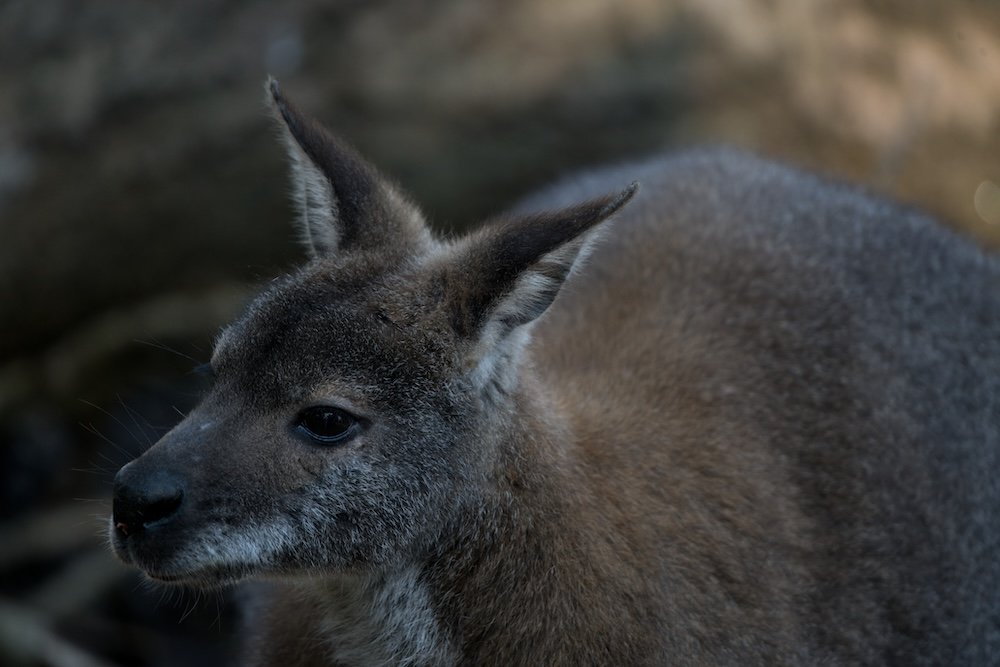
The Red-Necked Wallaby (Notamacropus rufogriseus)
Wallabies? The Isle of Man’s most unexpected residents arrived by accident. In the 1960s, red-necked wallabies, native to the cool, damp corners of southeastern Australia and Tasmania, slipped out of Curraghs Wildlife Park in the north of the island. The usual telling credits a single runaway pair. They settled in the Ballaugh Curraghs, a protected wetland of willow scrub and bog just beyond the park fence, and found an island with no foxes, no predators of any kind, and a climate much like the one they left behind. Nobody rounded them up, and they took the hint. When the Manx Wildlife Trust flew a drone with a thermal camera over the Curraghs in January 2023, it counted an average of 568 wallabies in that wetland alone. Later surveys put the island-wide total above 1,000, spread through Sulby Glen, Ramsey Forest and the northern and western hills, and one was even spotted taking the sea air on Ramsey promenade. Islanders are fond of them, and a stuffed one now stands in the Manx Museum. They are also a growing concern, nibbling native plants, damaging farm fences and bounding into headlights on country roads. The best chance of seeing one is a quiet walk along the Curraghs footpaths at dawn or dusk, when they come out to graze. Who will love it: nature lovers, families and anyone who enjoys explaining kangaroo cousins in the Irish Sea.
Port Erin
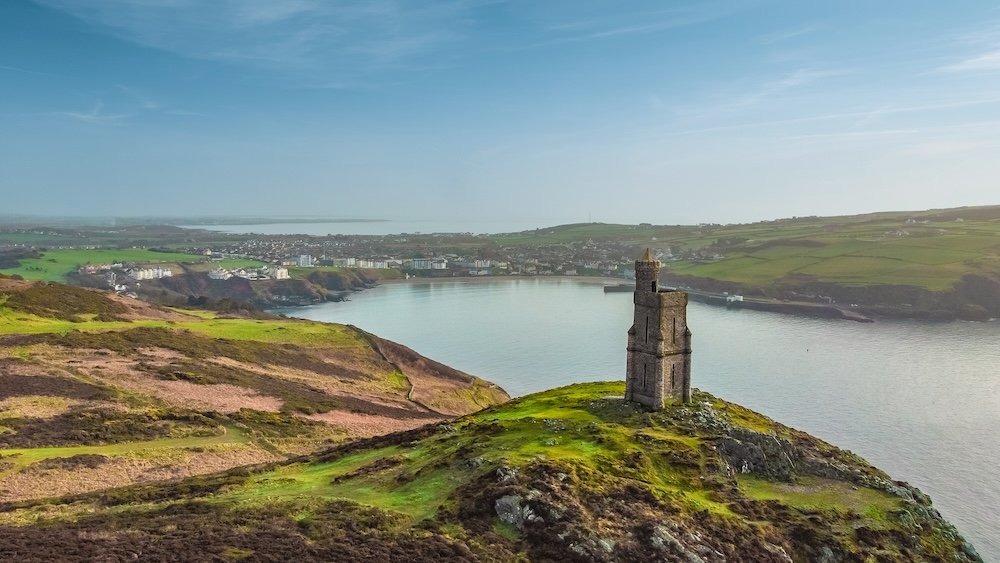
The steam railway’s western terminus sits on a deep, sheltered bay with a sandy beach, about an hour by train from Douglas. The Port Erin Railway Museum, beside the station, tells the story of the island’s steam railways and their role in 150 years of Manx life. Across the bay, Bradda Head rises to 382 feet, crowned by Milner’s Tower, built in 1871 in honor of William Milner, a maker of fire-resistant safes and a local benefactor; seen from above, the tower is shaped like a key and lock, a fitting monument for a man in the security business. The coastal footpath from here leads south toward the Sound and Cregneash.
Bradda Head
Port St Mary
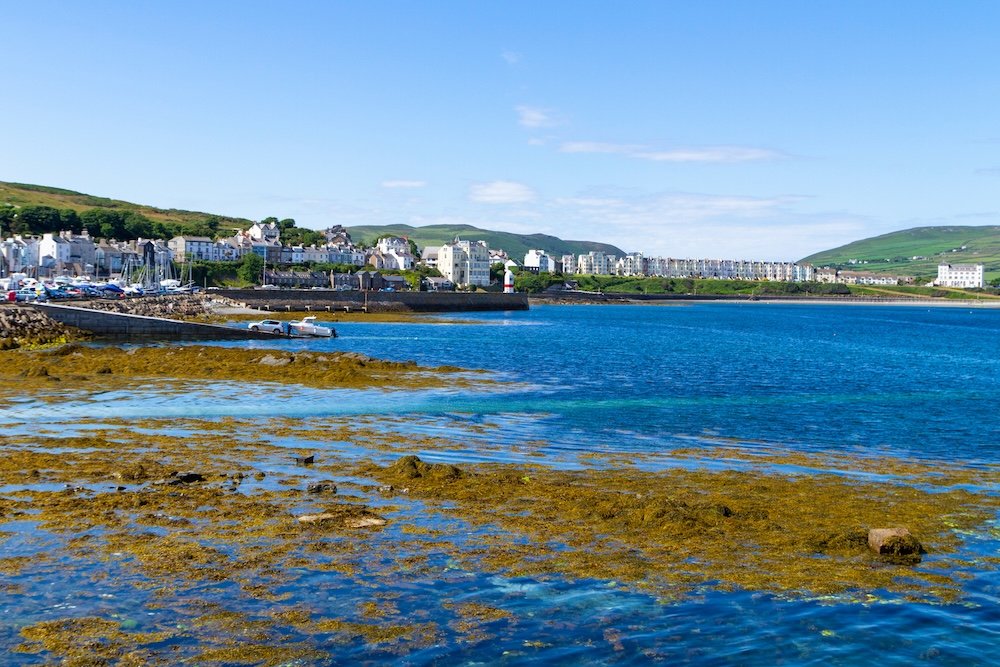
A working harbor town on the south coast, Port St Mary is the starting point for boat trips to the Calf of Man, with landing trips costing about £25, weather permitting. At Kallow Point, free binoculars and wildlife boards help visitors pick out seabirds and seals offshore. The Raad ny Foillan, the island’s coastal footpath, runs west from here past the Chasms, a series of deep fissures split into the sandstone cliffs, which call for sturdy boots and a firm hold on children, before dropping to the Sound. The steam railway stops here, and Port Erin is a short walk or bus ride away.
Views of Port St Mary (Manx: Purt le Moirrey) located in the south of the Isle of Man
Cregneash
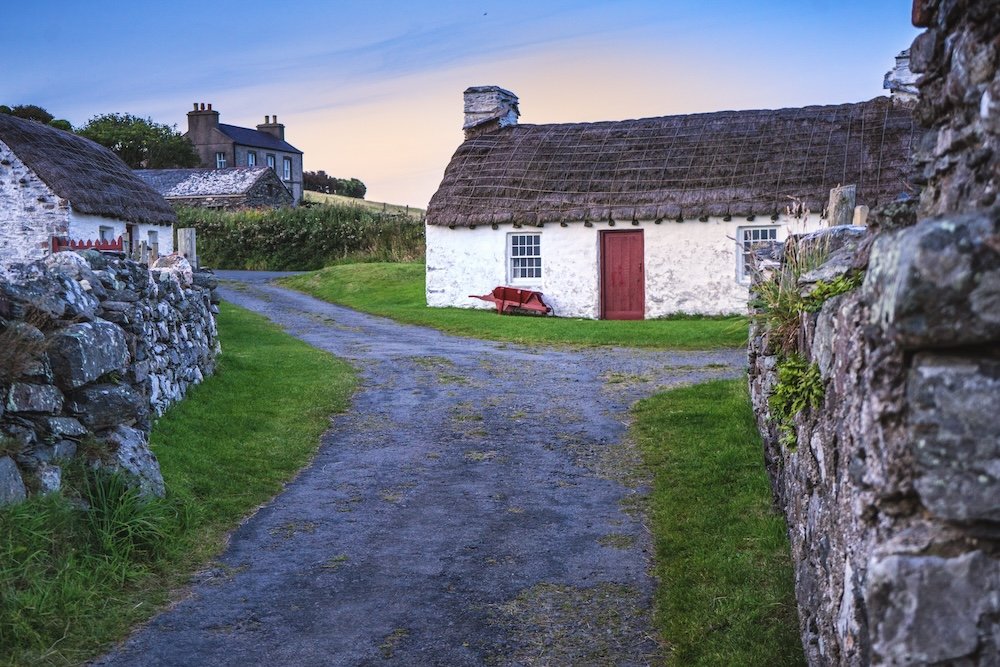
The steam train gets you to Port St Mary in less than an hour from Douglas, after which a short bus journey or a walk takes you to Cregneash. More hamlet than town, Cregneash sits on an upland plateau above the island’s southern tip and is the oldest open-air folk museum in the British Isles. Its thatched cottages, many in the traditional Manx style, show how crofters lived and worked, with weaving and knitting demonstrations, a working farm, Manx Loaghtan sheep, shorthorn cows and a resident Manx cat, the tailless breed the island is known for. Harry Kelly’s cottage, at the center of the village, is a fine example of a Manx home of the period, and Ned Maddrell, the last native speaker of Manx, was recorded speaking the language here in Cregneash. Admission is £14, about $19, and the Creg-y-Shee Tea Rooms serve refreshments. Cregneash is also one of the island’s 26 Dark Sky Discovery Sites, and the Sound, with its view of the Calf of Man, is a short walk downhill.
Cregneash, Isle of Man
Precautions Worth Taking
People who arrive in the UK directly from outside the Common Travel Area, such as citizens of the United States, Canada, and the European Union, will need an Electronic Travel Authorization if they board a flight or ferry after April 23, 2026. The authorization costs £20 (approximately £27) and can be applied for through the official UK ETA app or on the GOV.UK website; it is valid for two years or until the passport expires. A single ETA covers travel to both the UK and the Isle of Man, and it is required even when traveling via Dublin, where there are no usual passport checks. Neither airlines nor ferries will allow boarding without it.
The Manx pound is equal in value to sterling, and although British notes are accepted throughout the island, Manx notes are usually not accepted in the UK; that is why the cash machines at the airport and at the Douglas ferry terminal dispense English notes. Vehicles drive on the left. Although many rural roads have no general speed limit, towns and dangerous sections do have posted speed limits; the police still take action against dangerous driving, and using a handheld phone while driving is illegal. Mountain roads may disappear into fog, and in the northern part of the island, wallabies cross at dusk. Drones are prohibited at Manx National Heritage sites.
The weather changes rapidly; in summer, maximum temperatures are between 60 and 65 degrees Fahrenheit; in winter, the highest temperatures are in the mid-40s; and the wind never misses a day, particularly on the summit of Snaefell. Bring several layers and a rain jacket in all seasons.
When to Go
The heritage season runs from late March until the first day of November, when the castles, the Laxey Wheel, and the railways are open. May is generally the driest month and therefore a good time for walking. From late May to early June, the TT takes place; the 2027 races will run from May 31st to June 12th, when accommodation sells out a year in advance, prices rise, and sections of the course are closed off as roads. In summer, the hottest days occur, and Tynwald Day is also on July 5th; in late August, both the Manx Grand Prix and the Classic TT are held on the same course. In autumn it gets wetter, with November usually the wettest month. During winter everything is quiet, and the wind is strong; the railways and most of the castles are closed, although the Manx Museum and the House of Manannan remain open all year, and the dark skies are at their best.
On the last morning, the airport bus crosses the Fairy Bridge again. Commuters read their phones, the ribbons move in the wind, and someone near the back says hello, just in case.