


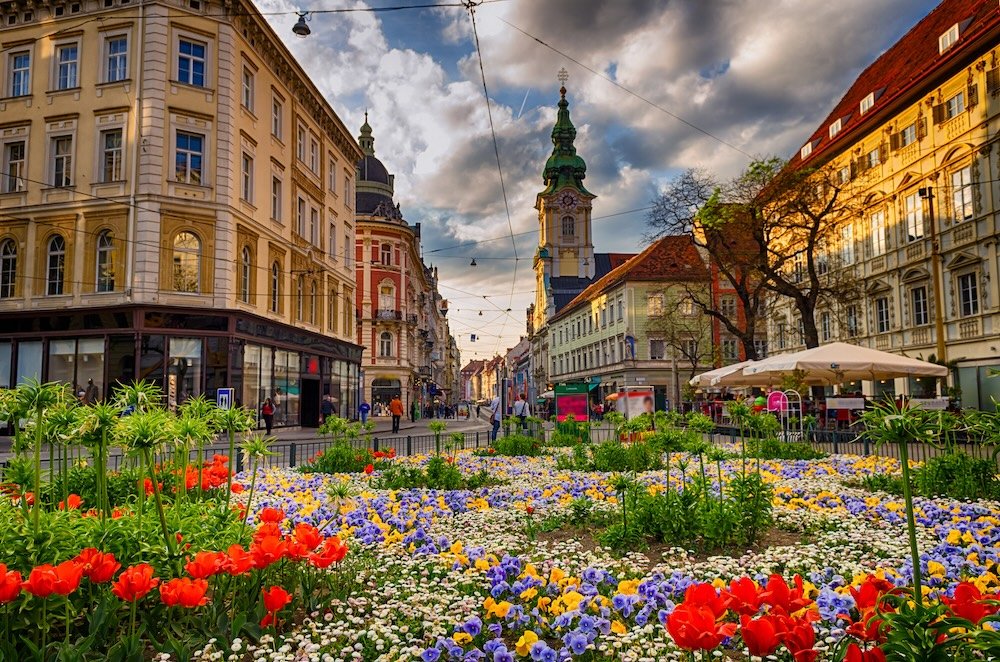
Austria’s second-largest city has a Renaissance fortress, a blue museum that resembles a friendly alien, and a Saturday market where people pour pumpkin seed oil on vanilla ice cream. Moreover, it is less crowded than it should be. Then there is the matter of the clock on the Uhrturm. The long hand shows the hours while the short hand indicates the minutes, a feature that dates back to when the tower displayed only the hour, and the residents below needed a hand big enough to see from the street. When tourists glance up from the Hauptplatz, they check their phones and then squint again. The residents, by contrast, never do so and they know what the tower has cost them.
Graz has earned two separate UNESCO awards. The historic center, one of the best-preserved old towns in Central Europe, was named a World Heritage Site in 1999, and in 2010 the designation was extended to cover Schloss Eggenbind in the town’s western part. UNESCO also designated Graz a City of Design in 2011. Meanwhile, the city had about 1.47 million overnight stays in 2025, a record for Graz but less than half of Salzburg’s 3.28 million, despite having roughly twice Salzburg’s population. These figures favor the tourist. Since 2008, the city has held on to the title Austrians have awarded it as the country’s culinary capital, because it has more than 60,000 university students who keep its cafés busy, its bars open late, and, as a result, keep the old town from looking like a museum.
The city’s name is derived from the Slavic word gradec, meaning “little castle”, since it was named after a small fort on the rock which now stands some 400 feet above the main square. From 1544 onward, the Italian architect Domenico dell’Allio transformed the Schlossberg into a Renaissance fortress so strong that no army ever took it by force; when French troops besieged it in 1809, the small garrison commanded by Major Franz Xaver Hackher held out.
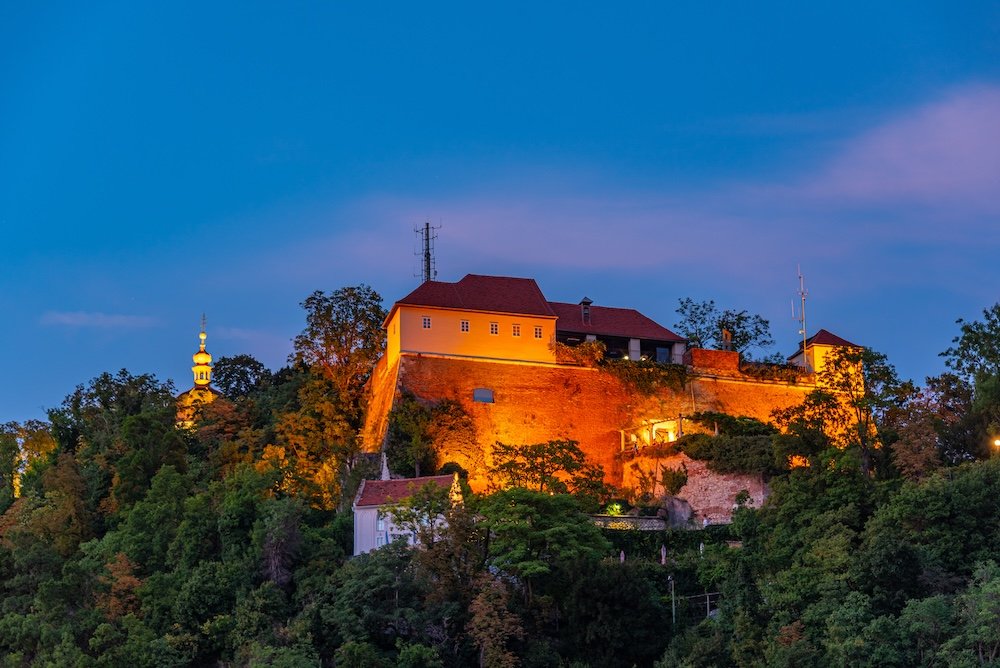
In 1809, Napoleon’s army captured Vienna, and the peace treaty that ensued called for the Schlossberg fortress in Graz to be taken apart brick by brick. Even though the people of Graz knew that they could not achieve victory by military means, they were not prepared to give up the landmarks which they regarded as important. So they pooled their resources and paid the French officers a large sum of money to spare two buildings from being blown up: the Uhrturm and the Glockenturm, or Bell Tower. This united show of civic determination saved the buildings. The clock tower then became the most noticeable surviving structure of the old hilltop citadel, and a building originally built for war purposes became the city’s permanent symbol.
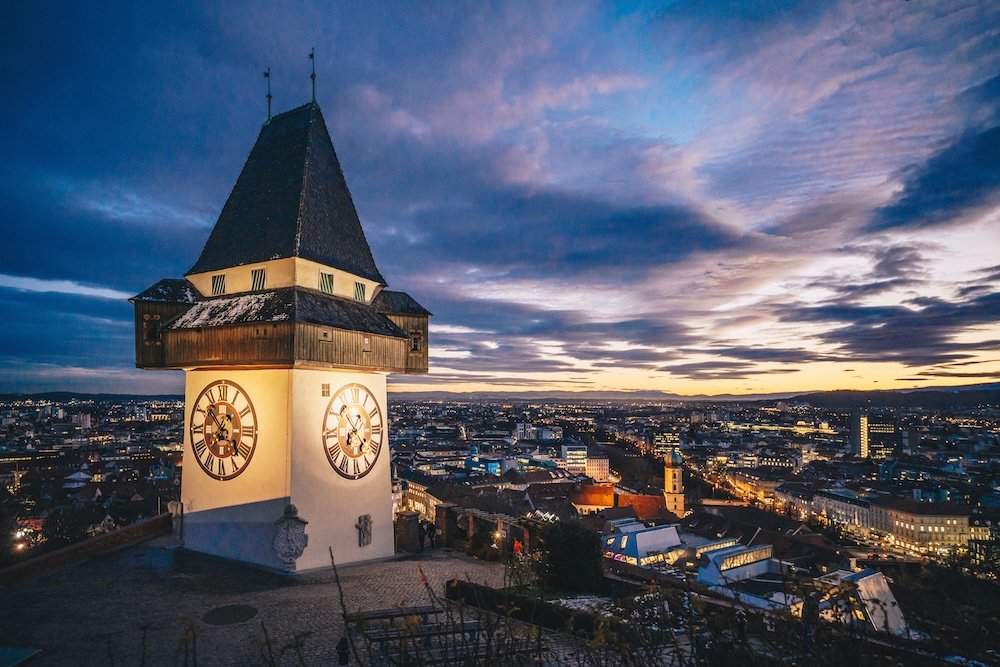
The tower, located at the southern end of the Schlossberg, stands as the symbol of Graz, the capital of Styria and the second-largest city in Austria; most tourists who visit Austria never go so far south since they go to Vienna and Salzburg and then go back home, Graz being the place you arrive at if you carry on with your trip.
Napoleon eventually succeeded, although only in other respects. After Austria’s defeat at Wagram, the Treaty of Schönbrunn required the fortress to be demolished, and French engineers then began building the walls and bastions. At this stage, the situation becomes entirely practical. The people of Graz, realizing they would have to lose both their clock tower and their bell tower, launched a fundraising campaign and paid the French a ransom of just under 3,000 florins so both towers could be left standing. It is hard to think of a more Austrian way of resisting: when the cannons fail, negotiate.
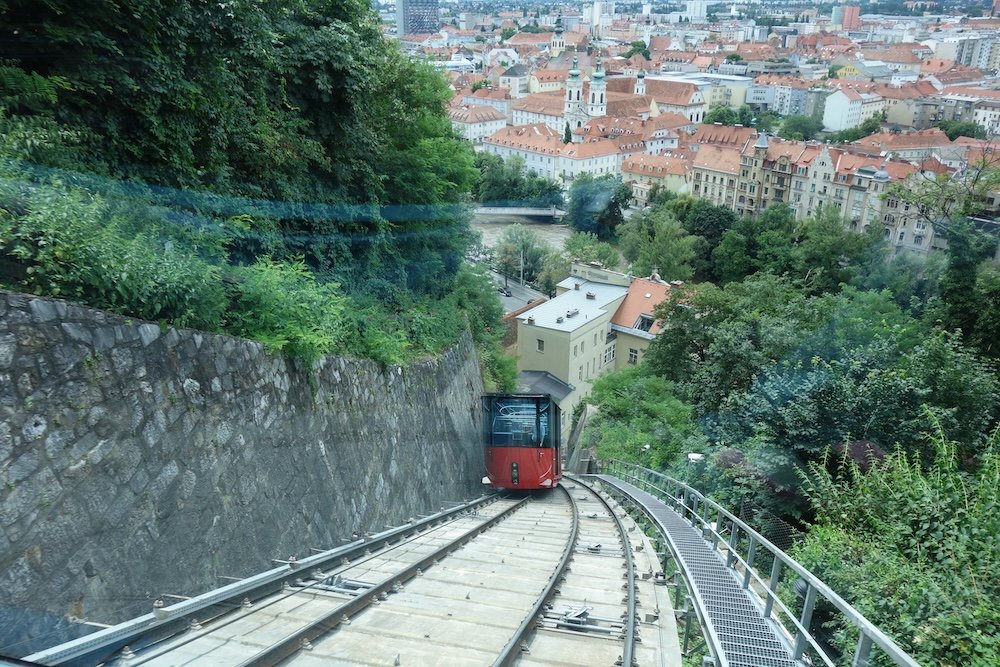
In 1839, the ruins were made into a public park, and today the summit can be reached via the 260 steps of the Felsensteig path, by funicular, or by a glass elevator bored into the rock.
On the way down, though, the hill shows a sense of humor. The Schlossbergrutsche, the world’s tallest underground slide, goes down 210 feet through a tube more than 550 feet long in about 40 seconds; riders must be at least 4 feet 3 inches tall, and adults tend to come out at the bottom smiling, since they managed to get away with it.
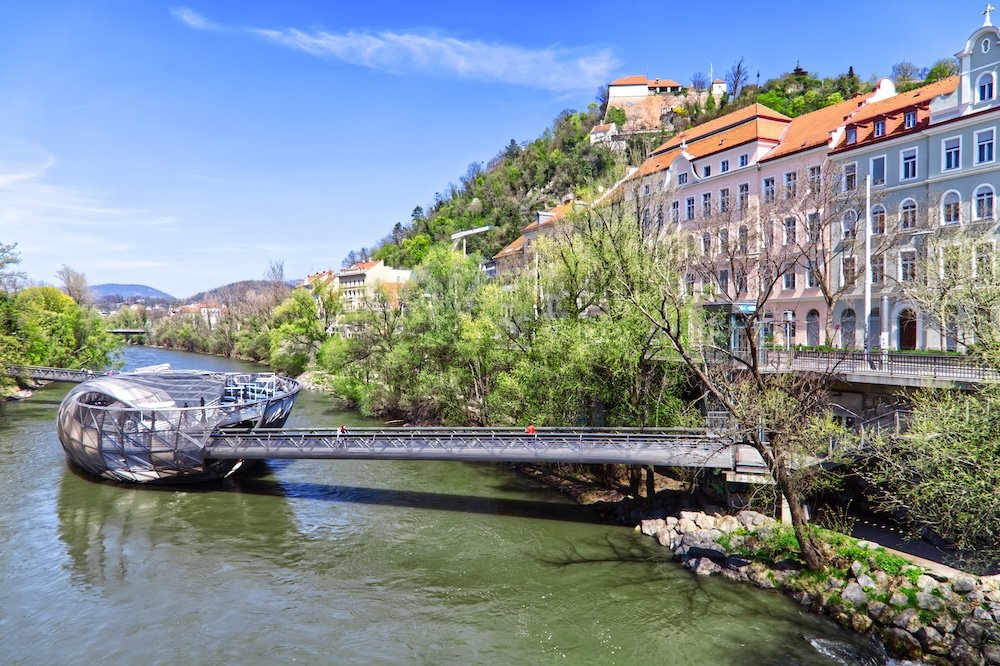
Below the hill, the red tile roofs dip in waves all the way down to the Mur River, and behind simple doorways lie courtyards. Vito Acconci’s Murinsel, located in the middle of the Mur, is an artificial island with a café and an amphitheater. The Murinsel was created for Graz’s year as European Capital of Culture 2003.
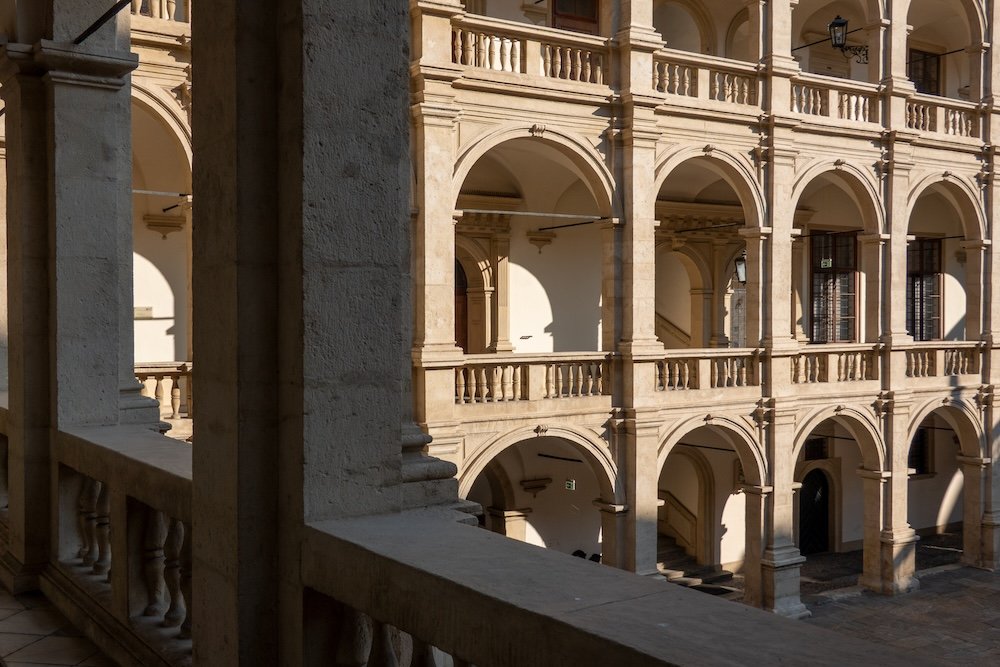
Graz’s Landeszeughaus, the largest of the world’s surviving historic armories, houses about 32,000 items from the 15th to the 18th centuries on their original racks across four floors. It was built as the main depot for equipment in the southeastern section of the Habsburg Empire and stocked because Ottoman raids posed a real threat and as a precaution in case a militia had to be armed quickly. Because heritage regulations stipulate that the items must not have individual labels, the place resembles a store room more than an exhibition: rows of breastplates and helmets await a muster that never occurred.
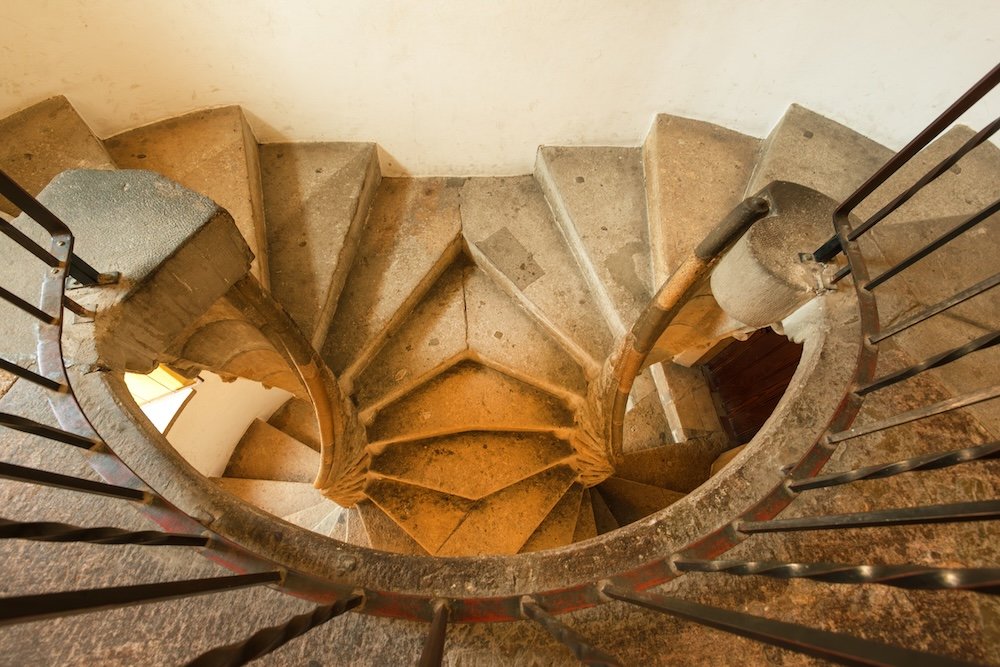
A short distance from that location, in the Burg complex that now houses the Styrian government, a double spiral staircase of Gothic origin was built between 1499 and 1500, made of two sections of stone that split apart and then reunite as you climb. The staircase is open to the public.
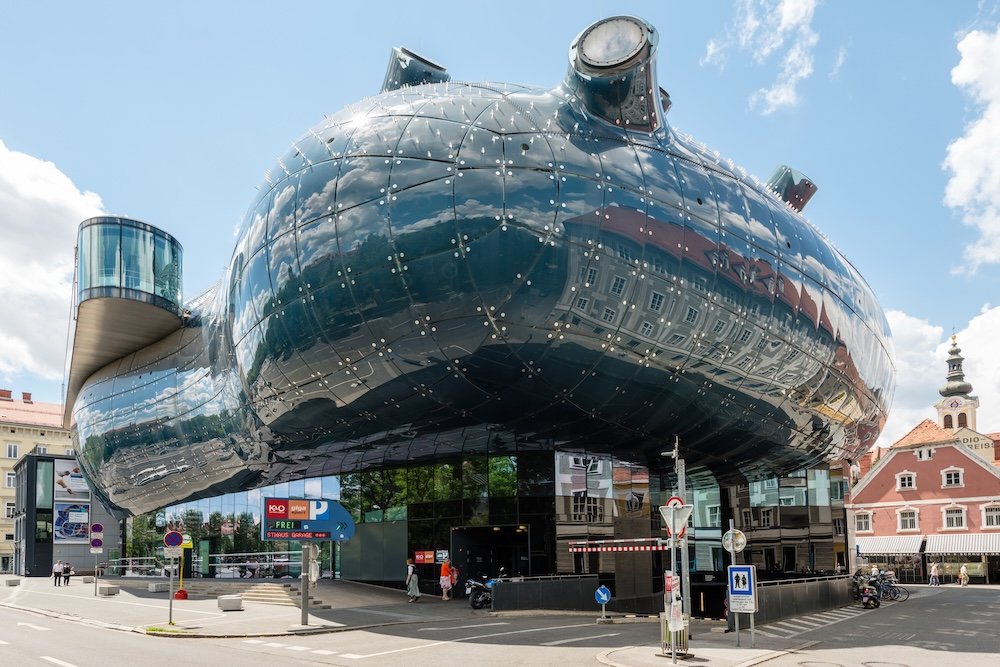
The Kunsthaus Graz, which was designed by Peter Cook and Colin Fournier when Graz was named European Capital of Culture in 2003, is a protruding blue biomorphic shell that the architects referred to as the “Friendly Alien”; it does not have a permanent collection and appears to be entirely at home amongst the Baroque rooftops.
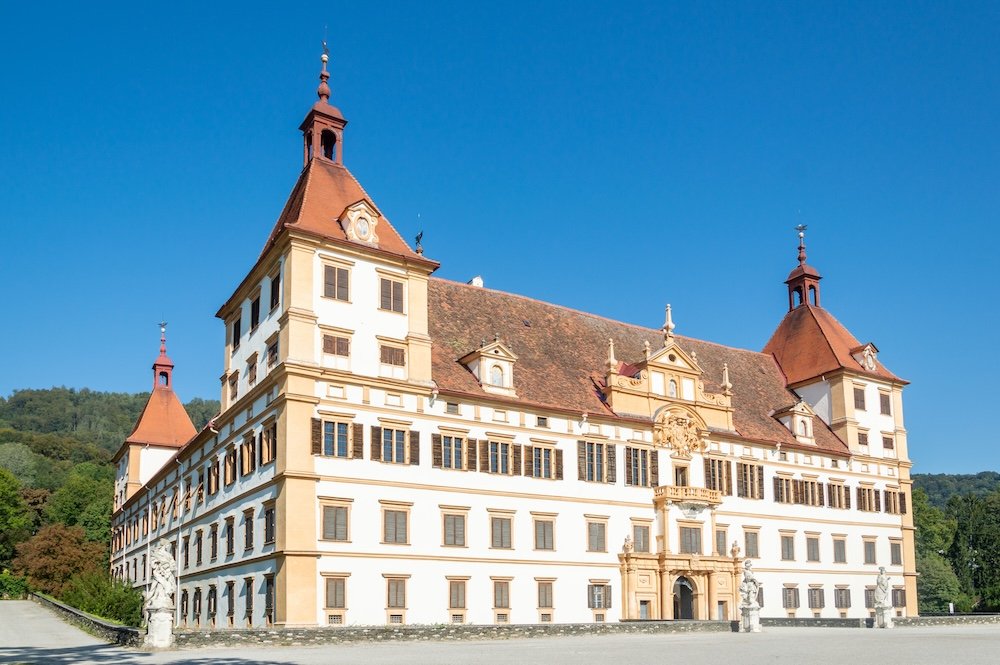
Schloss Eggenberg, which can be reached by taking a tram west of the city, is the town’s most prominent Baroque landmark and was constructed as a stone calendar for Hans Ulrich von Eggenberg; the building has 365 windows corresponding to the days of the year and 24 state rooms representing the hours of the day, and these rooms still have neither modern heating nor electric lighting. Guided tours are offered only from spring to autumn. The Planetary Room, completed in 1685, is the building’s centerpiece.
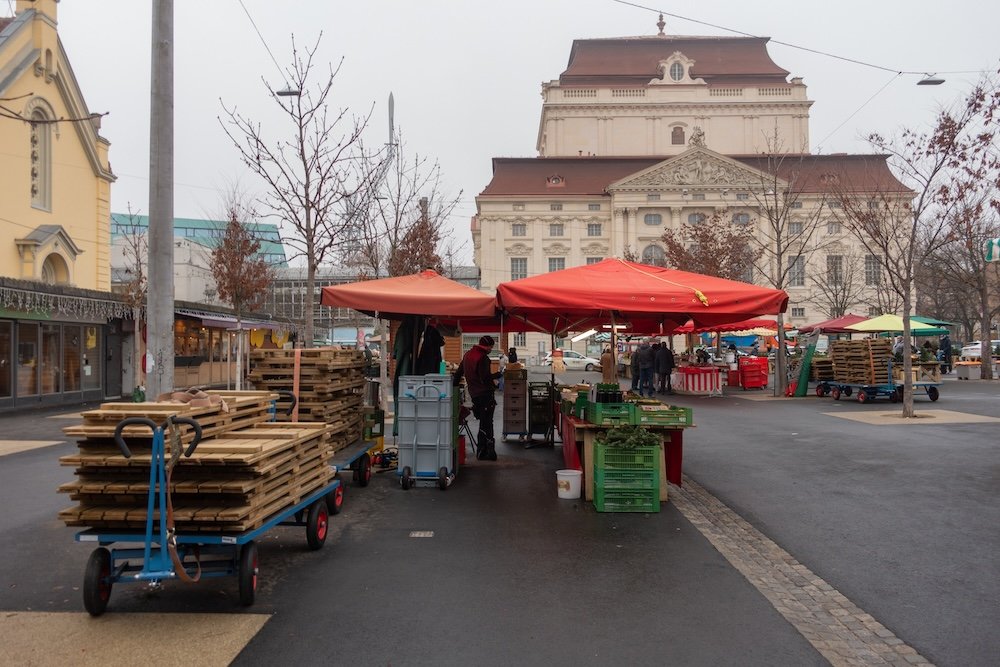
You can experience culture in Graz right at ground level, and the best way to take part is by having breakfast. The farmers’ markets at Kaiser-Josef-Platz and Lendplatz are open from 6 a.m. to 1 p.m., Monday through Saturday, with Saturday mornings being the week’s most social moment. The main product is Styrian pumpkin seed oil, a dark green, very nutty oil with EU protected-origin status. It takes between 30 and 35 pumpkins to produce about a quart of the oil, and in Styria it is used on salads, on soups, and yes, even on vanilla ice cream. The idea of mixing them seems like a challenge and tastes like a revelation.
The evenings are connected with the Lend district, the former industrial area on the opposite side of the river, which has since become the city’s creative quarter and, as a result, is associated with the arts calendar. Styriarte presents classical and early music in late June and July, with some of the performances held at Eggenberg. From late July to early August, La Strada uses the squares to stage street theatre and new circus acts. In the autumn, Steirischer Herbst, an event running since 1968, brings contemporary art to the city’s more unusual sections. Graz takes equal seriousness to both its avant-garde and its folk costumes, which doesn’t seem contradictory to anyone.
July and August are the busiest months; the average high is around 79°F, afternoon thunderstorms originate from the Alps, and heat waves occasionally reach the 90s. Although visitor numbers are low compared with Salzburg’s standards, hotels are likely to be full during the festivals.
The shoulder season is near perfect: in May, June, and September temperatures rise to the upper 60s and 70s, sweater-weight evenings occur, and you make the fewest compromises; in September and October, the grape harvest happens, young wine called Sturm is made, and golden light falls on the vineyards south of town.
From November through March, during the quieter part of the year—cold and mostly grey, with the highest temperature in January reaching about 39°F —there is, though, one exception. Between mid-November and the holiday period, Advent markets fill the old town, all within easy walking distance of one another, and the Landhaus courtyard holds a full-size nativity scene carved from more than 77,000 pounds of ice. After New Year’s, the city becomes quiet once more, and prices drop, even though the state rooms at Eggenberg are closed, and the armory begins offering guided tours in the winter.
At the end of the day, when they return to town, the Uhrturm still shows off its big hour hand to the city below. The clock was purchased with florins and has been keeping time for Graz ever since.