


This is Sulphur Springs, in the town of Soufrière on Saint Lucia’s southwestern coast. It advertises itself, not inaccurately, as the world’s only drive-in volcano. You do not hike to it. You park next to it. The crater sits inside the Qualibou caldera, a volcanic system that formed tens of thousands of years ago and last stirred in 1766, a steam-driven blast that coated the surrounding countryside in ash. Nothing has erupted since, but the vents and mud pools still active today are what’s left of a system that, geologically speaking, is merely resting rather than finished. It is a strange, faintly sulfurous introduction to an island that turns out to be full of contradictions like this one.

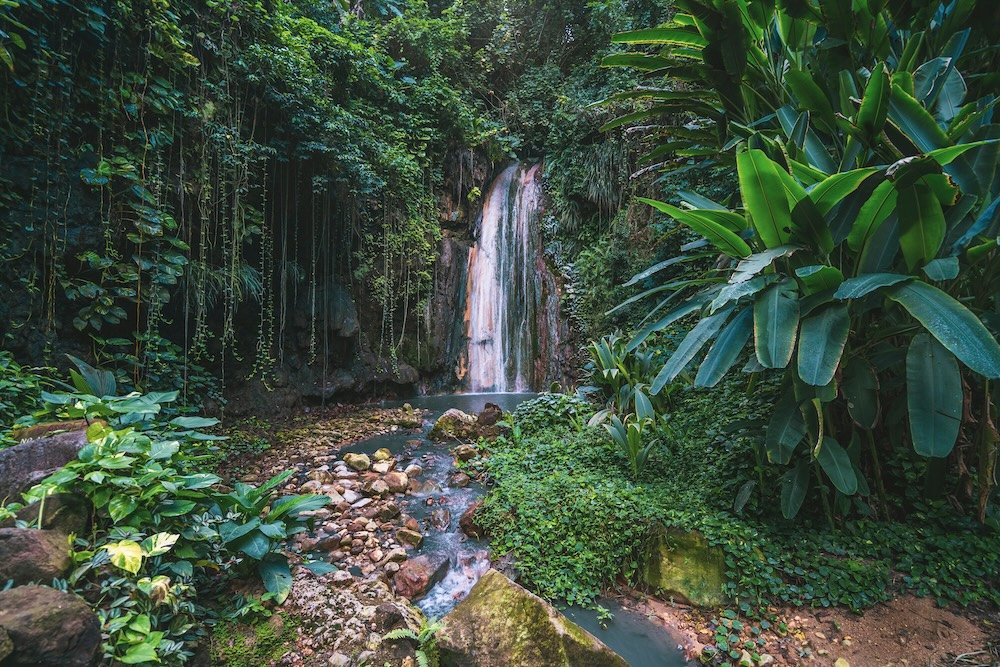
Saint Lucia sits in the eastern Caribbean, one of the Windward Islands in the Lesser Antilles chain, wedged between Martinique to the north and Saint Vincent to the south. It is small, 238 square miles, a shape cartographers have compared to a mango or an avocado. The interior is where the island does its real work: roughly 70 percent of Saint Lucia is covered in rainforest, rising toward Mount Gimie at just over 3,100 feet, the whole mountainous mass wrung out constantly by trade winds that dump rain on the windward slopes and leave the leeward coast comparatively dry. Trails through the Saint Lucia Forest Reserve cut across the island, connecting the Atlantic side to the Caribbean side through cloud forest thick with philodendron and tree ferns, past waterfalls that show up on no postcard because there are simply too many of them to choose from.
The Millet Bird Sanctuary, on the reserve’s edge, holds one of the last strongholds of the Saint Lucia parrot, a green-and-blue bird whose wild population had collapsed to roughly a hundred individuals by the mid-1970s under pressure from hunting, the pet trade, and habitat loss. Saint Lucia named it the national bird in 1979 and banned hunting it outright, and the population has climbed back into the hundreds since, one of the more successful bird recoveries in the Caribbean and a source of local pride now stamped on the national coat of arms and repeated in murals across the island.

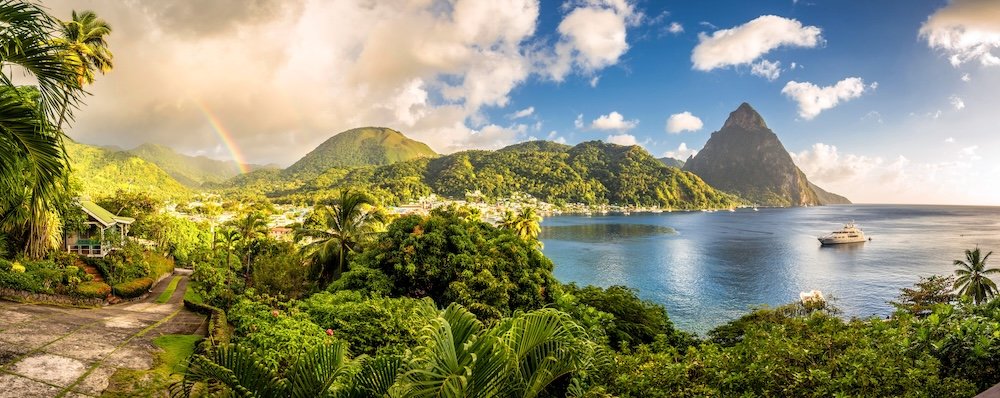
The coastline is where the volcano shows off. Gros Piton and Petit Piton, twin spires of andesite rising directly out of the sea near Soufrière, are what most people picture when they picture Saint Lucia, and the picture undersells them. Petit Piton climbs to 2,438 feet, Gros Piton to 2,619, both formed as volcanic plugs, magma that hardened inside a vent and stayed standing after the softer surrounding rock eroded away over millions of years. UNESCO inscribed the Pitons Management Area as a World Heritage Site in 2004, a designation covering roughly 7,190 acres that takes in the peaks, the surrounding reef, and the town of Soufrière itself. Guides run both climbs, though Gros Piton is the one with an actual maintained trail; Petit Piton is a technical scramble that most operators no longer offer as too dangerous.

None of this geology explains why the island is named what it is, which turns out to be a better story than the volcano. French settlers, arriving in the 1650s, named the island for Saint Lucy of Syracuse, a Christian martyr from Sicily killed in 304 AD during the persecutions under the emperor Diocletian. The legend that grew up around her, embellished over centuries, holds that her eyes were gouged out, either by her tormentors or by her own hand, which is how she came to be venerated as the patron saint of the blind. Saint Lucia is, as far as anyone can establish, the only sovereign nation on earth named after a historical woman. It’s a small distinction with a long tail: the island’s national day, celebrated every December 13, falls on the feast day of Saint Lucy herself, and it’s marked as the Festival of Lights and Renewal, when Castries and towns across the island string up lanterns and hold candlelit processions.

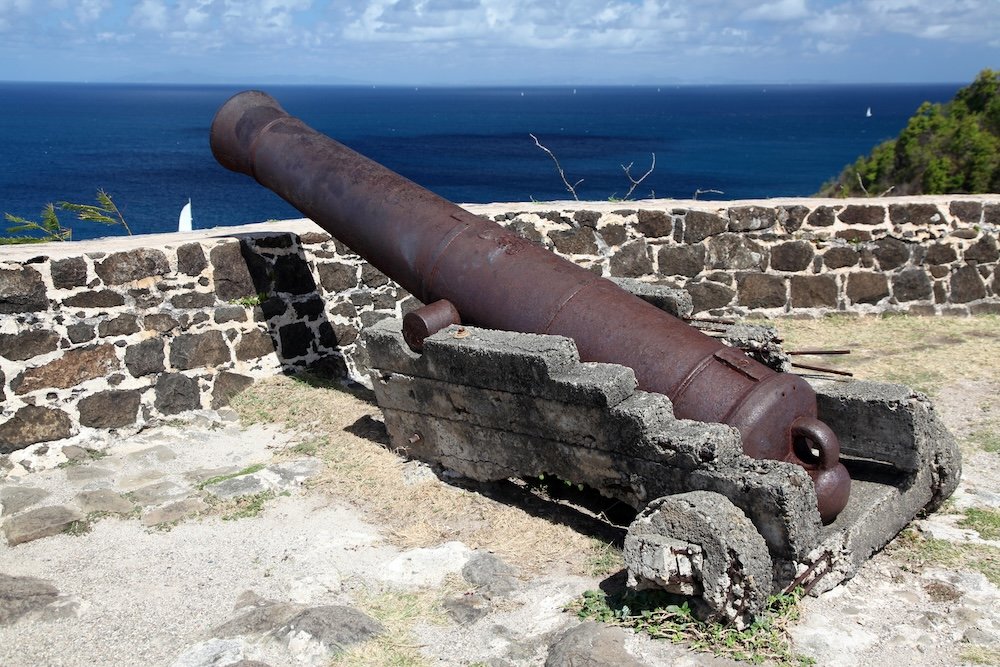
The French were the ones who named the place, but they didn’t keep it. Saint Lucia changed hands between France and Britain fourteen times over roughly a century and a half, seven times to each side, a tug-of-war fought with naval squadrons and muskets. The island’s harbors, Castries and Marigot Bay chief among them, were valuable enough, and its high ground at Morne Fortune commanding enough, that neither empire could leave it alone for long. Britain took final control in 1814 after Napoleon’s defeat, and the French Creole culture that had already taken root by then never left. Saint Lucia became internally self-governing in 1967 and fully independent on February 22, 1979, choosing to remain a Commonwealth realm, with the British monarch as ceremonial head of state and a locally elected prime minister running the government.
What that colonial back-and-forth left behind is a population, today numbering around 180,000, that speaks English as its official language while a French-derived Creole called Kwéyòl remains widely spoken at home, in markets, and in music, a linguistic fossil record of every regime that passed through. About 85 percent of Saint Lucians trace their ancestry to the enslaved West Africans brought to work the island’s sugar and, later, banana plantations, with smaller communities of mixed, Indian, and European descent rounding out a population that is overwhelmingly Christian, a legacy of missionaries from both colonial powers.

It is a small population to have produced two Nobel laureates, and yet it has, which gives Saint Lucia the highest number of Nobel Prize winners per capita of any country in the world. Sir Arthur Lewis, born in Castries on January 23, 1915, won the 1979 Nobel Prize in Economic Sciences for his work on development economics, in particular a model explaining how labor moves from subsistence agriculture into industrial sectors in developing economies, research that grew directly out of watching colonial economies like his own. Derek Walcott, born in Castries on January 23, 1930, exactly fifteen years to the day after Lewis, won the 1992 Nobel Prize in Literature for a body of poetry and drama, most famously the epic poem Omeros, published in 1990, which reworked Homeric structure through a distinctly Caribbean lens and refused to treat the region as a footnote to European literary tradition. Both men left Saint Lucia for long stretches of their working lives and both, in different ways, kept writing their way back to it.
The calendar does the rest of the cultural work. May brings the Saint Lucia Jazz and Arts Festival, launched in 1992 to fill what had been a quiet month for tourism and now a fixture that pulls international acts to open-air stages around the island, less a festival for jazz purists than a wide-net celebration of music set against beaches and rainforest hills. Carnival runs through July now, moved by government decision from its traditional pre-Lenten date so it would stop competing for attention with Trinidad’s much larger Carnival each Ash Wednesday, and the parade through Castries runs on soca, elaborate costume, and a level of civic participation that turns the capital inside out for a week. October belongs to Jounen Kwéyòl, Creole Heritage Day, when villages across the island cook in the street and dress in madras plaid to mark a culture built from French, West African, and English fragments. The signature dish is lambi, conch meat pounded tender and simmered in a Creole curry heavy with thyme, garlic, and Scotch bonnet, sold from roadside stalls alongside bakes and bouyon, food that makes the abstract idea of Creole heritage into something you can actually taste. Late November through mid-December brings the Atlantic Rally for Cruisers into Rodney Bay Marina, hundreds of yachts finishing a transatlantic crossing from the Canary Islands, their crews stumbling onto the dock after two or three weeks at sea to horns, flags, an ice-cold rum punch pressed into their hands, and a gift basket of local fruit and spices, an odd, wonderful collision of European sailing tradition and Caribbean welcome. Then December 13 closes the year with the Festival of Lights, the whole island lit up on Saint Lucy’s own feast day.

Back at Sulphur Springs, the guide walked us past the fence line to where the mud baths steamed in shallow concrete pools. A woman asked, not entirely joking, whether the gray mud would stain her swimsuit. “Everything here stains something,” he said, and checked the temperature. It was a small, practical answer to a small, practical question, delivered by a man who lives twenty minutes from an active volcano and finds nothing remarkable about that fact at all. Which is, in the end, the most honest thing anyone told me on the island: Saint Lucia was named for a martyr, fought over for a century and a half, and built two Nobel laureates out of a population smaller than a mid-sized American suburb, and none of it stopped a Tuesday morning from being, mostly, about the mud.