


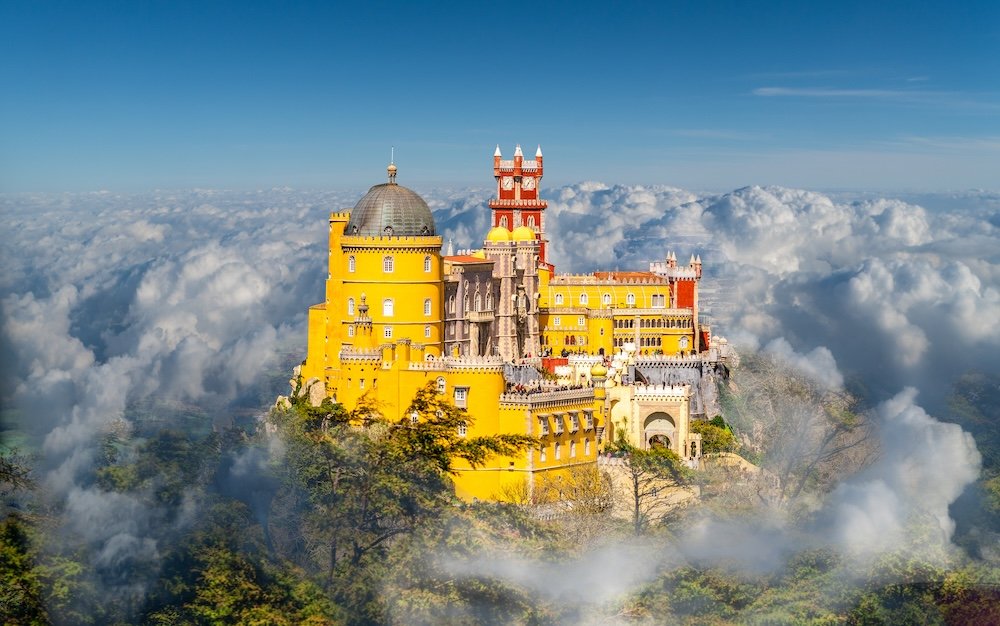
The fog does the introducing in Sintra. You climb the switchbacks out of town in a tuk-tuk that smells faintly of diesel and eucalyptus, the driver working the horn at every blind corner, and for most of the ride there is nothing above you but gray. Then, without warning, a canary-yellow tower punches through the cloud like something surfacing for air, followed by a dome, and the effect is less “castle in the mist” than a magic trick performed badly enough that you can see how it’s done. Pena Palace wants that reaction. It was built to produce exactly that reaction, by a king who never met a stylistic reference he didn’t want crammed onto one hillside, and understanding why requires going back three centuries before he touched a single stone.
In 1503, Manuel I ordered a monastery raised on this outcrop above Sintra, on the site where pilgrims claimed the Virgin Mary had appeared to a shepherd. The Hieronymite monks who eventually occupied it lived modestly by the standards of Portuguese royalty, which means their cloister was still carved with the maritime rope-and-coral motifs of Manueline architecture, the same decorative language stamped across the Jerónimos Monastery in Lisbon that Manuel’s wealth from the spice trade paid for. It was a working religious house, not a showpiece, and it served that way for over two hundred years. Then, in 1755, the earthquake that leveled much of Lisbon reached the hills of Sintra and cracked the monastery badly enough that repair never fully caught up with decay. When Portugal dissolved its religious orders in 1834, the monks left for good, and the site sat as a shell of scorched granite and broken tile, the kind of ruin that shows up in Romantic paintings precisely because nobody has gotten around to fixing it.
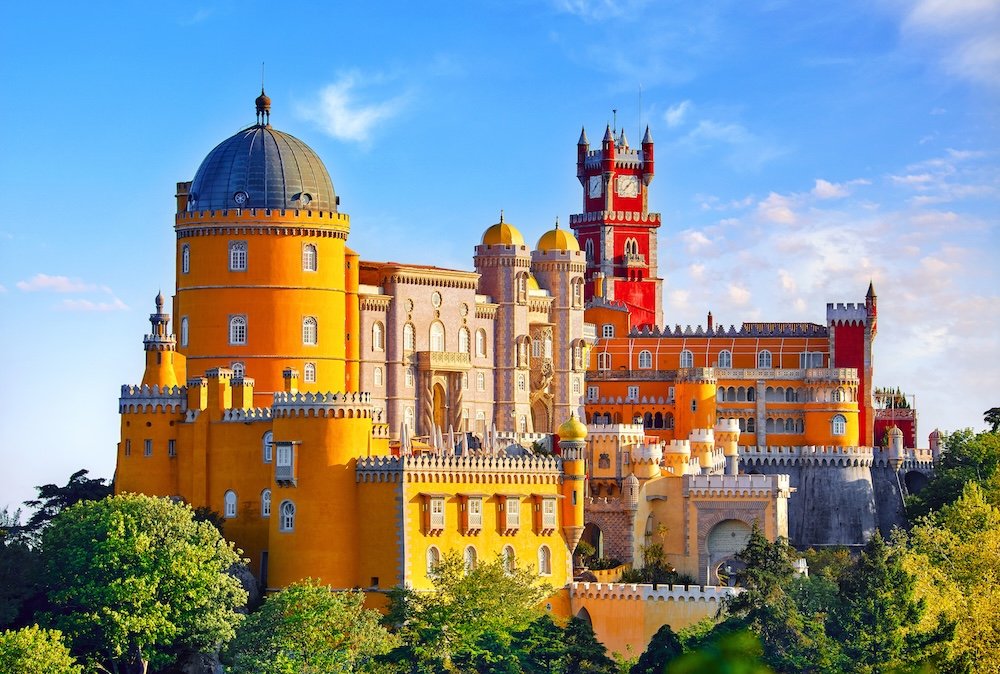
Which is where Ferdinand of Saxe-Coburg-Gotha comes in, a German prince who married into the Portuguese throne as consort to Queen Maria II and apparently found the ruined monastery more interesting than anything happening at court. In 1838 he bought it. What he did next was not restoration, not in any sense a preservationist today would recognize. Working with Baron Wilhelm Ludwig von Eschwege, a Prussian mineralogist and military engineer who had spent years surveying Portugal’s mountains and evidently developed opinions about castles along the way, Ferdinand kept the old cloister and chapel largely intact and built an entirely new palace around and above them. The result borrows a Moorish minaret here, a Manueline window frame there, crenellations lifted from a Rhineland fortress and a dome that owes more to Bavaria than to Iberia, the whole assembly held together by nothing more disciplined than one royal patron’s enthusiasm. Architectural historians eventually gave this approach a name, “Romanticism,” as if a category could make it seem less improvised than it clearly was in practice.
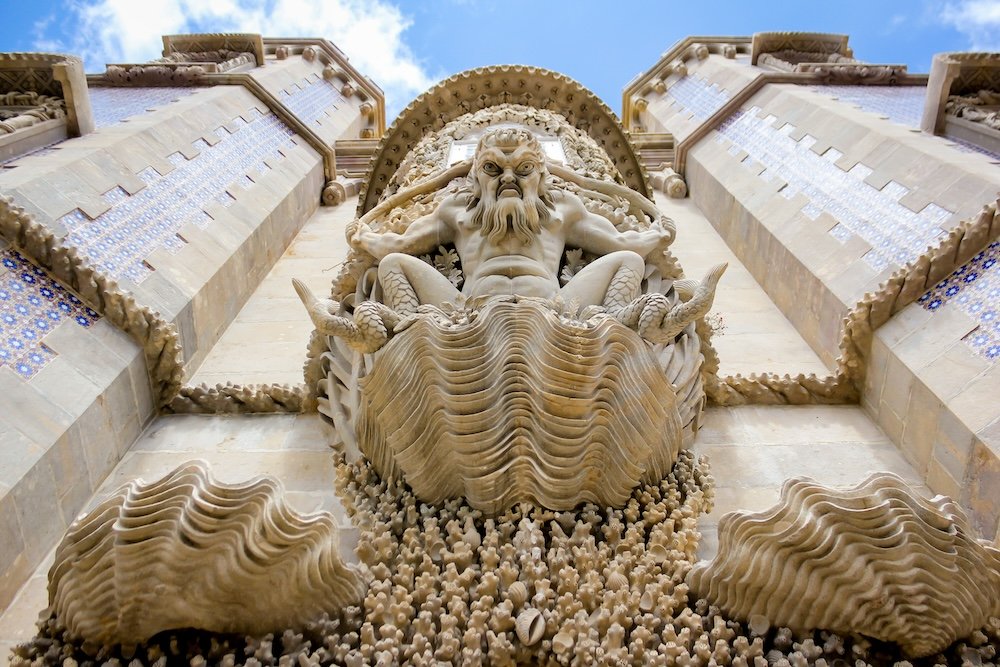
The join is still visible if you know where to look, and that detail is worth carrying up the hill. Stand at the base of the Clock Tower and the palace’s silhouette reads like a cross-section of its own history: the weathered, unadorned granite of the sixteenth-century monastery on one side, the glazed ochre-yellow and crimson-red stucco of Ferdinand’s nineteenth-century addition on the other, meeting at a seam that nobody bothered to disguise. A stone Triton crouches over the main archway into the new wing, half man and half sea creature, supposedly holding the entire building up on his shoulders — a fittingly theatrical guardian for a palace that treats structural logic as optional. Nearby sits a drawbridge with chains and a portcullis, fully operational in appearance and entirely decorative in function, since no army ever seriously threatened a Portuguese summer retreat. Ferdinand, by every account, knew exactly how silly this was and built it anyway.
He also built something quieter a short walk into the surrounding park: a rustic chalet for Elise Hensler, an American-born opera singer he married after Maria II died, and whose title — Countess of Edla — the royal family accepted with considerably less enthusiasm than Ferdinand did. The chalet is cork-bark-clad and unassuming in a way the main palace never bothers to be, and standing in front of it after an hour spent absorbing crenellations and tilework feels like overhearing someone’s actual life after sitting through their performance.
Portugal’s monarchy did not survive Ferdinand by much. Carlos I and Queen Amélia used Pena as a summer residence into the twentieth century, and when the republic arrived in 1910, the palace was nationalized within the year and opened as a museum, its interiors left largely as the royal family had abandoned them. UNESCO folded it into the Cultural Landscape of Sintra in 1995, and a 1996 restoration returned the exterior to the yellow and red that decades of Atlantic weather had scoured to gray stone.
What today’s visitors actually get, past the crowds funneling toward the same three terraces for the same photograph, is an argument conducted in architecture: a modest religious ruin that one restless king refused to let stay modest, wrapped in enough invented history to make actual history harder to find, until you round a corner into a plain granite cloister and realize the monks were there first, and are, in their quiet way, still winning.