


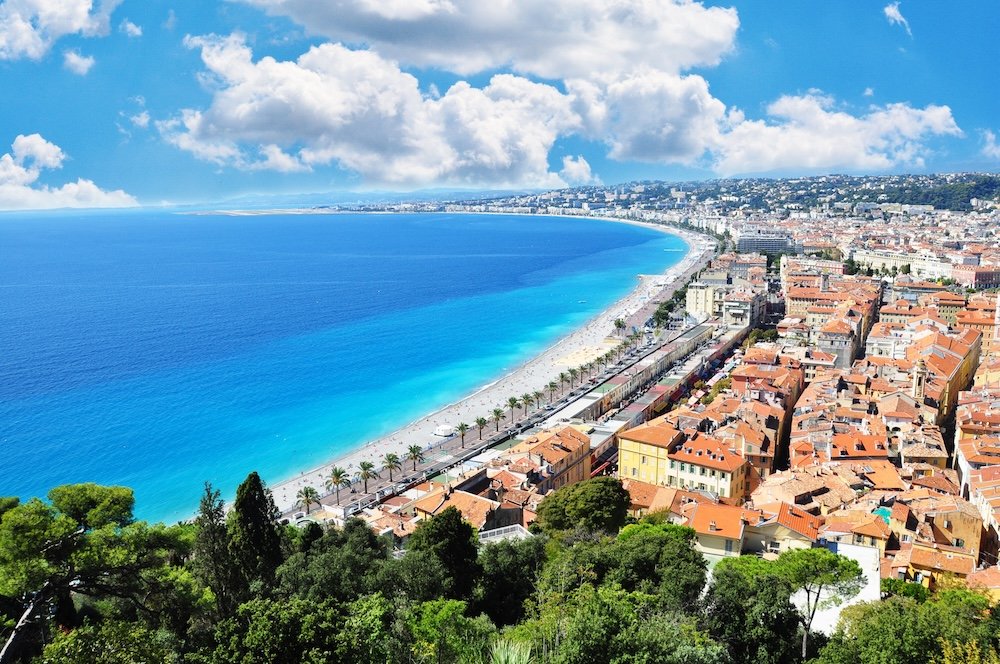
It is noon on Castle Hill, and the shot fires from a small battery near the old fortress walls. It has been going off at noon since 1860, when a Scottish resident, Sir Thomas Coventry, reportedly sick of his wife’s habit of serving lunch late, asked the city if he could pay for a daily noon shot to keep the household on schedule. He eventually moved back to Scotland and took his cannon with him. The city continues the tradition nonetheless, because by then everyone had adjusted to setting their watches by it. These days, it is no longer a cannon; instead, the town uses fireworks. The joke, such as it is, has outlived the man who started it by more than a century.
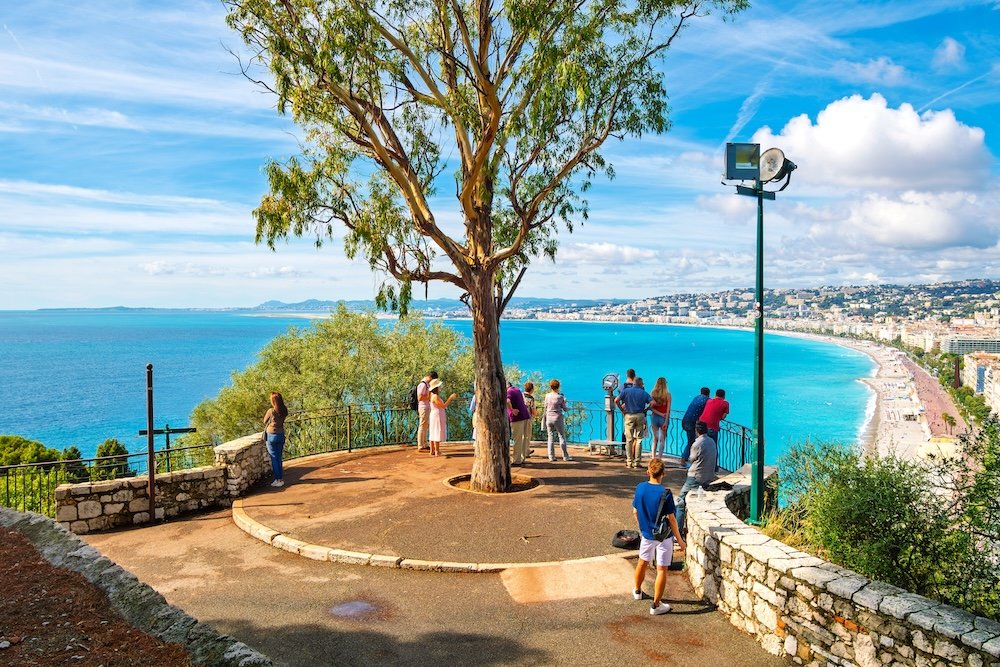
Importantly, the cannon that fires the shot is on a hill where no castle now stands. For the better part of a thousand years, a castle stood there, and by the eleventh century it had grown into a proper medieval stronghold with a cathedral and a walled village on the hill. In 1706, however, Louis XIV laid siege to it, and a stray cannonball flew through the fortress window and landed in the powder magazine, doing more damage than the siege itself. Louis XIV, apparently reluctant to leave a fortified rebel city so close to his new border, had the whole thing torn down, wall by wall, stone by painstaking stone. Centuries later, much of that stone was hauled down the hill and used to pave the waterfront walkway that made Nice famous.
Nice was Italian longer than it was French, and it shows in the architecture and the food. Founded by Greek traders around 350 BC and named Nikaia for Nike, the goddess of victory, it changed hands to the House of Savoy in 1388. It remained theirs, on and off, for nearly five hundred years, becoming Savoy’s only real port on the Mediterranean. It became French in 1860, when Victor Emmanuel II handed the city and county over to Napoleon III as part of the deal that made him King of Italy, sealed by a regional vote that the Italian general Giuseppe Garibaldi, born in Nice himself, called a rigged formality. A fair number of the city’s Italian-designation residents left rather than becoming French overnight. The ones who stayed are why a plate of pasta in Vieux Nice tastes more like Liguria than Provence.
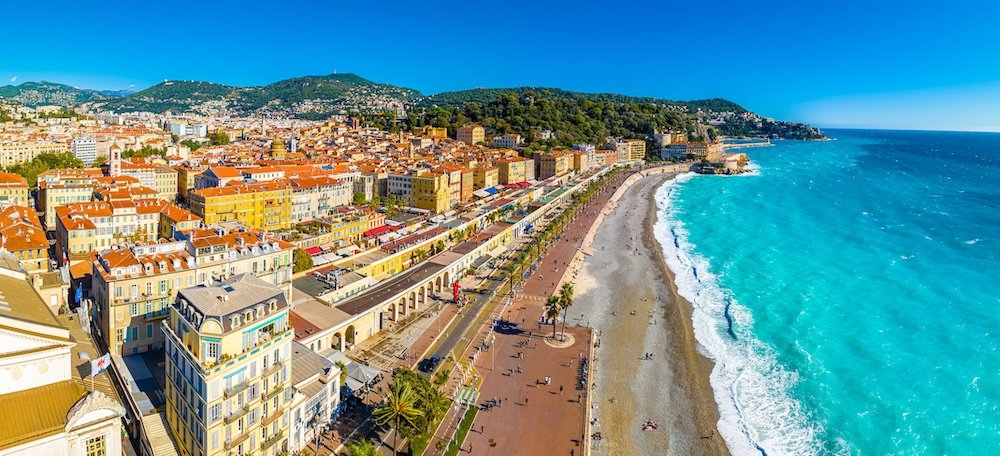
The English weren’t far behind, for a very specific reason: doctors in London had begun prescribing warm coastal air as medicine for tuberculosis and general poor health, a fad known as climato-therapy, and Nice had a nice, mild winter that wealthy Britons could afford to leave the fog behind for a season. They built villas, donated a chapel, and eventually funded the seaside walkway, built partly from the old castle’s stones, that still bears their name. The Promenade des Anglais, the walk of the English, now runs about four miles of palm trees and rollerbladers dodging cyclists and hotels that look like wedding cakes, and it is, if nothing else, the best free entertainment in the city if you’re sitting there watching who goes by.
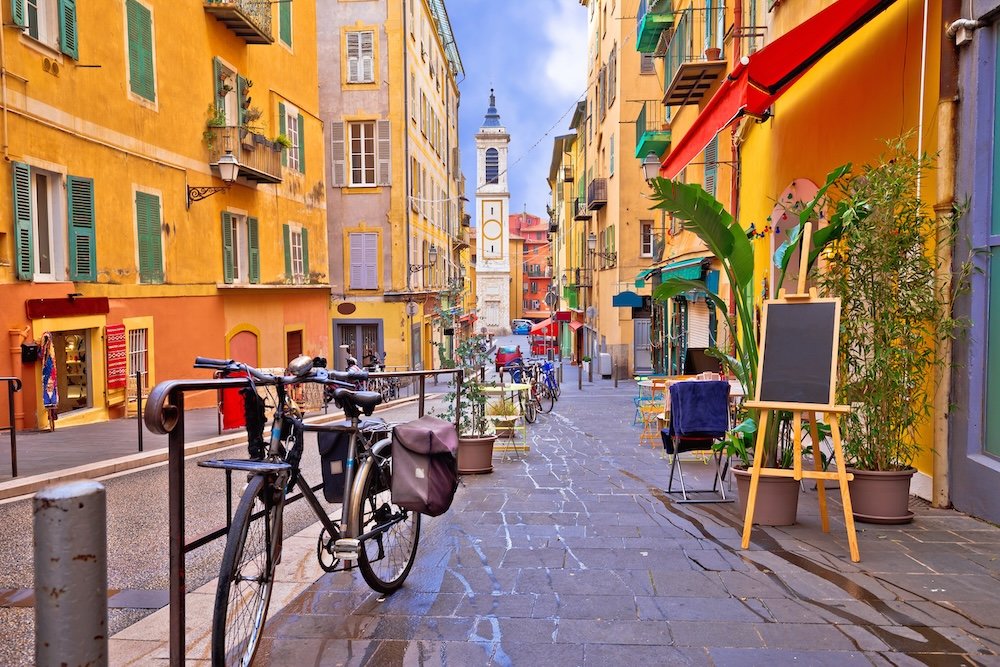
Vieux Nice, the old town wedged between the bottom of Castle Hill and the straight street grid, was planned long before anyone owned a car, and it hasn’t apologized for it since. The streets are narrow, laundry lines straddle the space between buildings, and every few steps there is a chapel, bakery, or shop devoted entirely to olive oil.
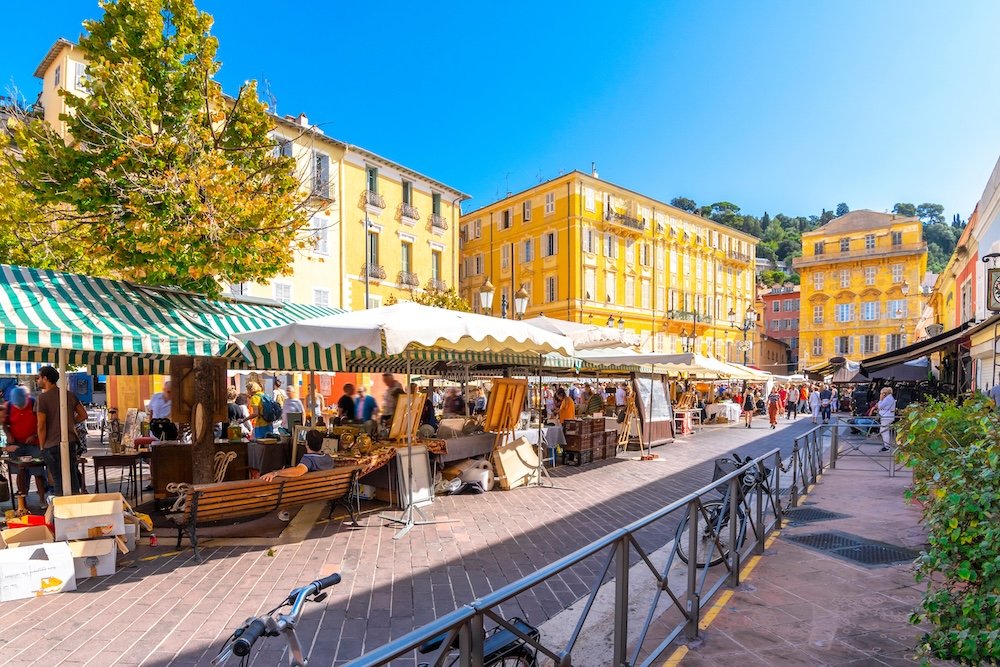
At the center is Cours Saleya. This long open market is open every day of the year, one end devoted to flowers and the other to produce and food, except on Mondays, when it becomes an antiques market, and the flower stalls are replaced by dealers setting out old silver and postcards on folding tables. By most reckoning, it is one of the more photogenic markets in France, if not the most. However, the photographs don’t quite capture the noise, the smell of citrus coming off a fruit stand or the particular tone a vendor uses to tell you, kindly but with finality, that you are squeezing the peaches wrong.
Here is the thing no one really prepares you for: the beaches in Nice are not sand. They’re pebbles, smooth gray stones called galets, washed down from the mountains by three local rivers and replenished by the city every spring after winter storms pull some of them back out to sea.
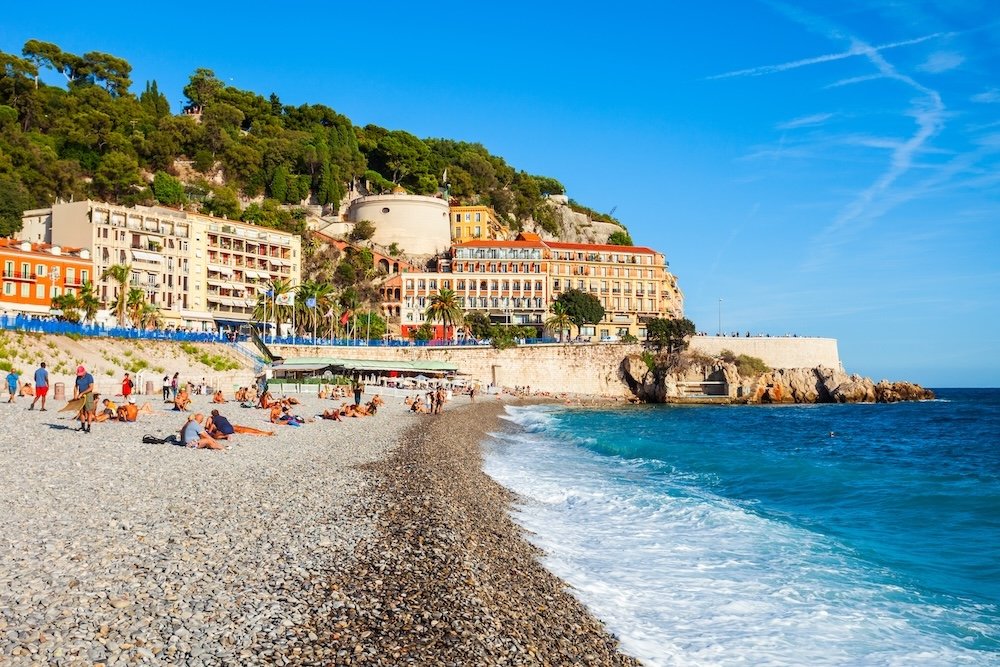
Walking barefoot on them is a genuine athletic event, and more than one visitor has learned that the hard way, hopping a foot at a time across the stones heading for the water like they’re crossing a bed of coals, which in August, with the sun radiating up off the rocks, isn’t far off. Some beaches have laid ropes to help people haul themselves up and over the steeper mounds. Bring water shoes, and most visitors bring a thick padded beach mat or rent a lounger. No one local will judge you for it.
There are about two dozen public stretches along the Baie des Anges where you can lay out a towel free-style, and a run of private beach clubs, some of them attached to grand old hotels where a daily fee rents you a lounge chair, a shade umbrella and a server who will bring you a glass of rosé without you having to get up. Either way, the water does the actual selling: a clear, deepening blue that the whole Riviera takes its old name from, the Côte d’Azur, and that looks from the Promenade above less like a beach and more like the edge of a very good painting.
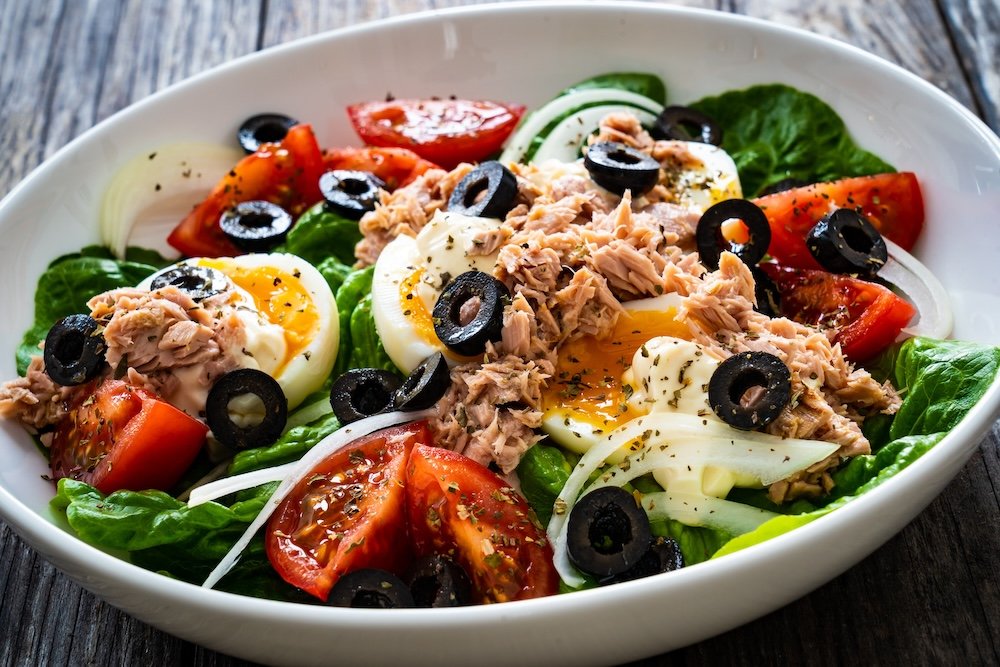
Niçois food takes itself so seriously that real debates rage over the ingredients of the salade niçoise, named after the city. Traditionalists: tomatoes, anchovies, olive oil. That’s it. No lettuce. No cooked bits. Everyone else: hard-boiled eggs, tuna, green beans, boiled potatoes. The one you’ll actually find on offer anywhere, really delicious irrespective of which faction it happened to align itself.
Socca is the street food to know: a thin chickpea flour pancake (with olive oil and water) baked in a wood-fired oven until the edges char, then cut into ragged shapes and eaten hot from a paper tray dusted with black pepper. Cheap. Ubiquitous in the old town. Best eaten standing up, apparently, and preferably too hot to hold. Good companions include pissaladière, a sort of flatbread with caramelized onions, olives and a scattering of anchovies (but no cheese), and pan bagnat, essentially a salade niçoise squeezed into a round bread roll and left to imbibe its juices for a few hours. It’s the sandwich you’ll find eaten cold on the beach regularly, because, well, that’s how it’s constructed.
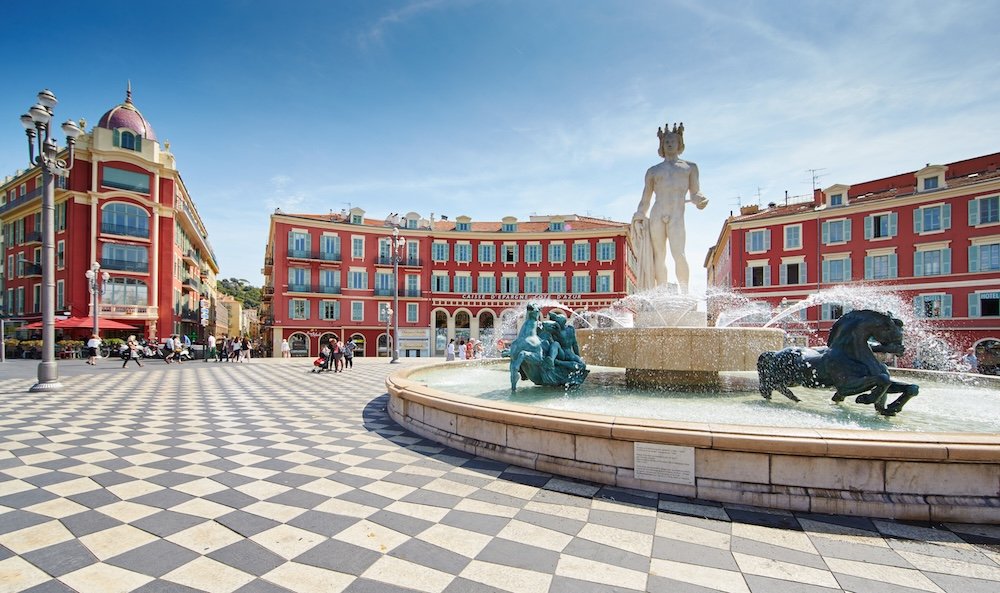
Place Masséna is the wide, checkerboard-paved square that used to be a riverbed, which explains why it sits so oddly flat in a city built mostly on slopes. Architect Joseph Vernier spent nearly two decades, from 1832 to 1850, framing the new square with arcaded buildings painted that particular burnt ochre-red, modeled loosely on the porticos of Paris’s Rue de Rivoli, and the color has since become as much a symbol of Nice as the water itself. At the center of the square, the Fontaine du Soleil sends a marble Apollo up out of a ring of statues representing the planets, and the fountain has its own small scandal attached to it: when the 23-foot Apollo went up in 1956, locals decided his proportions were a bit much even after the sculptor was called back to scale him down, and by 1979 a group calling itself the League of Feminine Virtue had gotten him exiled to a football stadium on the edge of town. He stayed there until public nostalgia, helped along by a mayor looking to make peace over a disruptive tram project, brought him home in the early 2000s to resume his post, apparently no less scandalous than ever. Since 2007, seven illuminated figures by Catalan sculptor Jaume Plensa have stood watch around the square’s edges. By day the square is mostly a wide-open crossing point, street performers and everyone else cutting through on the way to the water. By night, it turns into the one part of Nice that seems built to be stood in rather than walked through.
For indoor culture, the hillside neighborhood of Cimiez boasts two museums worth a walk up to see: the Matisse Museum, housed in a seventeenth-century villa with olive trees out the back, and the Chagall Museum, a building specifically designed to house Marc Chagall’s biblical paintings (which he donated to the French state himself). Both Matisse and Chagall spent lengthy portions of their lives working in and around Nice, drawn by the same light that talked half of Europe’s aristocracy into moving here in the first place.
Nice sits in the middle of a stretch of coastline, making it one of the most convenient spots in Europe to use as a base for a week of day trips. Villefranche-sur-Mer is ten minutes from Nice by train, and as far as you can get from crowds while still technically being in Nice’s backyard, a small pastel town with a harbor and fishing boats that looks like it was meant to exist as a postcard and has mostly succeeded. Èze is a walled medieval village improbably perched on a clifftop with a view of the sea, a steep but not particularly difficult walk from the coast road, with a garden at the top that offers one of the best views on the whole Riviera for the price of a ticket. Twenty-five minutes from Nice by train, Monaco is worth a half-day visit even if you have no interest in the casino, so that you can experience the sheer mass of money that seems to inhabit its harbor and appreciate the changing of the guard outside the Prince’s Palace.
Antibes, twenty minutes in the other direction, has its own old town and a busy market, plus a Picasso Museum housed in the seaside château where the artist worked for barely two months in 1946. They left enough paintings and ceramics behind to still populate it. Saint-Paul-de-Vence is a hilltop town about an hour inland by bus, trading the coast for stone streets, art galleries, and the Fondation Maeght, a modern art museum with its own following regardless of what’s going on at ground level. Menton is forty minutes east of Nice and nearly at the Italian border, and receives a fraction of the visitors Nice does despite possessing its own pastel old town stretch and a lemon-growing tradition serious enough to support an entire February festival centered around it.
All of which is doable without a car, and Nice is sufficiently served by regional trains and buses to the hills to make it simple to see half of the Riviera and still make it back in time for dinner.
The evening crowd thickens on the Promenade behind you as the sun goes down, and somewhere up on the hill, that “cannon” is done for the day, quiet until noon tomorrow. It’s a strange little anachronism of a tradition for a city to maintain, firing a shot from a fortress that isn’t there anymore, at a time nobody actually needs it for. But Nice has never seemed fussed by keeping things that no longer served their original purpose. It just finds them a new one.