


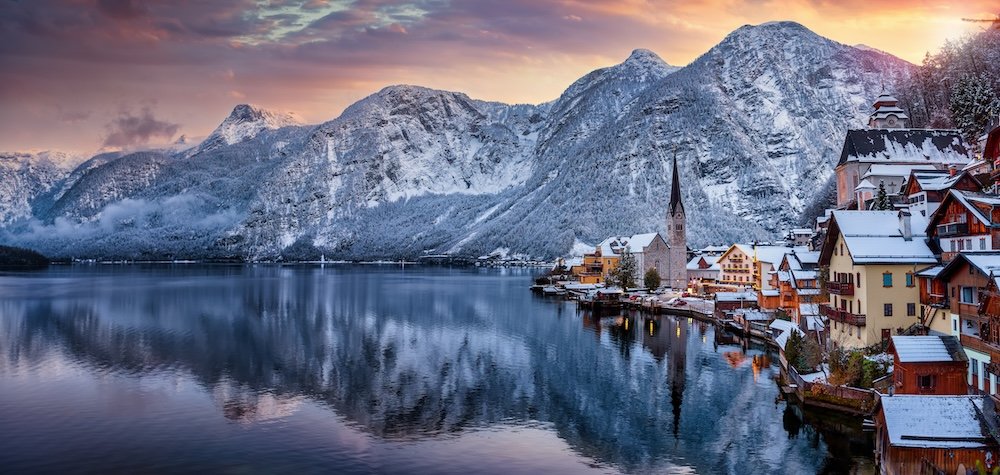
Hallstatt, Austria, has made an entire identity around being too idyllic to be real. However, its reputation is well-deserved and, for a reputation, strangely problematic, which is why the place is worth knowing for what it is rather than simply being photogenic.
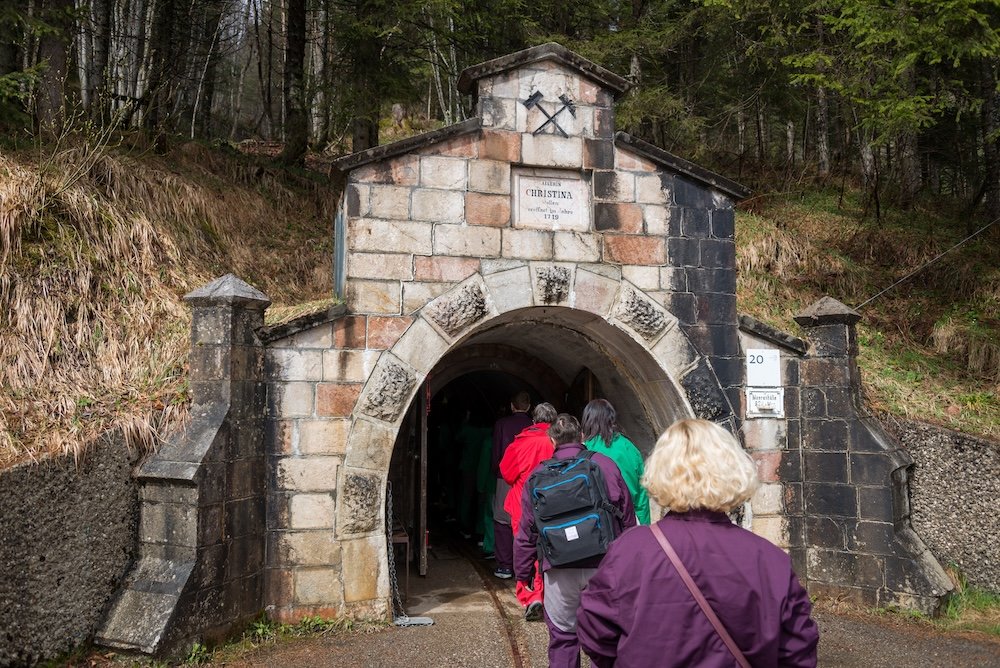
Humans have harvested salt from the hill above Hallstatt for roughly 7,000 years, and its history has been well-documented, perhaps ironically given salt’s uncanny ability to preserve whatever it touches. In 1838, some miners found a Neolithic deer-antler pickaxe forgotten in the rock, dated to around 5000 BCE, the oldest mining implement ever discovered in Europe. Deeper in the hill, archaeologists later found a wooden staircase built around 1344 BC, thought to be the oldest staircase still standing in continental Europe. By the time of the Iron Age, circa 800 to 400 BC, Hallstatt miners were tunneling as deep as 600 feet into the side of the mountain, using nothing more advanced than bronze picks and torchlight, and the burial grounds they established proved so well-stocked with preserved treasures that historians eventually named an entire previous European era after the town: the Hallstatt culture, the archaeological designation for the early Iron Age across much of the continent. Few villages of 750 souls can claim to have had their name attached to a period of prehistory. Still, a landslide around 350 CE briefly ended that anyway, an indication that the mountain Hallstatt made its name for never quite wanting to cooperate. Mining soon resumed nearby and hasn’t really stopped since; the Salzwelten works still offers tours through the old shafts today. In 1997, UNESCO included Hallstatt under the wider Hallstatt-Dachstein Salzkammergut Cultural Terrain World Heritage listing, noting both Hallstatt’s salt economy through the millennia and the alpine landscape it grew into.
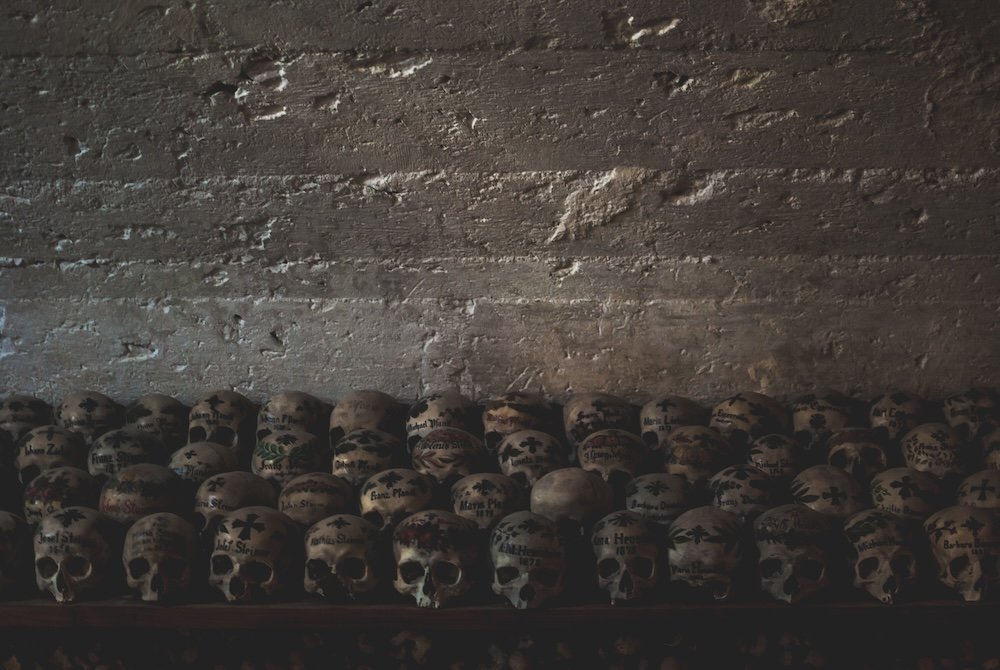
Perched up the hill and out of view of the church tourists photograph, a smaller building sits that most day-trippers stroll right past: the Beinhaus, or charnel house, of St. Michael’s Chapel. Hallstatt’s cemetery has always been low on space, constrained by a lake and a cliff, so for centuries the answer was pragmatic rather than nostalgic. Every decade or so the families of the deceased would exhume their loved ones’ bones, bleach the skulls in the sun, paint them with wreaths of ivy and roses for women, wreaths of oak leaves for men, along with the name, dates, and a small cross, and stack them neatly on shelves to make room for the freshly dead. Researchers who inventoried the collection between 1948 and 1950 tallied 2,104 skulls, more than 600 of them painted, mostly from the eighteenth and nineteenth centuries, with a few as recent as the twentieth century. Burial space eventually expanded, and the practice quietly fell by the later 1900s. However, the shelves remain, each skull still labeled, still facing the room, in what has to be one of the most disarming juxtapositions in European tourism: a village made famous for looking like a snow globe keeps its forebears on display two streets over by design, and with real care in how it was done.
Hallstatt’s paradox is that everyone wants to see the vista that made it famous, and the vista wasn’t made to hold everyone. On its busiest days, Hallstatt’s population of roughly 750 year-round residents is overwhelmed by up to 10,000 visitors, most of them for just a few hours rather than a night. “We are literally overrun,” Deputy Mayor Alfred Gamsjäger told reporters, and the village has been working the last couple of years toward a solution: a time-slotting system for tour buses that came into effect in May 2024, which the mayor says is working, and a proposed digital reservation system that would limit daily visitors to around 5,000 to 5,500, roughly half of peak volume. It has been difficult to enforce, since the same road that would be rate-limited also serves communities beyond Hallstatt, and cars and public transit arrivals aren’t even covered by the bus system.
Hallstatt’s weirdest episode of fame occurred 5000 miles away. In 2012, a Chinese mining and metals company built a full-scale replica of Hallstatt in Guangdong Province, complete with its own church spire, half-timbered buildings, and a stand-in for a lake, designating it as a luxury housing development for those who liked the look of Hallstatt more than the thought of visiting it. Austrian officials, reportedly bemused rather than offended, sent a small delegation to its opening.
For a destination with a small population and limited geographic span, Hallstatt offers a remarkable number of things to do. Start underground, since that’s where the village’s whole story starts. The Salzbergbahn funicular hauls visitors up the mountainside in about three minutes. After a year-long shutdown to rebuild the cable car and add a new elevator for anyone who can’t manage stairs, the ride and the salt mine at the top reopened in September 2026, newer and more accessible than at any point in its 7,000-year working history. Once inside, you’re handed a white miner’s suit and led through chambers of glassy salt walls and colored light. Still, the tour’s real hook is a pair of wooden slides built to move visitors the way miners once moved themselves, the longer one stretching nearly 200 feet, reportedly the longest of its kind in Europe. Ninety minutes, and you’ll leave slightly dusty and slightly delighted about it.
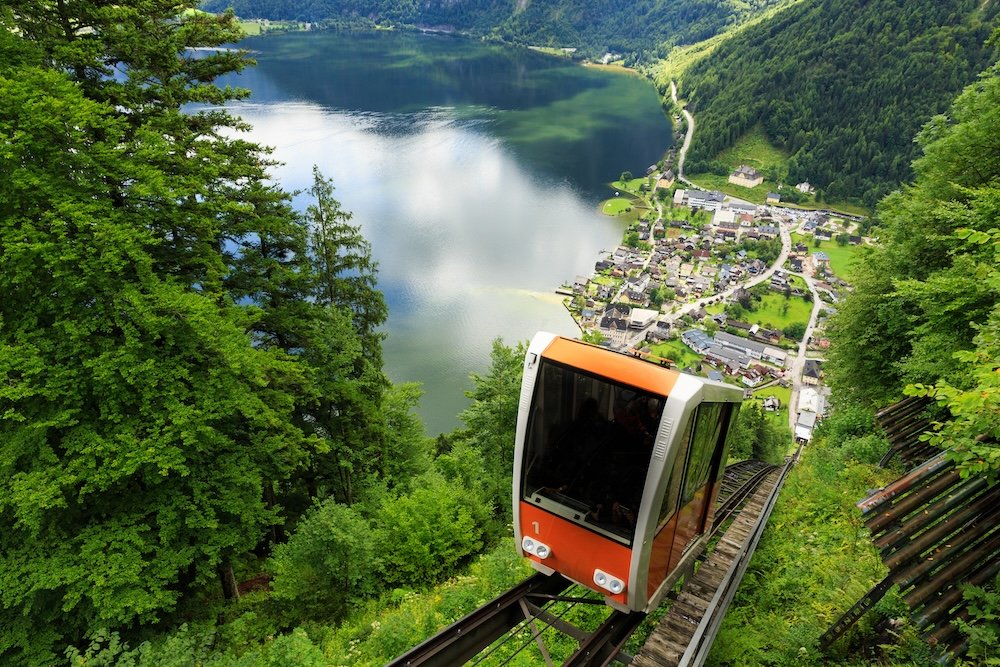
From the same high valley, walk the short distance over to the Skywalk. This cantilevered platform hangs almost 1,200 feet above Hallstatt’s rooftops, directly beneath the stone bulk of the Rudolfsturm, a defensive tower the Habsburgs built in the 1200s to guard the mine that paid for everything else. The platform reopened alongside the funicular, and the view from it does something the postcard shot from the village never quite manages: it puts the whole lake, the mountains, and the little cluster of roofs embedded into one frame at once, small enough now to look less like a village and more like an idea of one.

Back at lake level, rent a boat and be your own captain for an hour. Hemetsberger’s dock along the promenade rents electric boats, pedal boats, and old-fashioned rowboats, and the electric ones require no license, just a willingness to go slowly enough actually to look around. The lake is glacial and often glassy, and the view of the village from the water, rather than the shore, is the one almost nobody bothers to get.
For something with a heartbeat instead of a horsepower rating, lace up boots and take the panorama trail that climbs out from behind the Catholic cemetery. It’s an easy 45 to 60 minutes on forest track and paved lane, family-friendly and unhurried, past information boards on the old brine pipeline and a detour up the steep little Müllerstiege staircase to houses built directly into the cliff face. Hikers looking for real altitude can continue from the Salzberg high valley toward the Wiesberghaus, a mountain hut above 6,100 feet at the foot of the Dachstein massif. However, that route is a genuine alpine hike, not a stroll, and requires proper boots, water, and a realistic sense of your own stamina before you start.
Save the bone house for later in the day, when the crowds outside have thinned, and the village has gone quiet enough to match the room. St. Michael’s Chapel, up the hill from the main square, holds more than 600 painted skulls stacked neatly on open shelves, each one labeled with a name and a wreath of hand-painted flowers or ivy by a family who ran out of burial ground and found a gentler answer than most places would have. Admission is two euros, hours run longer in summer, and the ten minutes it takes to walk through leave a strong impression.
The classic view, the one everyone comes for, sits a short walk from the market square along Gosaumühlstraße, and it belongs to whoever arrives first. Go at first light, before the tour buses start their circuit, and walk back through the village while the shopkeepers are still setting out their morning bread. It’s the only hour of the day Hallstatt gets to look like the painting it inspired instead of the line for it.

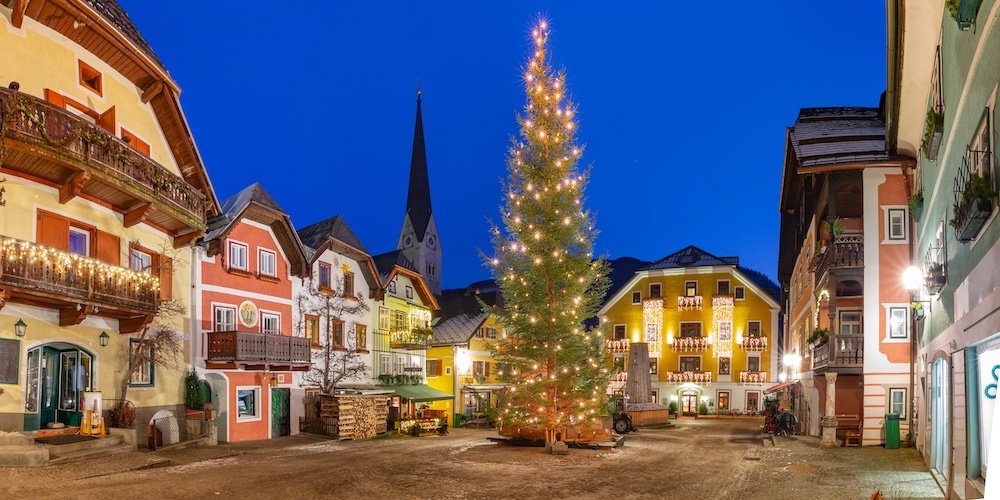
Book a room in Hallstatt itself, rather than using it as a bus terminal between Salzburg and Vienna, and the village offers you what the crowds don’t: an evening lakeside when the water has gone glassy again. At this dinner, the waiter isn’t rushing you, and you can walk up to the church square when nobody else is there. Those who spend the night in Hallstatt get the village that made it famous in the first place, without the line for the photograph.
Hallstatt is an excellent launching point for a few day trips most visitors don’t make, and it’s their loss. Gosausee is a glacial lake a thirty-minute drive south of Hallstatt which, like Hallstatt’s own lake, performs the same mirage act, this time showing the Dachstein glacier rather than a church steeple, with none of the crowds. The Dachstein Giant Ice Cave ascends by cable car from nearby Obertraun, guides visitors through galleries of ancient ice formations, and dumps them off at the Five Fingers observation deck, a series of steel walkways that plunge out over open air toward the valley floor, definitely not suited for anyone with an uneasy relationship to heights. And Bad Ischl is worth a visit: a pastel-cropped spa town walkable to cafes, moving at a pace suitable for a couple who’s already taken the photo everyone else came for and would rather sit down.