


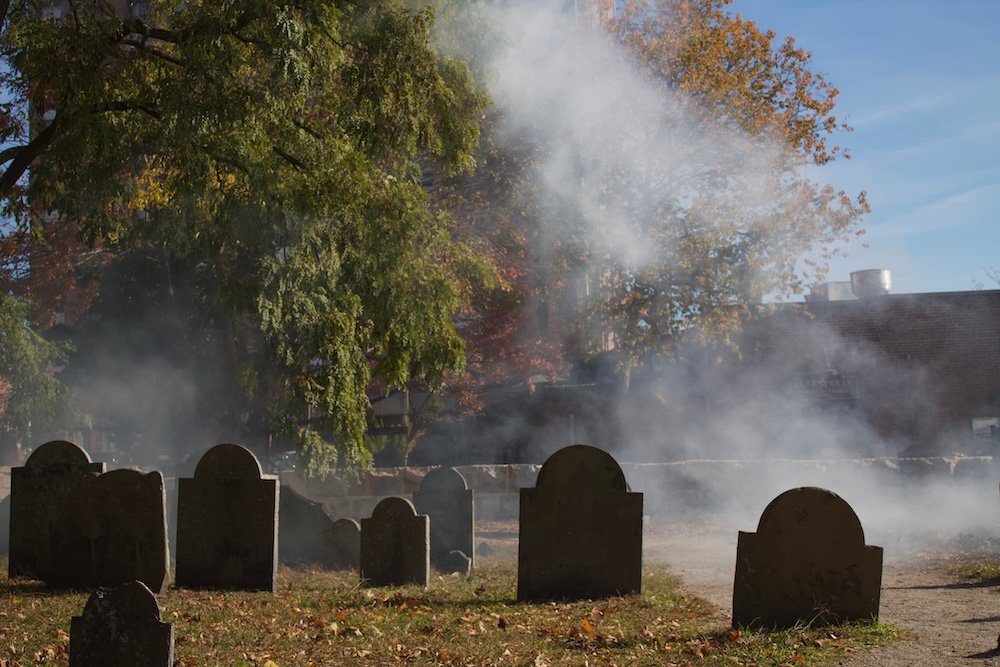
Proctor’s Ledge sits at the bottom of a residential street in Salem, a low stone outcrop behind a chain-link fence, wedged between a Walgreens parking lot and a row of houses with above-ground pools. There’s a granite memorial wall now, dedicated in 2017 after a team from the University of Virginia used tax records, deeds, and a 1692 diary entry to confirm what locals had long suspected: this patch of scrub land, not the wooded summit a quarter mile up the hill that generations of maps had labeled “Gallows Hill,” is where nineteen people were actually hanged. Three-quarters of a mile away, on Essex Street, tour groups in matching lanyards line up outside a wax museum while a woman in full Victorian mourning dress sells five-dollar tarot readings from a card table, and the crowd noise from the pedestrian mall doesn’t carry this far. Salem spent three centuries deciding what to do with its worst year, and it settled on doing both things at once: honoring it quietly a few blocks from where it commercializes it loudly.
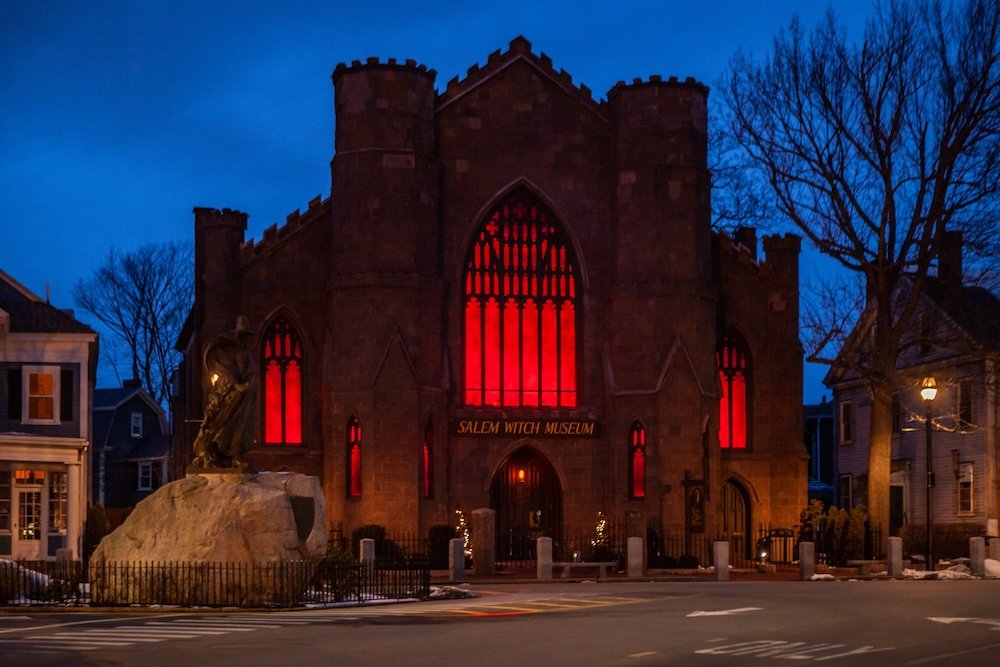
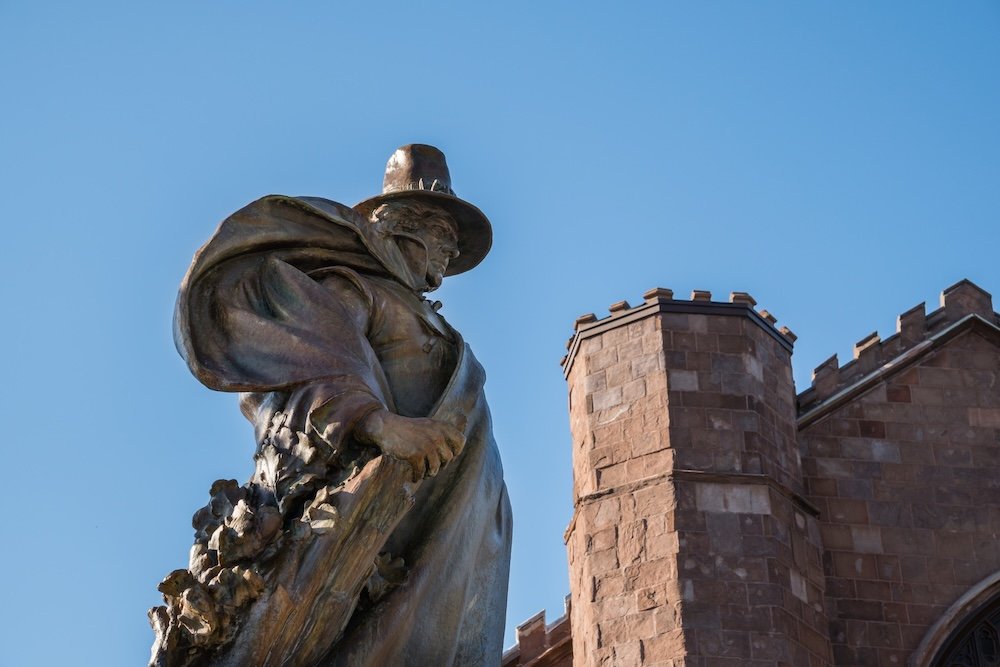
The year in question was 1692, when local courts, egged on by a handful of accusing girls in nearby Salem Village, put more than two hundred people on trial for witchcraft. Thirty were convicted. Nineteen were hanged in four separate rounds of executions between June and September, fourteen women and five men, their names read today at that quiet memorial: Bridget Bishop first, alone, in June; five more in July; five in August; eight in a single day in September. Giles Corey, an eighty-year-old farmer who refused to enter a plea, was pressed to death under stones over two days rather than give the court the satisfaction of a trial. Governor William Phips finally shut the proceedings down that October, after his own wife had been named as a suspect, which tends to concentrate one’s skepticism. The Salem Witch Museum on Washington Square now walks visitors through the whole sequence with stage sets and narration, and it does the history straight: this was mass hysteria and small-town score-settling dressed up in religious language, not a supernatural event, and the museum doesn’t pretend otherwise even while it sells the pointy hats in the gift shop on the way out.
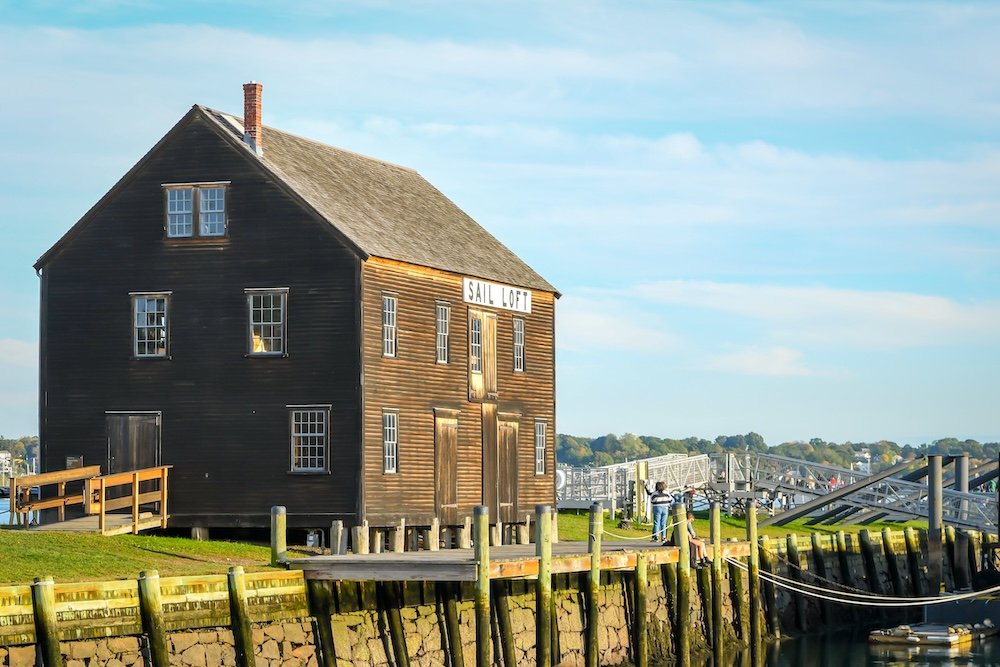
What tends to surprise first-time visitors is how briefly witchcraft actually defined Salem’s economy. For roughly a century after the trials, the city was better known for ships than séances. By the 1780s, Salem merchants were sending vessels to Canton for tea and porcelain, to Sumatra for pepper, to Zanzibar and the East African coast for ivory and cloth, to Russia and the Baltic for iron and hemp. Elias Hasket Derby, the city’s leading merchant, dispatched the Grand Turk to China in 1786 and by his death in 1799 was likely the young nation’s first millionaire.
In 1807, the year before Jefferson’s embargo throttled the trade, Salem’s customhouse collected $16.5 million in duties, nearly five percent of the entire federal government’s revenue, out of a town that never held more than about twelve thousand people. Salem sea captains got so used to hauling home curiosities from ports nobody else in America had visited that in 1799 they founded the East India Marine Society just to house the stuff. That collection became the Peabody Essex Museum, which now counts itself among the oldest continuously operating museums in the country and still displays the scrimshaw, Chinese export porcelain, and ship models those captains brought back, alongside a contemporary Asian and Oceanic art collection that has little to do with witches and draws crowds who came for entirely different reasons.
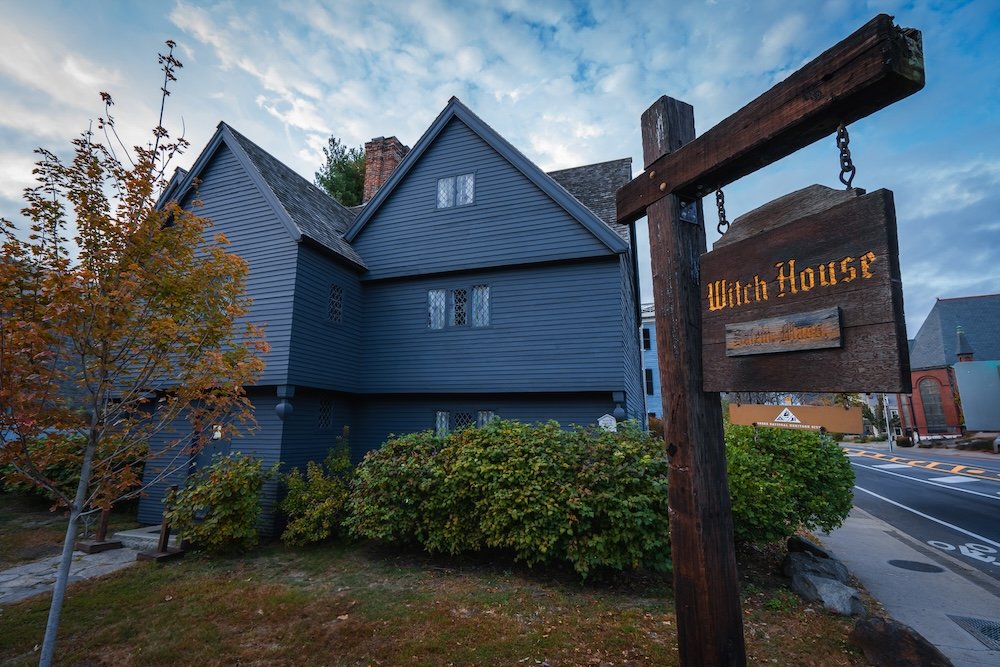
The maritime money is also, indirectly, why Nathaniel Hawthorne exists as a literary figure at all. He was born on Union Street in 1804, four generations removed from John Hathorne, one of the witch trial judges, a lineage that embarrassed him enough that he added the “w” to his name as an adult to put some distance between himself and his ancestor. The house he was born in has since been relocated to the grounds of the Turner-Ingersoll Mansion on Hardy Street, a sea captain’s home built in 1668 that Hawthorne’s cousin Susannah Ingersoll once showed him, pointing out where old roofline gables had been sealed up in the attic over the years. He never lived there, but the visit gave him a title: The House of the Seven Gables, published in 1851. The mansion has operated as a museum since 1910, its dark shingled bulk and diamond-paned windows looking almost too on-the-nose to be real, the kind of gabled, weathered New England pile a Halloween store would design if asked to invent one from scratch.
Salem Common, a nine-acre green a short walk from all of it, has been doing quieter work since 1637, when the town held its first militia muster there, a tradition formal enough that President Obama named Salem the birthplace of the National Guard in 2013. Nobody sells tarot readings on the Common. Dog walkers and Little League games have it most days, an ordinary New England park inside a city that has otherwise leaned hard into being extraordinary. That contrast is the real Salem story: a town that survived a genuine local atrocity, got spectacularly rich on the other side of the world, produced a writer who spent his career trying to work out what his family owed for the first part, and then found, sometime in the twentieth century, that the atrocity was the part tourists wanted to buy.
The witches, as it turns out, were never the whole story. They were just better marketing.