


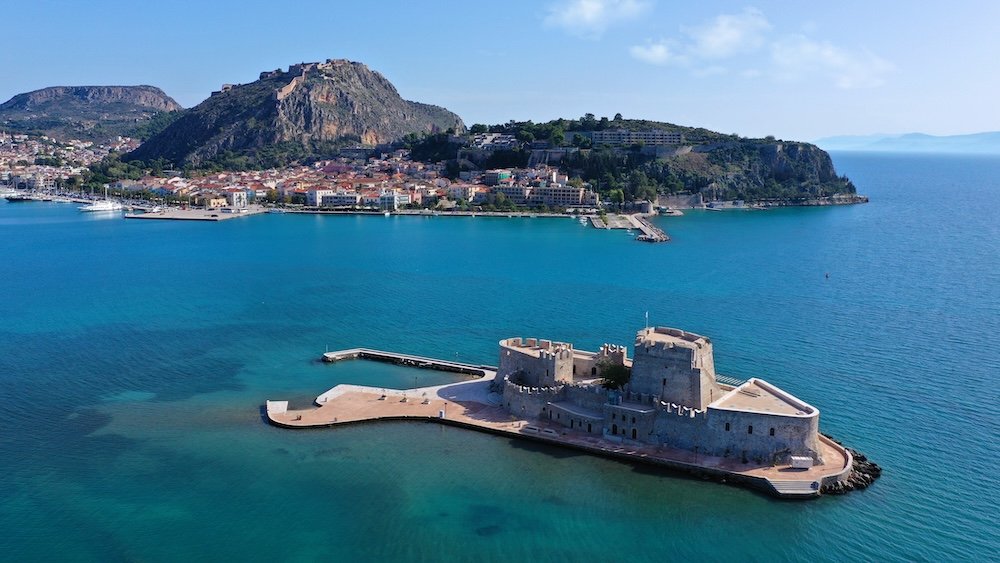
If you pick the wrong time to climb the “999 steps” of the Palamidi Fortress, those first 857 are the most difficult. In fact, there are not 999 steps; there are 857, and even for the physically fit, especially beneath the midday summer sun, the climb is strenuous. The best time is early morning or the last light of evening. The cooler the air, the better, and no matter the time of day, take water with you. It is not hard to understand why the Venetians saw fit to erect something this dramatic in the first place: they were not a subtle people.

Nafplio has never been a town for permanence. Twice the Venetians got it, first from 1388 to 1540, then from 1686 to 1715, with the Ottomans occupying the long years in between before taking it back themselves after Palamidi fell in 1715. When Greece won its independence, Nafplio got the ultimate consolation prize, becoming the first capital of the modern Greek state from 1827 to 1834 under Governor Ioannis Kapodistrias, who governed this fledgling nation from here until, on October 9, 1831, he was assassinated on the steps of the Church of Saint Spyridon by members of the Mavromichalis family, a bit of hometown theater mentioned almost as an afterthought in the guidebooks, as if political murder were merely part of the town’s historical charm. Seven years into the job, the capital was moved to Athens, and Nafplio settled into something it turns out it was much better suited for: being beautiful. Those who know Nafplio rightly consider it one of the most beautiful cities in Greece.

That brief capital stint gave the town its look. The new Greek government needed buildings that looked like a country worth visiting, so neoclassical mansions were erected along the streets spreading out from Syntagma Square, their blank facades and shuttered balconies bestowing a sort of Old World dignity to the Old Town that most other Greek port cities forgot to develop, and a few streets further in, the formality falls away to make way for something more complicated and ancient: alleyways barely wide enough for two people walking arm in arm. Bougainvillea spills over garden walls without any building permit. Wooden shutters faded to blues and greens peer out of windows that have clearly been photographed more often than their owners would like. High above it all, Acronafplia, the oldest part of the town, whose walls predate anyone here speaking Italian or Turkish by a wide margin, reminds you that people have been fighting over this particular hill for some time.

Nafplio stops being merely beautiful and starts being disarmingly beautiful at the coastline, the seafront promenade along Akti Miaouli looping around the water with the Old Town on one side and the open gulf on the other, unquestionably the best place in town to spend an hour doing nothing in particular. Out in the harbor, the small island fortress of Bourtzi sits waiting; in Nafplio, you can still book a visit. Built by the Venetians in 1471 to regulate who came in and went out, it had a slightly sinister career high point as the residence of Nafplio’s executioner before being happily repurposed into a boutique hotel in the 1930s.
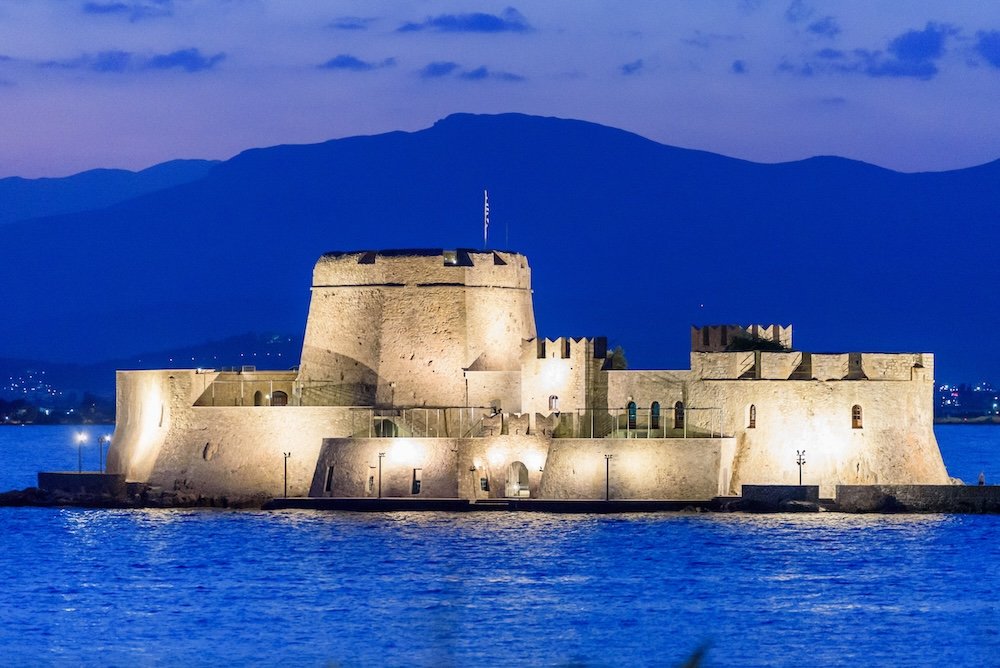
After years of restoration, it reopened to the public in August 2023 as an accessible cultural monument and tourist attraction. Admission is €7 for the fortress and €7 for the round-trip boat trip, and it is one of the more theatrically enjoyable fifteen minutes you can spend in the Peloponnese. Watch the sun set from the promenade, Bourtzi cast as a silhouette on the water, and Palamidi shining gold above the rooftops, and you will agree Nafplio’s romantic reputation isn’t just marketing. It is simply what happens when a town gets its lighting this right.
The Akti Miaouli side of the peninsula is where Nafplio performs for its audience. At the same time, the Arvanitia Trail wraps around the other side, a five-minute walk from the town’s main square, flanked by cactus and looping around the base of the Acronafplia cliffs, with the Argolic Gulf close enough to touch and the old fortress walls overhead. The beach at the end of it is pebbly rather than sandy, a status that locals treat as an endearing quality rather than an apology, and the water stays clear enough that you can see exactly what you are wading into. Bring shoes you don’t mind getting wet in, and plan to stay for sunset, when the whole headland will glow gold and the evening swimmers will seem in no particular hurry to get out.

In the evening the cafes that dot Syntagma Square and the street running parallel to it named Vasileos Konstantinou fill in that distinctly Greek manner wherein nobody appears to be in any particular hurry to anywhere, including the check, and if you order a coffee that arrives slower than it should and stays on the table twice as long as it needs to, you will understand the local pace. It is a good town for conversation, people-watching, and the sort of evening walk that counts as a plan. I
If you are the sort of traveler who likes a destination that has one good oddity to offer it, Nafplio has that covered with the Komboloi Museum, founded in 1998 by a couple, Aris Evangelinos and Rallou Gromitsari, who spent decades amassing worry beads after learning about them from family in Alexandria.
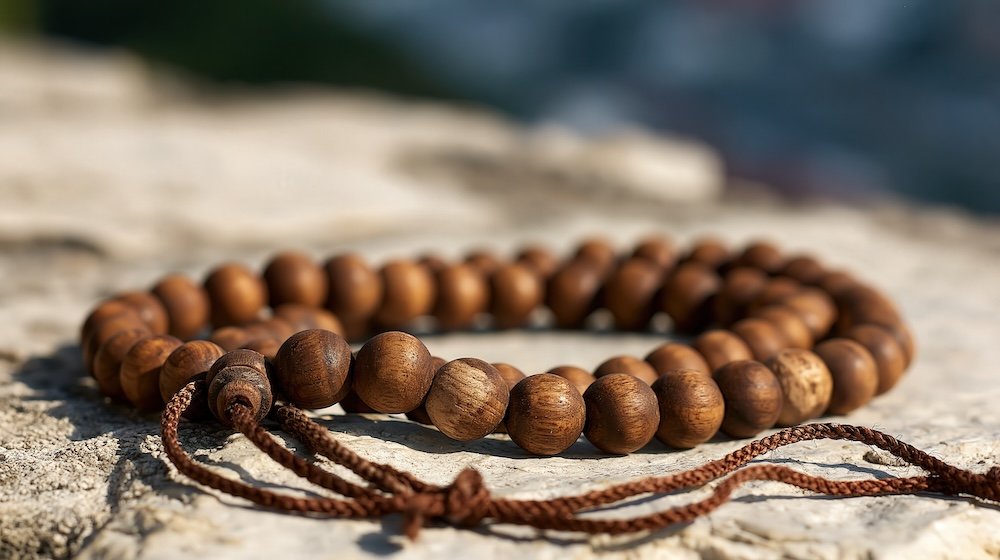
The museum features about four hundred prayer and worry beads made from amber, coral, ivory, and mastic, and displayed in rooms dedicated to Hindu, Buddhist, Muslim, and Christian traditions. It is, apparently, the only museum like this in the world, and it is a genuinely charming twenty minutes.
Nafplio earns its function as a base for the ancient sites dotted around the Argolid, and this is where the trip stops being merely beautiful and starts being meaningful. Mycenae, home to the Lion Gate and beehive tombs believed to have housed Homer’s Bronze Age heroes, is a twenty-five-minute drive away. Tiryns, whose Cyclopean walls are so large that the ancient Greeks believed they could only have been built by giants, is close enough to feel like a suburb of Nafplio rather than an excursion outside of it.

And Epidaurus, home to the best-preserved ancient theater in Greece that still hosts performances in a theater whose acoustics are so exceptional that a coin dropped on the stage floor can be heard clearly from the very last row, an engineering trick that modern engineers are still not entirely sure how the ancient Greeks managed.
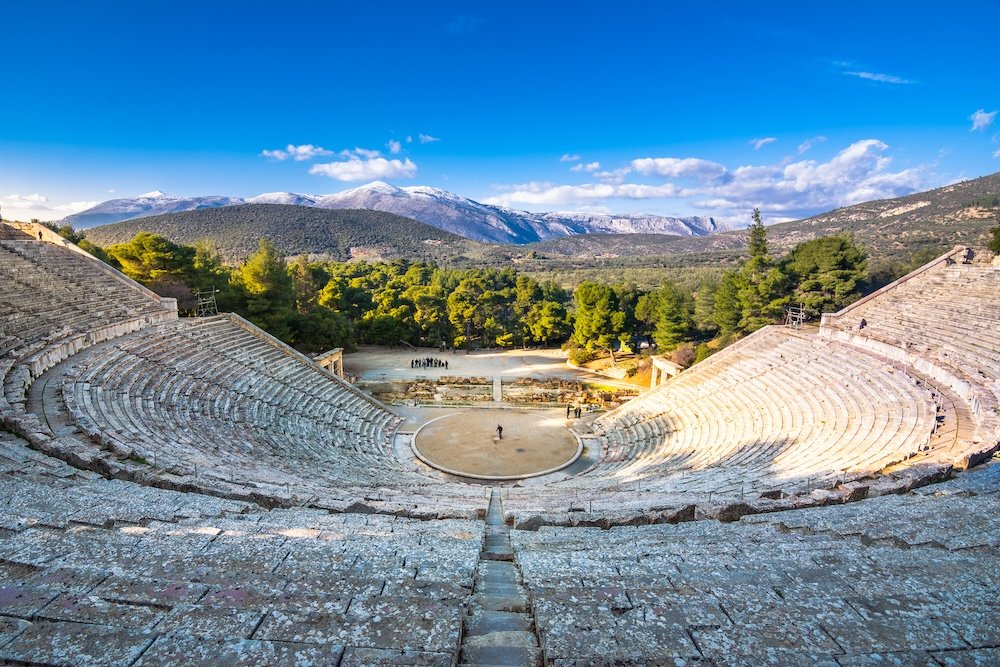
Spend a morning among ruins built to outlast empires, then come back to a town that has outlasted three of them, and Nafplio starts to look less like a pretty stop on the way to somewhere and more like the somewhere.
Greece made Athens the capital in 1834 and never looked back. Nafplio, meanwhile, seems entirely content with how things worked out. Athens got the ministries, the traffic, and the responsibility. Nafplio kept the view.