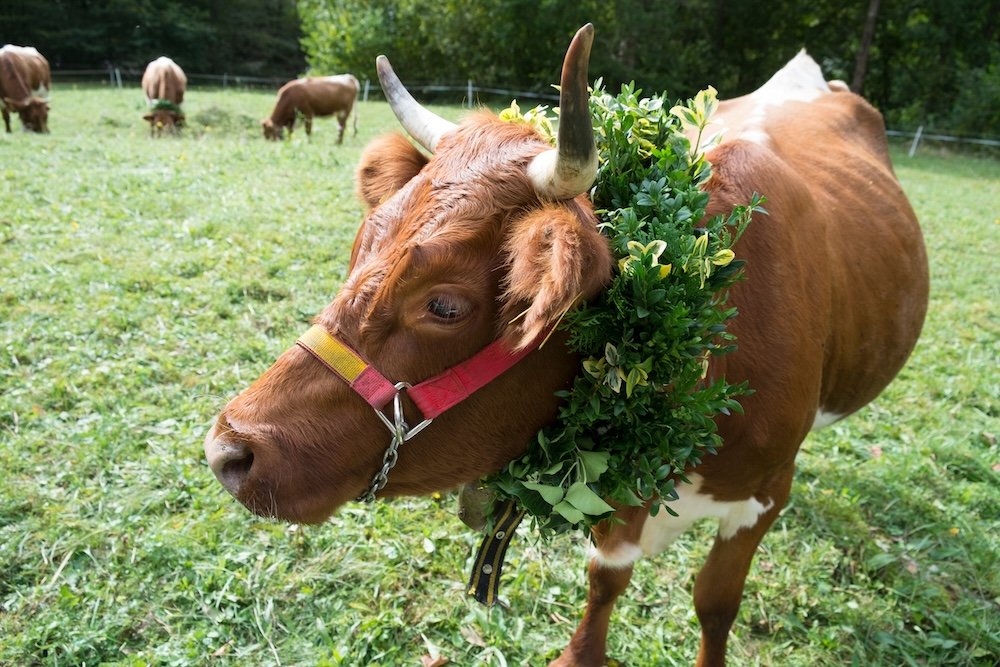
On the third Sunday of September, the meadow at Ukanc fills with the sound of cowbells arriving before the cows do. Then the herders come down from the high pastures, shoulders loaded with the basenga, the whole kit of tools and utensils that made cheese possible above the tree line all summer. The cattle wear flower crowns. The brass band plays through it. Somewhere behind all of this, Lake Bohinj lies perfectly still.
The Cows’ Ball, or Kravji bal, has closed Bohinj’s summer since the 1950s, and it says a great deal about the place. Half an hour up the road from Lake Bled, a lake that learned early how to be photographed, Bohinj has spent its history doing something more practical: grazing, smelting, climbing, and making cheese. Tourism came later, and it had to fit around the cows.
Cow decorated with garland. Bohinj cow ball and festival. Celebrating the return of cattle from high pastures where they graze in summer.
Why Bohinj, and Why Now
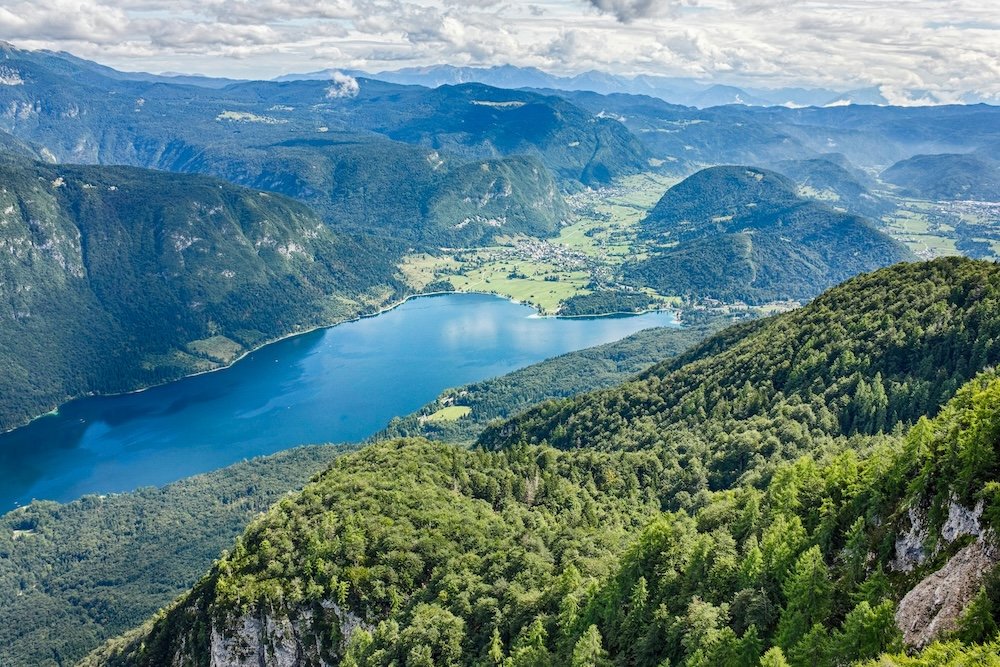
Few North Americans have been to the Bohinj region, and it is a great destination for those wishing to avoid overtourism. The lake runs about 2.7 miles long and a little over half a mile wide, sitting at roughly 1,726 feet above sea level inside Triglav National Park, the country’s only national park. It is glacial, clear, and deep, reaching 148 feet at its lowest point, and motorboats are not allowed. What moves across the water is mostly kayaks, paddleboards, rowboats, and the panoramic tour boat, so the loudest sound on a summer morning is often a swimmer discovering the water is colder than advertised. In high summer, the surface warms to around 75 degrees Fahrenheit, and in hard winters it often freezes.
What stands out, arriving from Bled, is its natural simplicity. No island church, no castle on a cliff; just a handful of villages, limestone walls on three sides, and a valley that still reads as agricultural. For travelers who want the Julian Alps without the tour-bus choreography, here it is.
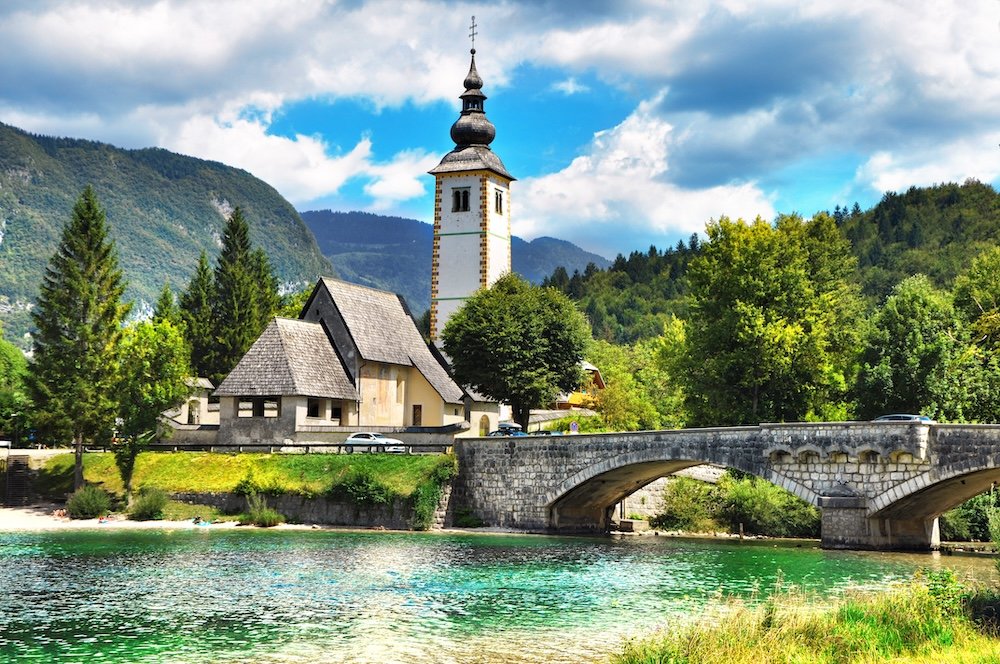
Bohinj Lake, Church of St John the Baptist
The postcard view sits at the lake’s eastern end in Ribčev Laz, where the Church of St. John the Baptist stands beside a stone bridge over the outflowing river. Built before 1300, it is layered with frescoes, including three versions of St. Christopher painted one over another on the south wall. Locals believed that anyone who looked at St. Christopher would not die that day, which made him the most practical saint in the valley. Inside, look for the pair of rare white devils. The better story concerns a 14th-century carved wooden head of John the Baptist. Bohinj is famously wet, and when prayers for dry weather failed, parishioners reportedly carried the head out onto the bridge, on the reasoning that once the saint got soaked himself, he would surely ask for the rain to stop.
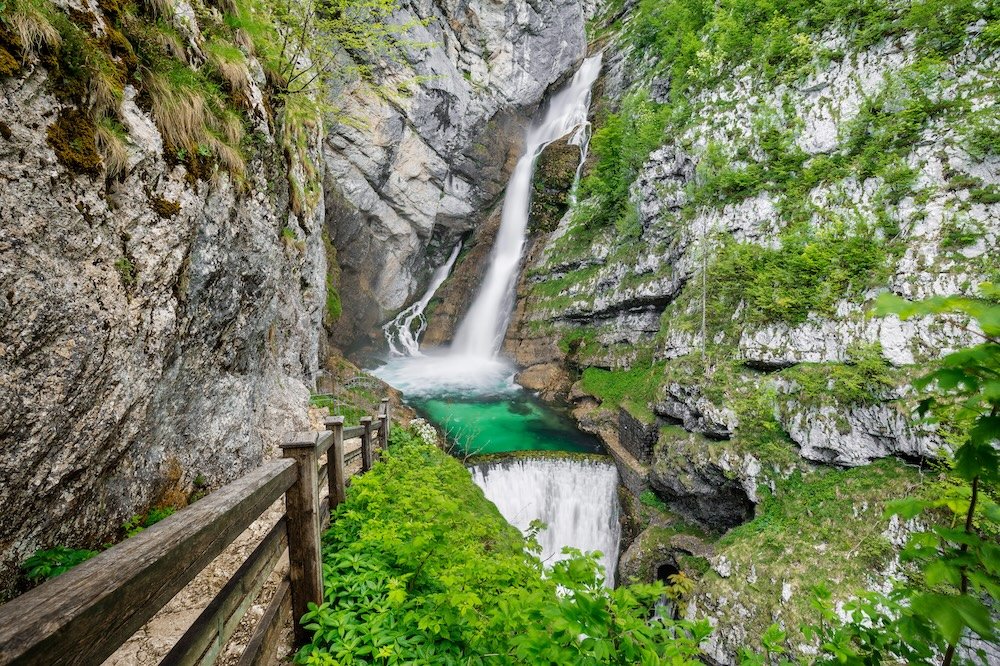
At the opposite, western end of the lake, the Savica Waterfall drops 256 feet into a green pool below the cliffs of Komarča. Reaching it, and joining one of the country’s most visited attractions, involves 553 stone steps through the forest, about 20 to 30 minutes each way. A small entry fee applies. France Prešeren, Slovenia’s national poet, set his epic poem “The Baptism on the Savica” here, and its waters feed the Sava, the country’s longest river.
Savica waterfall at Lake Bohin
North of the lake, above the village of Stara Fužina, the Mostnica Gorge runs for about 1.2 miles, with the river cutting as deep as 65 feet into the limestone. Its signature feature is the Little Elephant, a hollow in the rock that the water has shaped into something that looks, from the right angle, very much like an elephant drinking from the stream. Beyond it lies the Voje Valley, with a mountain hut serving home cooking and a 69-foot waterfall at the far end.
For the view from above, the Vogel cable car lifts passengers from near Ukanc to a station at about 5,036 feet, more than 3,000 feet over the water, with Triglav National Park filling the horizon across the valley.
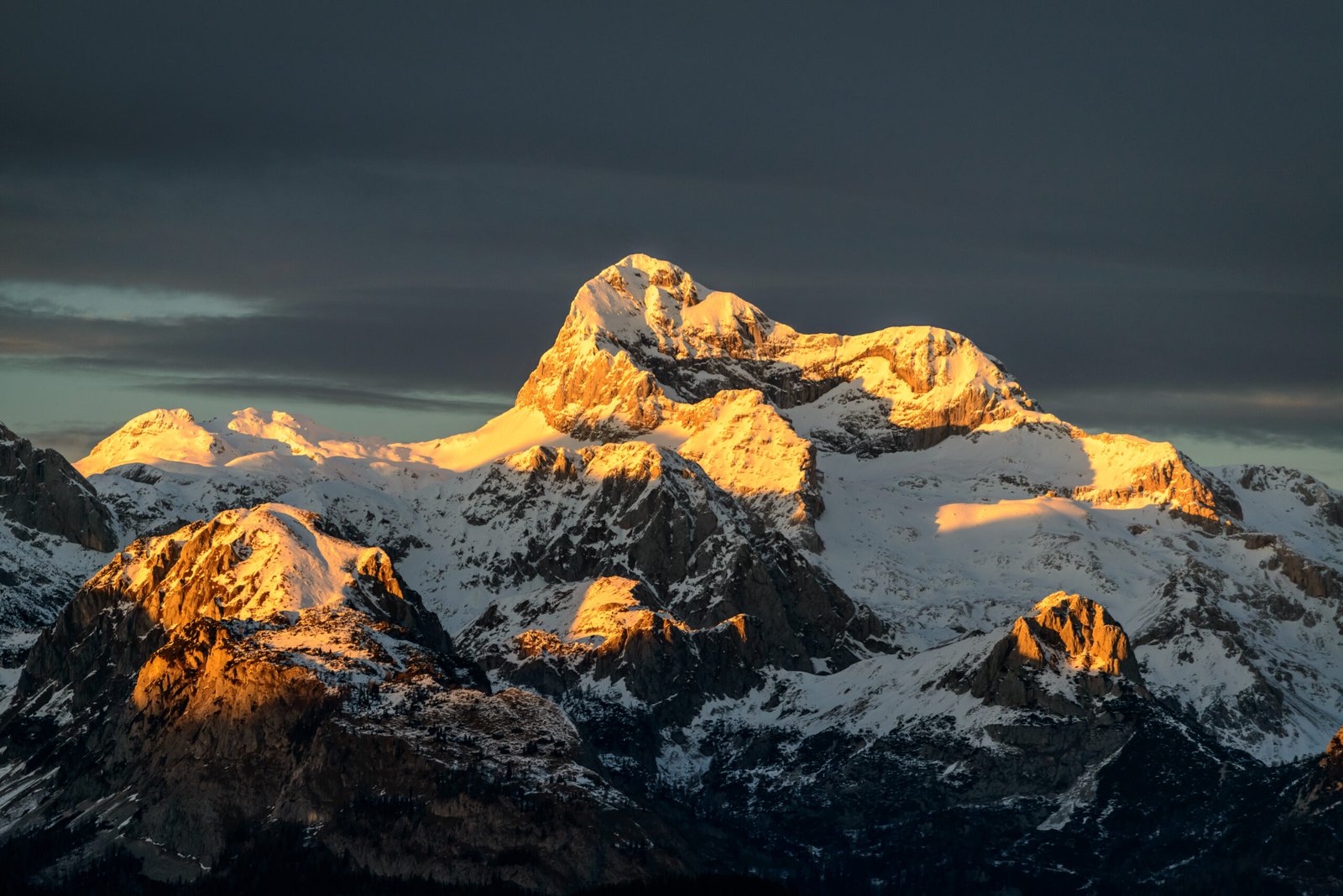
Triglav National Park
A Valley Built on Iron, Cheese, and Nerve
Bohinj’s history is written more in its industries than in its rulers. Herders have worked these pastures since the 13th century, and the village name Stara Fužina roughly means “old ironworks.” By the late 18th century, Baron Žiga Zois, an Enlightenment patron with commercial instincts and a scientist’s curiosity, owned the ironworks. In 1777, he built the single-arch stone bridge over the Mostnica Gorge to move ore and charcoal to his smelters. Local legend credits the Devil with the construction instead, which is perhaps the most ambiguous compliment a stonemason has ever received.
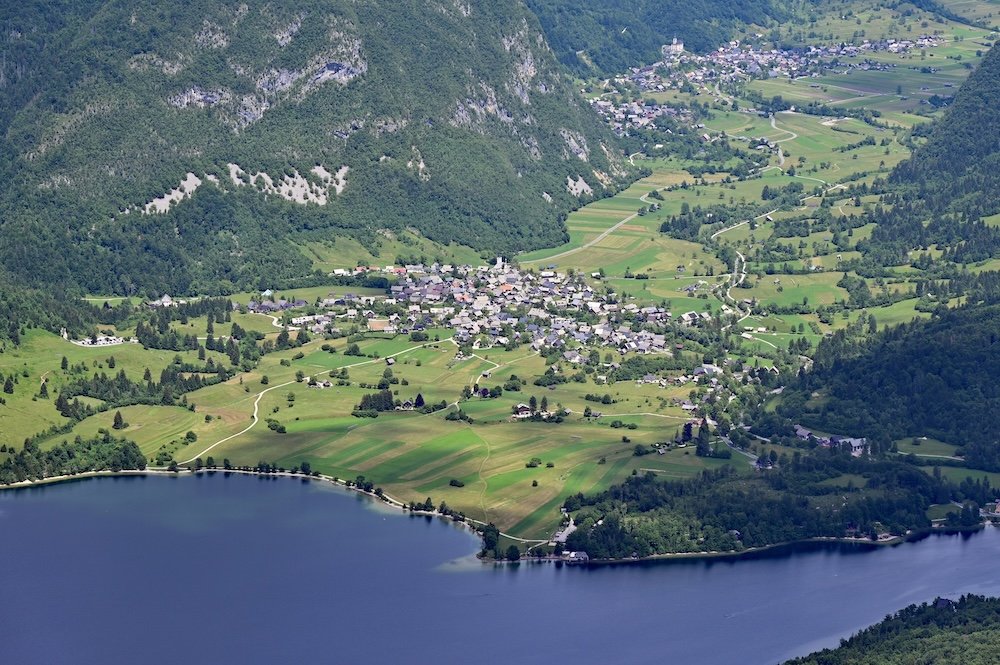
Lake Bohinj and villages of Stara Fuzina and Studor v Bohinju on east side of lake in Triglav National Park
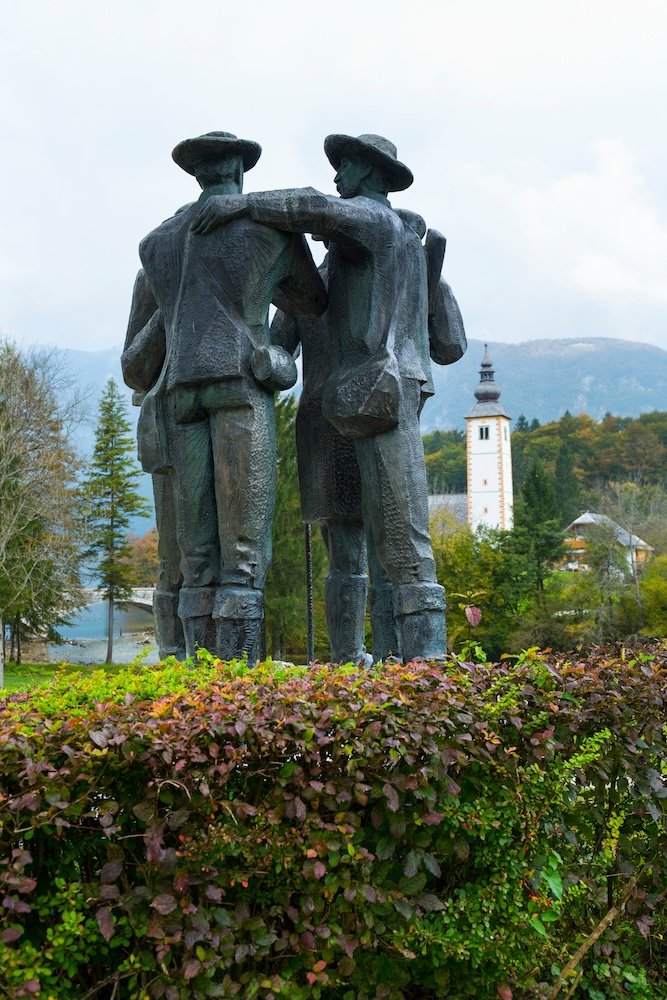
A year later, Zois turned his attention upward. Encouraged by his backing, four Bohinj men, the surgeon Lovrenc Willomitzer, the hunter Štefan Rožič, and the miners Luka Korošec and Matevž Kos, reached the summit of Triglav on August 26, 1778, the first recorded ascent of the 9,396-foot peak. Historians have long debated whether all four actually made the top. When the national mountaineering association commissioned a bronze monument for the bicentennial in 1978, it chose to depict every one of them, apparently on the principle that more first ascents are better than fewer. The four men still stand in a small park at Ribčev Laz, “Monument to Four Courageous Men,” with one pointing toward the mountain.
“Monument to Four Courageous Men”
What People Do There
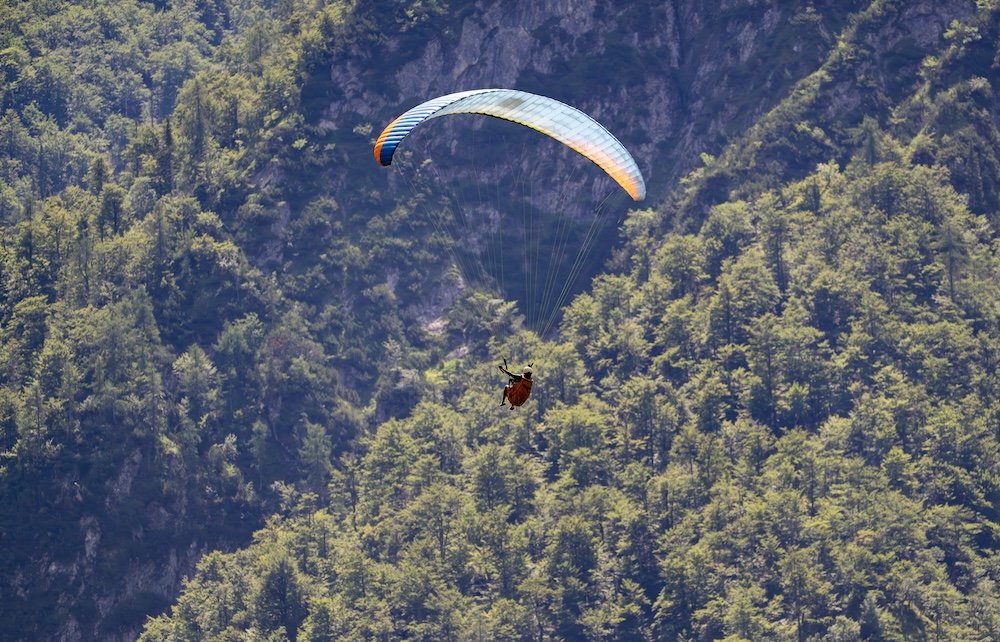
Most visitors start with the lake itself. The north-shore path from Ribčev Laz to Ukanc takes about an hour, and a popular rhythm is to walk one way and ride the boat back. Swimming, stand-up paddling, and kayaking fill summer afternoons, and cycling is permitted on the west, south, and east shores. Parasailing is also a favorite activity.
Paraglider descending over the landscape of Lake Bohinj and Triglav National Park
Serious hikers use Bohinj as a base for Triglav and the Triglav Lakes Valley; gentler walkers take the gorge, the waterfall steps, and the high summer pastures. In winter, Vogel becomes a ski area with natural snow and some of the country’s best slope views.
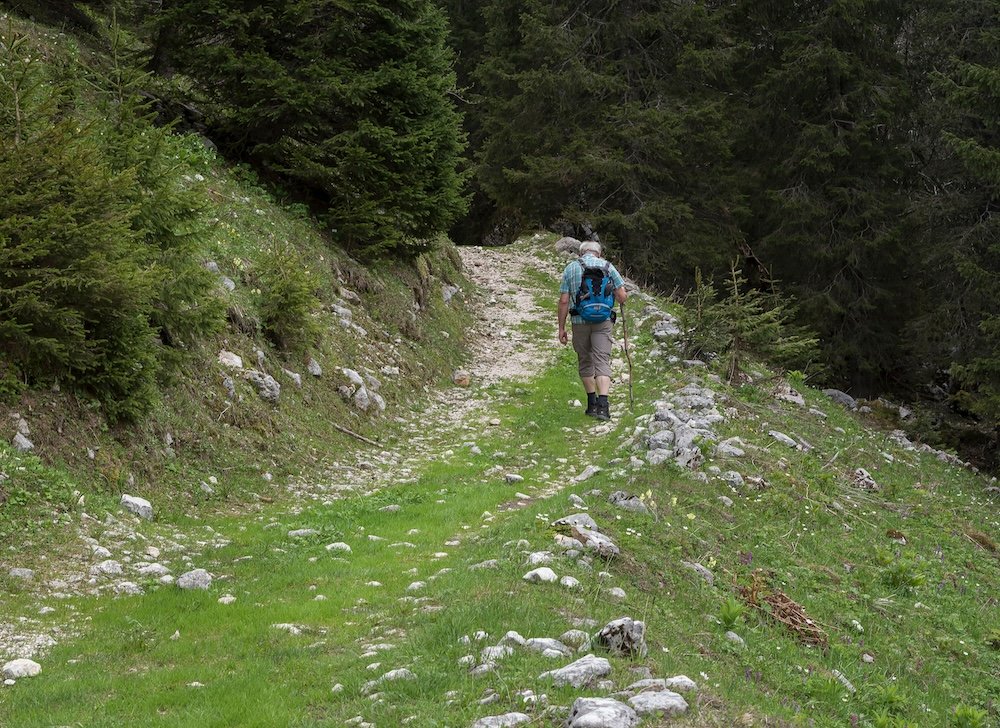
Hiking in Triglav National Park
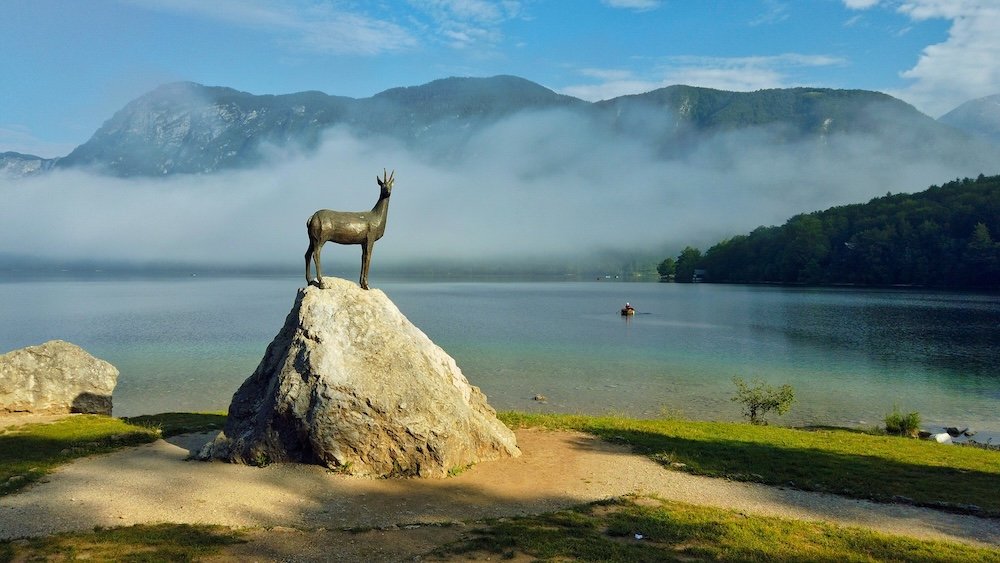
The valley’s folklore belongs to Zlatorog, the white chamois with golden horns who guarded a treasure beneath Mount Bogatin. In the legend, a lovesick hunter shoots him, Triglav roses spring from the blood, and the healed, furious chamois tears up his mountain garden and leaves forever. A bronze Zlatorog stands at the lake, and his name appears on everything from hotels to Slovenia’s favorite beer.
Zlatorog, the white chamois with golden horns who guarded a treasure beneath Mount Bogatin
The Zlatorog Fairy Trail is a great fit for families with young children. This looping path turns a walk in nature into a playful chance to learn. The park provides two simple rules for the trail, and they’re worth following everywhere else too. Participants are admonished to:
“Love nature and protect it!”
The trail in Ukanc brings characters from local fairy tales to life, each one at its own stop. The official Zlatorog Fairy Trail has seven of these stops. An eighth is in the car park at the crossroads for Ukanc, Vogel and the Savica Waterfall, and a ninth is at the entrance to the Savica Waterfall. Every tale in the brochure accompanying visitors comes from the Bohinj area and has been retold from the original texts. The activities along the way invite children to use seven senses: sight, hearing, smell, taste, touch, balance, and kinaesthetics, the sense of the body’s own movement. Each stop focuses on one sense, though visitors are free to use the others too. Legend says the healing yellow flowers described on the signboards grew from dust that fell from Zlatorog’s horns, and they bloom here in abundance. Along with the valley’s other natural beauty, they make up Zlatorog’s treasure.
The Culture of the Valley
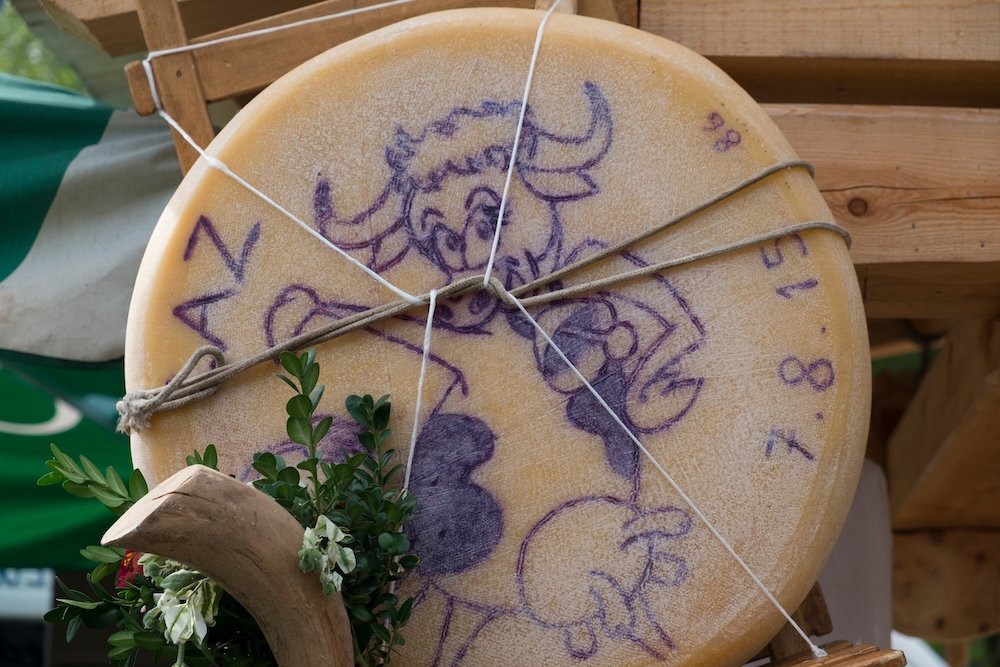
Bohinj’s culture is dairy culture, and it tastes like it. The Alpine Dairy Museum in Stara Fužina occupies a village cheese dairy built in 1883 that was still making cheese as late as 1967. Inside are the original copper kettles and a herdsman’s hut from the Zajamniki pasture, dating to 1849. The local specialty worth seeking out is Mohant, a pungent, spreadable cheese with European protected status. It smells like it before the plate arrives, and locals regard it with the affection other regions reserve for fine wine.
Cheese is produced in all Bohinj Alpine pastures and in the dairies in Bohinj valleys.
Day Trips from Bohinj
Lake Bled is about 18 miles away, roughly half an hour by car or a direct bus, and makes an easy morning of island views and cream cake. Ljubljana, about 52 miles off, earns a full day in its riverside old town. The most memorable excursion, though, is the car train. From Bohinjska Bistrica, the motorail follows the Bohinj Railway, opened by Austria-Hungary in 1906, through a tunnel of nearly four miles, the longest in Slovenia, to Most na Soči, delivering cars and passengers to the emerald Soča Valley in under an hour, with the Tolmin Gorges and Kobarid’s World War I history within reach. Closer to home, the Pokljuka plateau offers forest trails, alpine pastures, and a quieter angle on Triglav.
When to Go
High season means July and August. Afternoon highs sit in the mid-70s Fahrenheit, the lake is at its warmest, and the crowds are, too. Lakeside parking is paid by the hour with time limits, so the smart move is to park in Bohinjska Bistrica, about four miles east, and ride the seasonal shuttles to the villages, trailheads, and waterfall.
Shoulder season is the sweet spot, in two versions. Late May into early June brings the International Wildflower Festival, which in 2026 ran from May 22 to June 7, with guided botanical walks and floral menus in a valley home to more than 40 native orchid species. September and early October bring the first turn of the larches, emptier trails, the Cows’ Ball, and water still warm enough for the brave. Autumn is also the wettest stretch of the year, so pack for rain and let John the Baptist take care of the rest.
Low season, November through April, suits travelers who like their lakes quiet and their fires lit. Midwinter highs hover in the upper 30s, the lake often freezes, mountain huts close, and skiing takes over at Vogel.
Back at Ukanc, when the last of the cows have gone home, and the brass band has packed its instruments, the meadow goes quiet, and the lake does what it has always done. It stays still, reflects the mountains, and waits for next September.