The bus crunches to a halt. Up ahead, a blond grizzly is working soapberry bushes on the tundra above the road. The female driver, who has clearly done this many times before, turns off the engine and murmurs into the microphone something barely louder than “there he is.” Forty pairs of hands grip forty cameras. The bear doesn’t look up. He has no reason to. He’s about three hundred yards away on the other side of a river braid and doing what a grizzly does in August, which is to eat everything he can get his teeth on before the eating season is over, and the bus and its passengers are to him merely a mildly interesting sound that has ceased making sound.
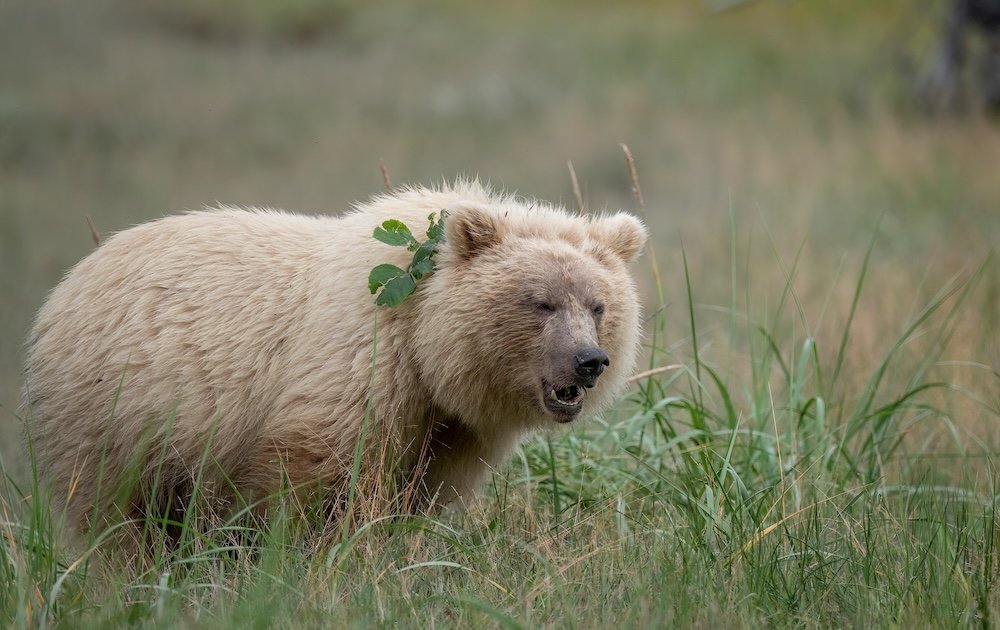
Blonde Two-Year-Old Cub
This isn’t a place where animals perform. There aren’t watering holes set up for a sunset shot, no fences, no feeding stations. Just one mostly gravel road that a private car can drive for fifteen miles before the National Park Service asks you to park it and get on a bus instead, and beyond that, six million acres of subarctic wilderness that has never particularly needed an audience.
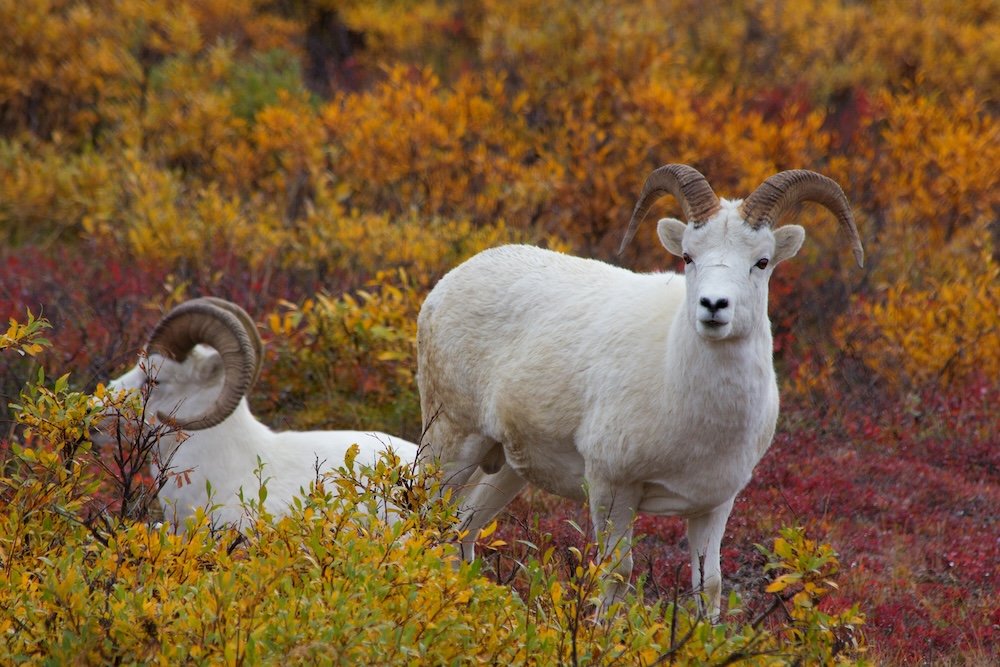
Dall sheep in autumn in Denali National Park
Denali became a national park in 1917 mostly because a Yale-educated engineer named Charles Sheldon quit business at 36 and spent two years camping in the area, studying Dall sheep that poachers were shooting by the hundreds to feed mining camps during the gold rush. Sheldon wanted the park named Denali, the Koyukon Athabascan name for the mountain, meaning something like “the tall one” or “the high one.” He didn’t win that argument and had to settle for Mount McKinley National Park, submitted by a prospector who admired a presidential candidate he had never met. The park itself was renamed Denali in 1980 and the mountain in 2015, only for a 2025 federal decree to change the peak’s official name back to McKinley while leaving the park’s name alone. Locals mostly kept calling it what they had always called it.
The Landscape
What Sheldon was trying to protect becomes clearer when you’re standing in it. Denali’s landscape starts with low taiga forest near the entrance thick with black spruce and willow, moves through windy open tundra, and ends up in the Alaska Range itself where the mountain formerly, and occasionally still, called McKinley jags to a peak at 20,310 feet, the tallest mountain in North America by base-to-summit height rather than sea level, the statistic Alaskans deploy when they want to make a point about Everest. Less than a third of summer visitors see the whole mountain during their visit. It makes its own weather, blanketing itself in cloud by day, and rangers have learned to expect a question first gently and then less gently about when it’s going to come out. It comes out when it feels like coming out, usually early in the morning or late in the evening when the light is low enough to flatter it.
The park road itself is a different story than the one it’s usually taken to be telling. A slow-motion landslide at a place called Pretty Rocks, where a rock glacier has been thawing since the 1960s under warming permafrost and has accelerated steadily since 2014, punched a hole in the roadbed at mile 45 and forced a complete shutdown of the western half of the park in 2021. A bridge built to span the unstable ground has been under construction since 2023, and as of this summer, buses still pull back to mile 43, the East Fork River crossing. Eielson Visitor Center, Wonder Lake, and the old mining settlement of Kantishna, all deep in the park’s most dramatic terrain, remain off-limits for another year. Buses to Kantishna aren’t expected back to their full pre-collapse schedule until 2027. It’s a genuine loss to those of you hoping to see Wonder Lake’s glassy view of the mountain, and also, if you’re the sort of person who wants to look at it the way a geologist would, a fairly effective way of conveying what “the ground here is not as permanent as it looks” means in practice.
The Big Five
Alaska’s tourism industry borrowed the phrase “The Big Five” from African safari destinations decades ago: five big mammals, none of them baited or collared for your convenience, all viewable from a road that hasn’t been fundamentally rerouted since the 1930s.
Grizzly bear in Denali National Park feeding in a red-leaved patch of blueberries.
Grizzly bears are the animal visitors came to see, and Denali’s are a true subpopulation, smaller on average than their coastal brethren because there’s no salmon run this far from the ocean. Their diet leans heavily toward roots and berries, plus the occasional ground squirrel dug up with a set of claws designed for the job. Grizzly brown bears are a North American subspecies of the brown bear (Ursus arctos horribilis) recognizable by a muscular shoulder hump and long claws. Adult male inland grizzlies can weigh upwards of 800 to 1,000 pounds. They are omnivorous and eat berries, grasses, roots, nuts, insects, and, when available, large mammals and fish. Brown bears spend the winter hibernating in dens to avoid the cold weather and lack of abundant food sources. They are most reliably viewed on the open tundra between Igloo Canyon and Sable Pass, working hillsides in long, slow traverses that make sense once you realize a bear here has to cover a lot of ground to get enough calories to see him through a denning season that eats more than half the year.
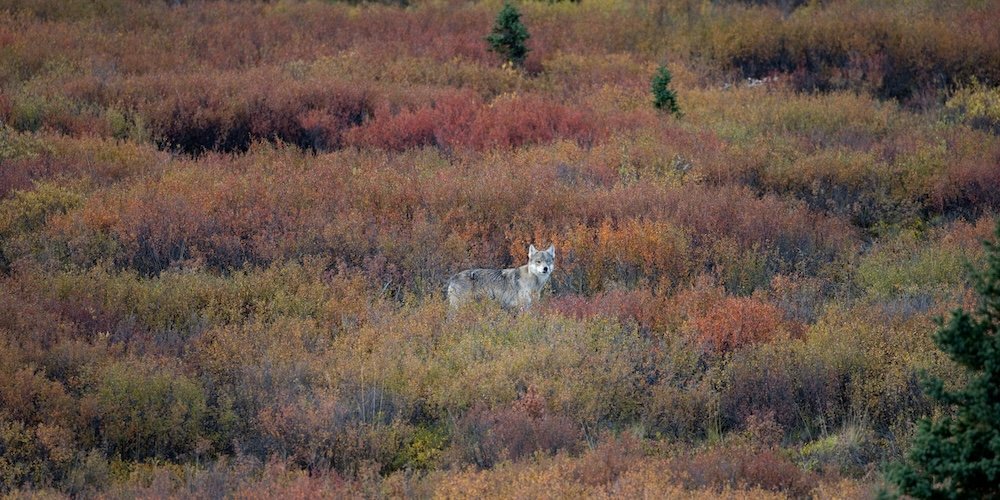
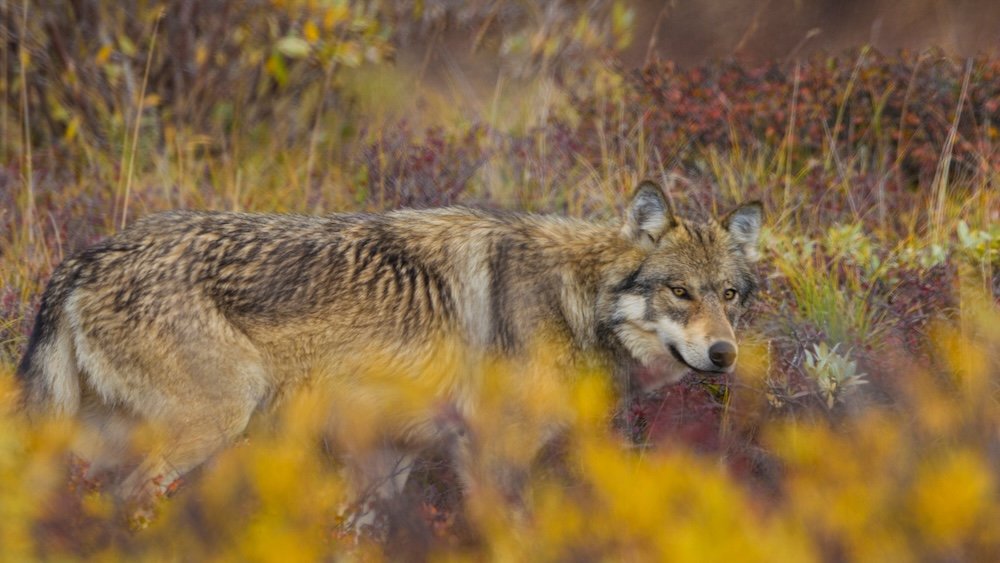
Gray wolves are the animals that fewer visitors see and that everybody asks about. The gray wolf (Canis lupus) is the largest wild member of the dog family (Canidae) and an apex predator native to Eurasia and North America. Adult males typically weigh 65 to 175 pounds, while females weigh 50 to 120 pounds. They are generally 5 to 6.9 feet from nose to tail tip. They possess a narrow chest, powerful long legs, and large paws designed for long-distance running and traversing deep snow. Wolves are highly social and live in extended family groups (packs) most often consisting of 4 to 9 individuals. Their primary diet consists of large hooved mammals such as elk, moose, deer, caribou, and bison, supplemented by smaller mammals such as rabbits and mice.
Gray Wolf (Canis lupus) standing in fall colored tundra
Adolph Murie’s wolf studies around Denali, begun in 1939, were among the first serious scientific arguments that predators were not simply vermin to be wiped off a landscape, and Denali’s wolf packs have been followed in one form or another ever since. They move quickly and hunt mostly at dawn and dusk and prefer river bars and creek beds to open slopes, which means a sighting is usually a gray blur crossing gravel at a distance and disappearing before you’ve finished the sentence “wolf, ten o’clock.” Consider it a bonus.
Caribou bull in front of Mount Denali
According to the US Park Service, caribou and Eurasian reindeer are the same species (Rangifer tarandus). People in North America generally call wild populations “caribou,” while domesticated or Eurasian ones are called “reindeer.” Their large, wide hooves act like snowshoes, preventing them from sinking into deep snow. The range of the Denali Caribou Herd remains almost exclusively within the boundaries of Denali National Park and Preserve. In the Alaskan spring, females migrate to areas known as “calving grounds,” where they give birth in relative safety. Calves are born brown and lack spots. Mature caribou stand approximately four feet tall at the shoulder, are eight feet in length, and typically weigh from 130 to over 350 pounds.
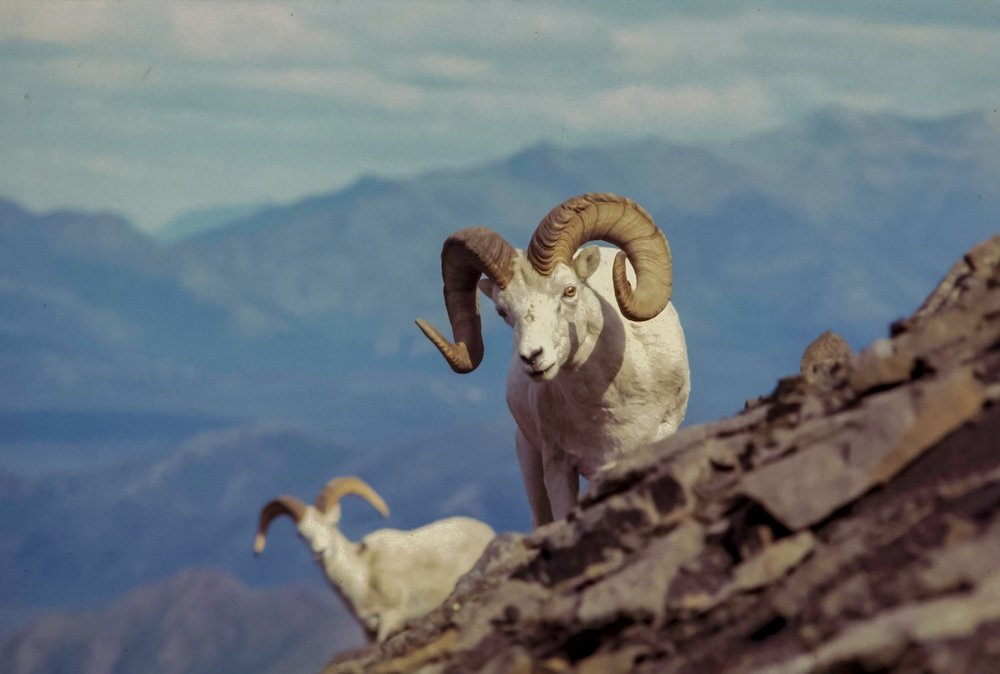
Dall Rams On Sable Mountain
Dall sheep (Ovis dalli) are the animal that started all of this, the reason Sheldon came north in the first place, and they stick to the kind of terrain that makes them difficult to poach and difficult to get close to: steep, rocky hillsides well above the road, particularly through Igloo Canyon, from which you’ll often spot them before you quite believe an animal that white can stand on ground that vertical. They are off-white with hollow guard hairs and thick winter coats. Rams weigh 160 to 180 pounds, while ewes weigh 100 to 110 pounds. They eat grasses, sedges, lichen, moss, and other plants. Their predators include wolves, coyotes, golden eagles, wolverines, and brown bears.
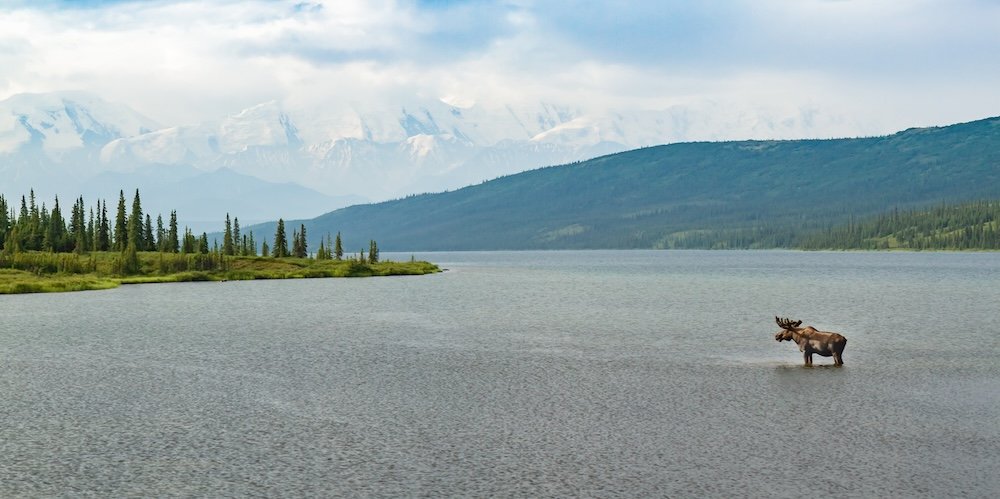
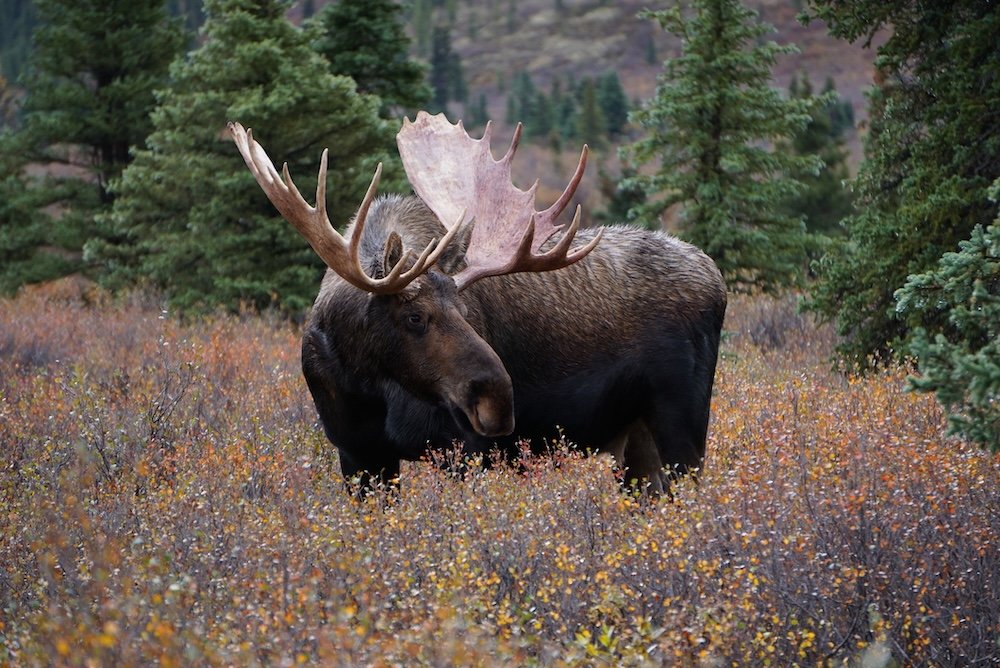
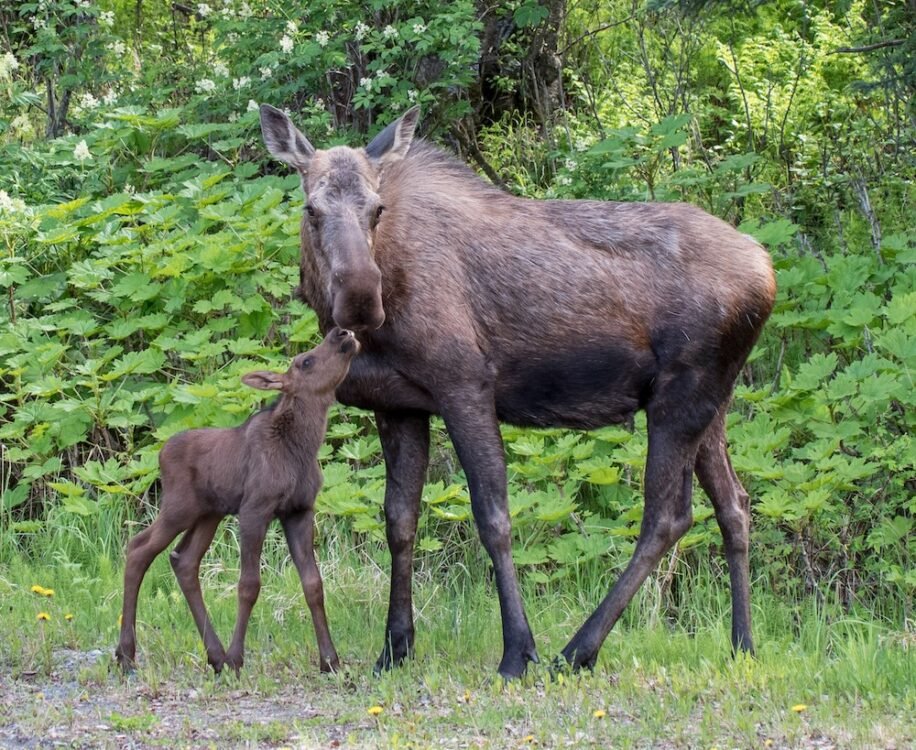
Moose (Alces alces) are the animals that people underestimate until they don’t. They like the willow thickets and boggy forest near the park entrance, which means you’re statistically more likely to see one in the first fifteen miles, before the private vehicle restriction even takes effect, than anywhere else in the park. A bull can weigh 1,600 pounds and moves slowly until it doesn’t. Cows with calves and bulls in fall rut are, for different reasons, animals you give a wide berth to and do so unhurriedly.
Staying Safe
Denali’s safety guidelines are about distance, and the distances are not recommendations. Maintain a distance of at least 300 yards from bears, about three football fields, and 25 yards from everything else, wolves, moose, caribou, sheep alike. If a bear hasn’t seen you, the goal is to remain unseen and back out quietly. If the bear has seen you, stay put, and speak in a calm voice.
Running, the one option that never, ever, has a good outcome, is the one thing that will make things worse because it can put you into a chase mode with an animal that can outrun you without much effort. Bear spray, carried where you can get it in under two seconds without burying it in a pack, is the recommendation for backcountry travel.
On ?a statewide basis, moose injure humans more often than bears do in an average year, primarily because they appear so benign. When a moose lays its ears back or raises the hair on its hump, it is issuing a warning that most humans fail to notice until it is too late. They must flee (as opposed to a bear, for which you’re not supposed to run away from) ideally behind some solid object: a boulder, a treeline, a moving vehicle.
Alaskan Grey Wolf in Denali National Park
By design, Denali has no marked trails beyond the immediate vicinity of the park entrance. The intent is to avoid social trail erosion as you see in more heavily visited parks, which means route finding, map reading, and river-crossing skills are all on you. Glacial rivers run around 36 degrees Fahrenheit, cold enough that a fall into them can quickly become a hypothermia emergency. Conventional wisdom is to cross braid sections (the shallow bits) rather than a single deep channel, keep boots on for traction, and cross early in the day before glacial runoff raises the level too high. Weather changes fast enough at this latitude and elevation, in any season, that layers, an actual rain shell, and the flexibility to turn around are not optional accessories.
Photographing It
The single best piece of gear advice that you will hear from anybody during your entire visit will be to bring more lenses than you think you need, as both the 300-yard bear rule and the 25-yard rule for everything else will apply to photographers with perfect accuracy. A 400 mm or 600mm lens turns a safely distanced grizzly into something photograph-worthy. This is where your higher-end digital camera comes in. A phone camera mostly turns the same animal into a brown smudge on a green hillside. Most amateur wildlife photography around Denali happens from inside the bus, through an open window, since the buses themselves act as a sort of walking blind that wildlife has stopped bothering with after decades of habituation.
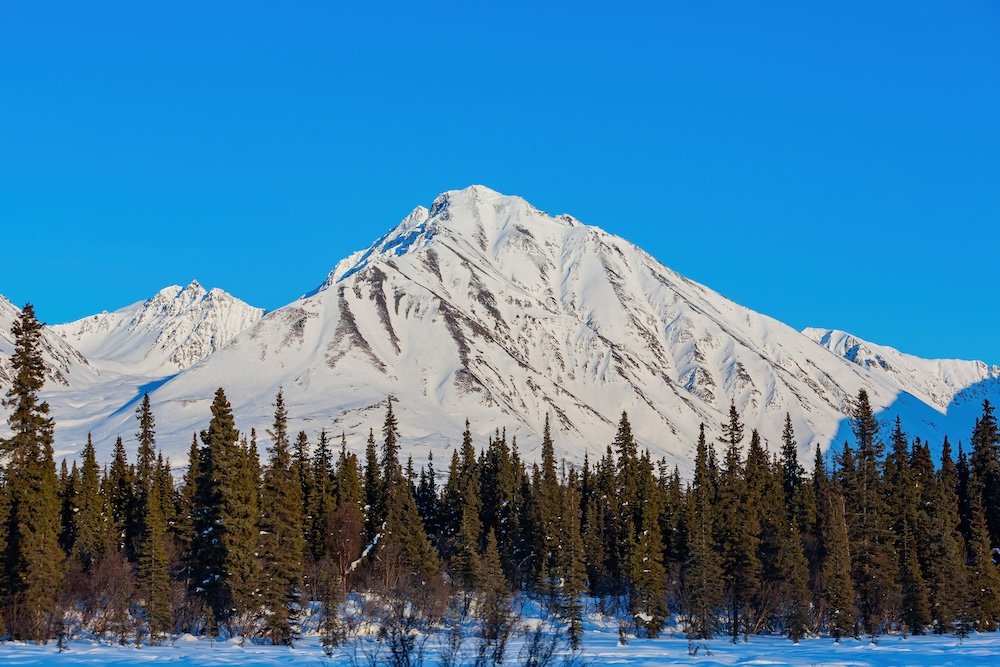
Mount Denali
The mountain, though, is a patience game. The best light is early morning or late afternoon, when the sun is lower in the sky, and the cloud that is so frequently present has time to burn off or hasn’t yet formed, and the clearest views and best color result. In mid-August, you get to see the caribou and moose at full antler, and the bears in thick pre-denning coats, and mid-June through mid-July is peak wildflower season on the lower stretches of the road.
Getting Around
The road math is easy once you understand the philosophy behind it: private cars are allowed to mile 15, Savage River, and no further, a limit that the park established in 1972 (the year a new highway connection to Anchorage and Fairbanks nearly doubled park visitation and rangers began noticing wildlife beginning to avoid the road again). Beyond that, it’s a bus, one of three types. Green transit buses are un-narrated and fluid, good for hikers who want to get off, hike, and flag another bus down later that is heading the same direction. Tan tour buses are narrated and official, driven by a guide who won’t stop for your impromptu hike but will provide commentary on what you can see. Camper buses are stripped of some seats to make room for backpacks, for people with camping or backcountry permits.
This season, all three turn around at mile 43, the East Fork crossing, rather than heading on to Eielson and beyond, an unavoidable result of the Pretty Rocks bridge project. A round trip to that turnaround takes about four and a half hours; tickets are booked through the park concessioner well in advance during park summer weeks, and the $15 admission fee (good for seven days) is in addition to the bus fare. Nothing here moves fast, and that turns out to be the point. A road intended to be driven at 25 miles an hour, past a bear that has no reason to look up, is not a road intended to get you somewhere. It is a road meant to make you notice where you already are.
That grizzly on the soapberry slope was still there when the bus finally pulled away, unmolested, unwatched now by anybody but the mountain, which, for once, that particular evening, had decided to come out.