


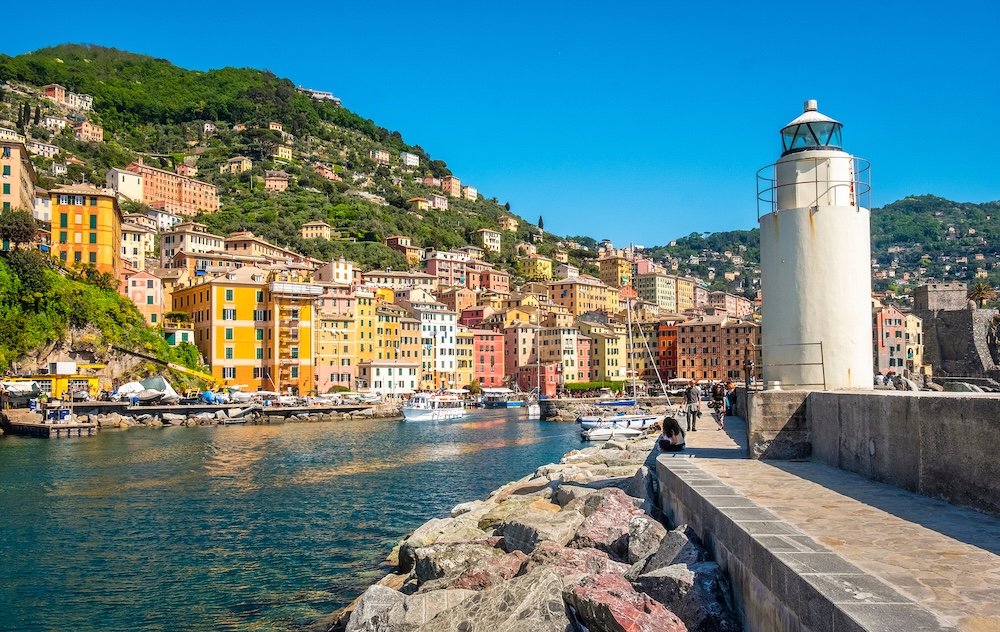
On a weekday morning, the seafront in Camogli smells of warm olive oil from the bakery ovens on Via Garibaldi. The houses by the water rise to about six stories and are painted ochre, rose, and lemon, with green shutters left open to the light. From a higher floor, a woman leans out and shakes a tablecloth over the street. The window next to hers also has half-open shutters, and a neat shadow falls under the sill; nobody will ever lean out from it.
A man wearing rubber boots is carrying a coil of net towards the harbor.
Why Camogli
Camogli is a fishing town on the Italian Riviera, about half an hour by regional train east of Genoa and on the western side of the Portofino promontory. While Portofino attracts yachts and gets most of the media attention, Camogli has fishing boats, serves focaccia, and holds most of the Portofino Regional Park, a protected headland of oak woods, cliff paths, and remnants of wartime gun emplacements that ends suddenly in the sea.
Camogli is almost painfully beautiful. It has a working harbor, a train station close to the beach, festivals, and year-round boats that run to one of the coast’s most remarkable medieval sites, making it a convenient base for visiting Portofino, Genoa, and the trails.
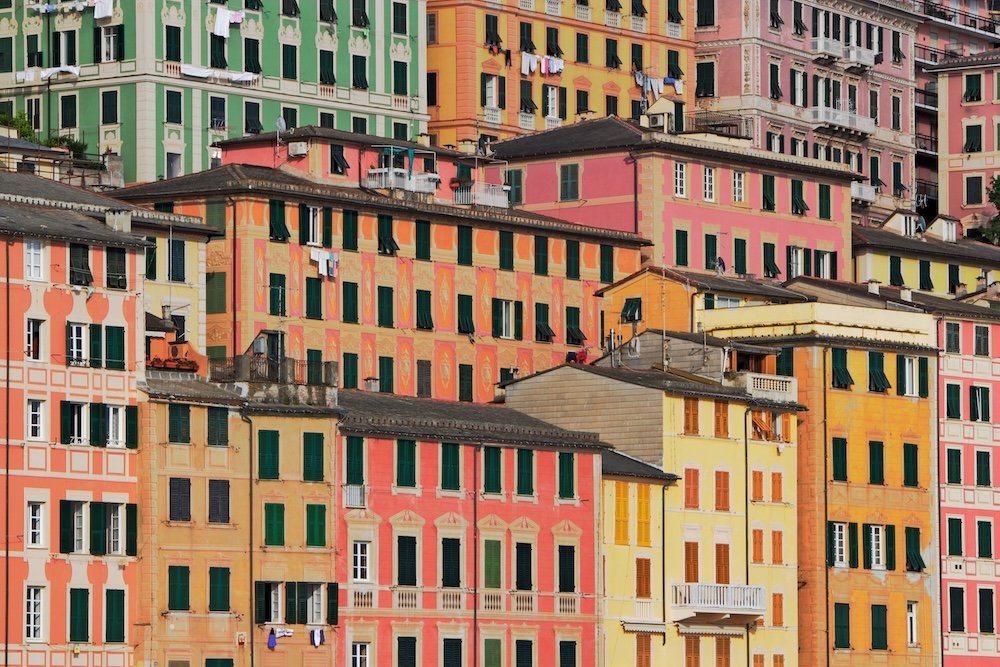
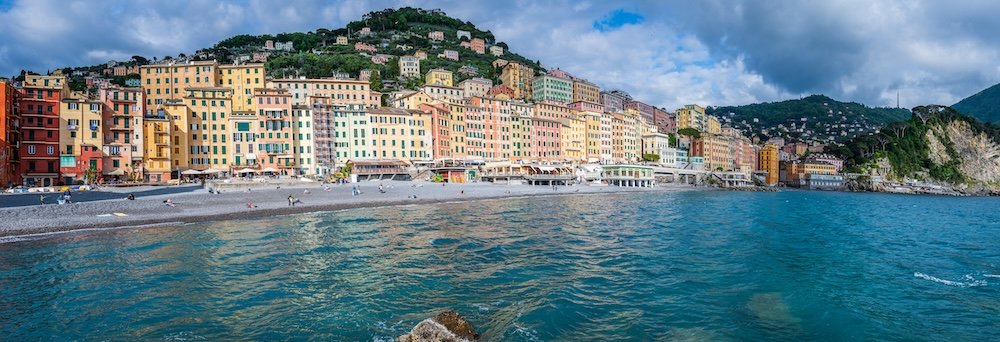
Your first impression of Camogli might be, probably will be, one of height. Unlike fishing cottages that generally sit low, the houses along the seafront rise to six stories or more, shoulder to shoulder, in a long wall of ochre, rose, lemon, and brick red, so the town looks less like a village and more like a single painted cliff. The second surprise appears up close. Many balconies, window frames, cornices, and half-open green shutters are painted onto flat plaster, following the Ligurian “trompe l’oeil tradition”. The painted features blend so closely with the real windows that a visitor can spend several minutes trying to work out which are real and still get some wrong.
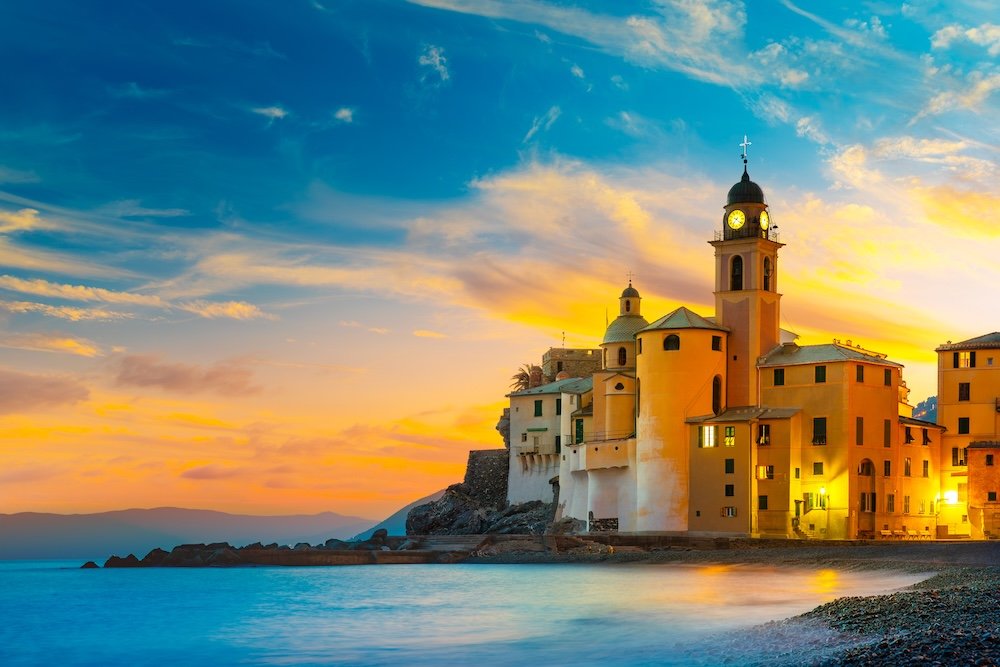
At the far end of the beach, the old Isola blocks off the harbor. There, the plain, pale facade of the Basilica of Santa Maria Assunta and the short tower of the Dragonara fortress stand against the open water, and the church’s unremarkable exterior gives no hint of the gilded, chandeliered interior behind its doors. Below, wooden boats crowd the small harbor, and fishing nets pile up on the quay. Because the town faces west across the Golfo Paradiso, the late afternoon light comes in at a low angle and is warm, deepening the facades’ original colors. This, in turn, makes the painted windows even more difficult to distinguish from the real ones.
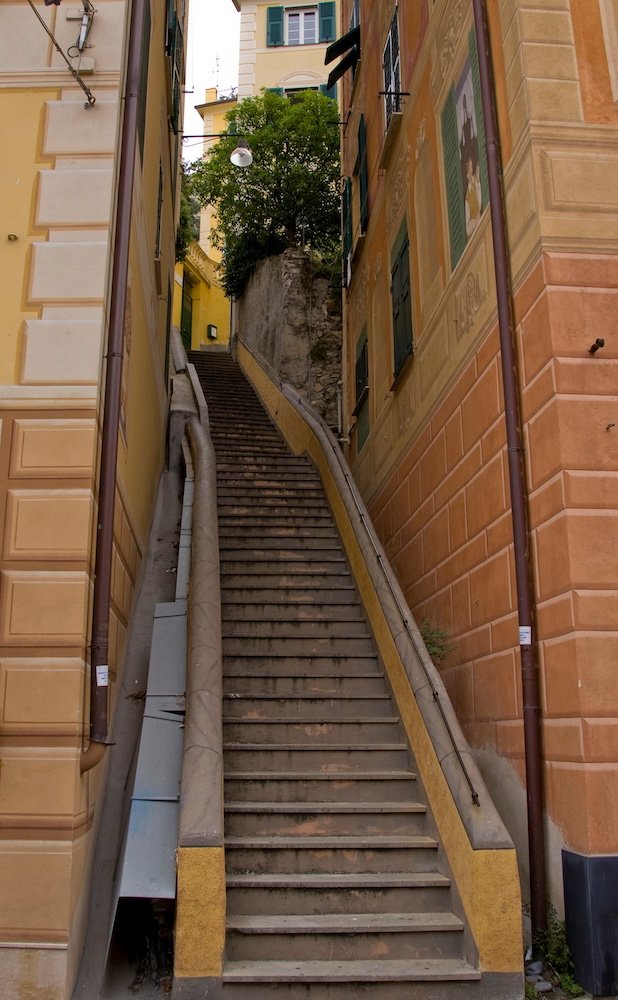
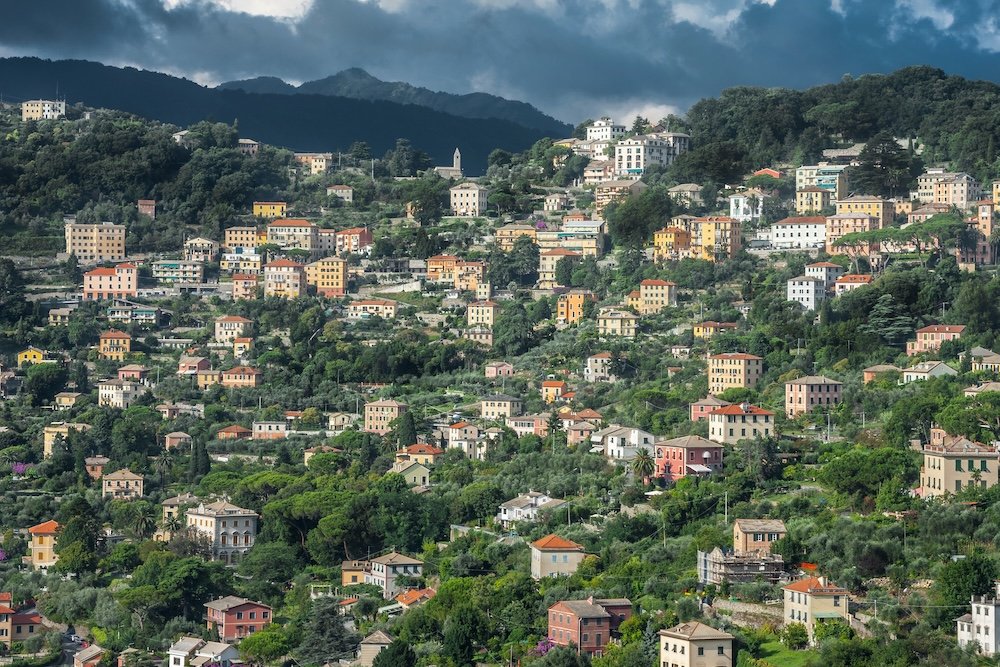
Then there is the matter of walking. In Camogli, you walk on two levels. On the seaside, Via Garibaldi is level and slow, a promenade where focaccia crumbs, sand, and pebbles crunch underfoot, with tall painted houses on one side and the sea on the other. Inland, however, the town begins to rise. The narrow streets the Genoese call caruggi slope upward between buildings so close together that they share laundry lines, and steep staircases run between the houses, leading up to Via della Repubblica, the higher pedestrian level where residents buy bread and discuss the weather. In some seafront houses, a door reaches the water below, and another set of stairs inside leads up to the street behind, so residents can leave their home from the beach and reach the bakery without climbing many stairs inside. As you continue, the stairs become shaded paths lined with cypress and olive trees, leading up to the hamlet of San Rocco and beyond to the Portofino park. Visitors tend to stop more often than they intended, as new views keep appearing. Locals pass with groceries without seeming winded, as people do when they have been climbing these steps since childhood.
The origin of the town’s name is a bit of a mystery. One suggestion points to the Genoese dialect expression cà a muggi, ‘houses in heaps’, which describes the seaside area. Another, far more romantic, explanation favors cà de mogge, ‘houses of the wives’, since the town’s men were so often at sea.
As early as the 11th century, records show harbor activity in the area, and in the 12th century Genoa established the Dragonara. Camogli only became wealthy later. Between the Napoleonic Wars and the First World War, Camogli families acquired and armed more than 2,900 sailing vessels, and in 1853 the town’s captains and shipowners set up their own marine insurance society, the Mutua Assicurazione Marittima Camogliese. Membership required being from a Camogli family and having a Camogli address; the society operated until 1888. The society’s ships served through the Crimean War and sailed to the Black Sea and the Americas until steam ended the age of sail.
Gio Bono Ferrari, a writer from Camogli and a devoted historian of Ligurian sailing, published La città dei mille bianchi velieri, “The City of a Thousand White Sailing Ships”, a reference to a military campaign in 1860 to take Sicily for a united Italy, giving the town the nickname it still uses. He then did something harder than simply writing a book: he persuaded local families to surrender the captains’ portraits, ship paintings, and brass instruments displayed in their sitting rooms, and in 1937 founded a museum. It still accepts only objects that belonged to Camogli residents, and it labels the items on display with the families’ names, their nicknames, and brief family anecdotes. It is more a family album decorated with rigging than a museum of ships. Today, Camogli preserves his memory through a central street named after him (Via Gio Bono Ferrari), his museum, and a monument erected at the municipal cemetery.
The Attractions Everyone Comes For
The Isola, the Basilica and the Dragonara. What is now a rocky outcrop blocking off Camogli’s harbor was originally an island, and locals still call it the Isola. A wide staircase leads from the boats up to the Basilica of Santa Maria Assunta, founded in the 12th century; it has a simple exterior but a Baroque interior decorated with gilded stucco, colored marble, crystal chandeliers, and frescoed ceilings. Behind the basilica stands the Castello della Dragonara, a small medieval fortress built under Genoese control to watch the coast for raiders. Both entry to the basilica and the view are free.
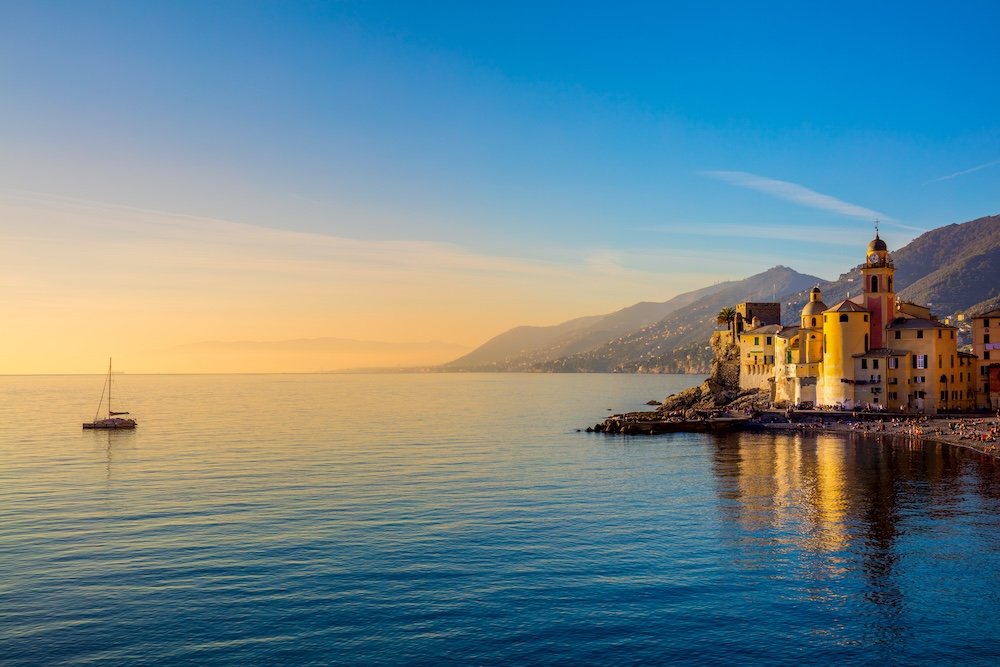
The Palazzata and the beach. The Palazzata is the row of tall houses along the seafront which gives Camogli its picturesque appearance. Below this, a public pebble beach about a quarter of a mile long lies between the Dragonara and the Cenobio dei Dogi hotel. The pebbles are smooth yet firm, and water shoes make a real difference. It is free.
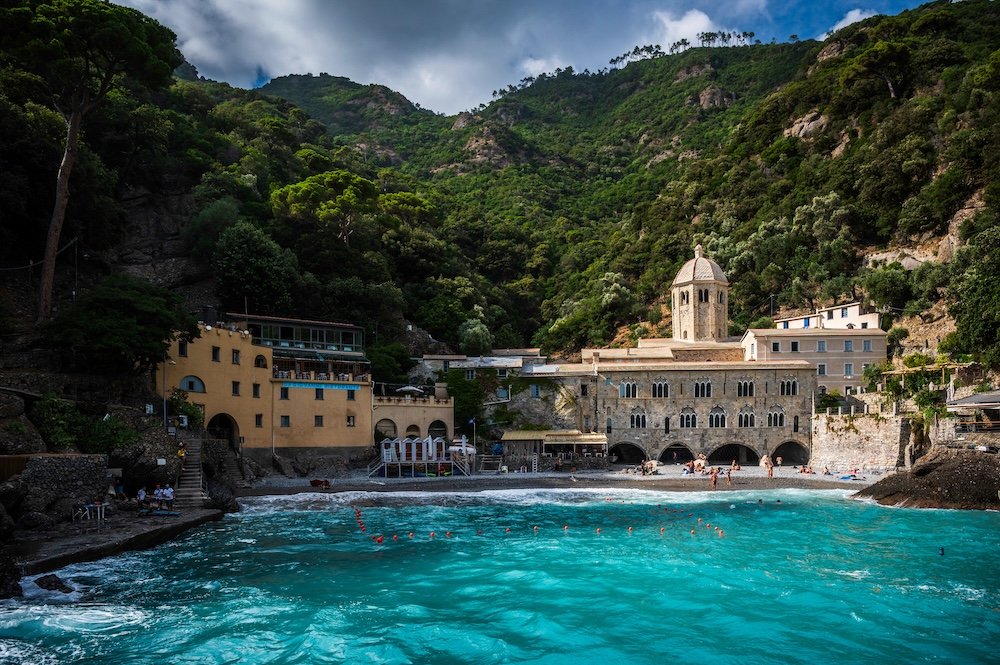
The Abbey of San Fruttuoso sits on the opposite side of the promontory, in a cove reachable only on foot or by boat, and a Benedictine monastery has stood on its small pebble beach since around 1000. FAI, the Italian heritage foundation, owns the abbey, carried out the restoration work, and opened it to the public in 1988. Admission for adults is €10 (approximately $12). All-year-round boats depart from Camogli’s harbor for a journey of about half an hour, and a one-way fare has recently been around €8.50 (about $10). If the sea gets rough, the boats stop running, and the abbey closes too.
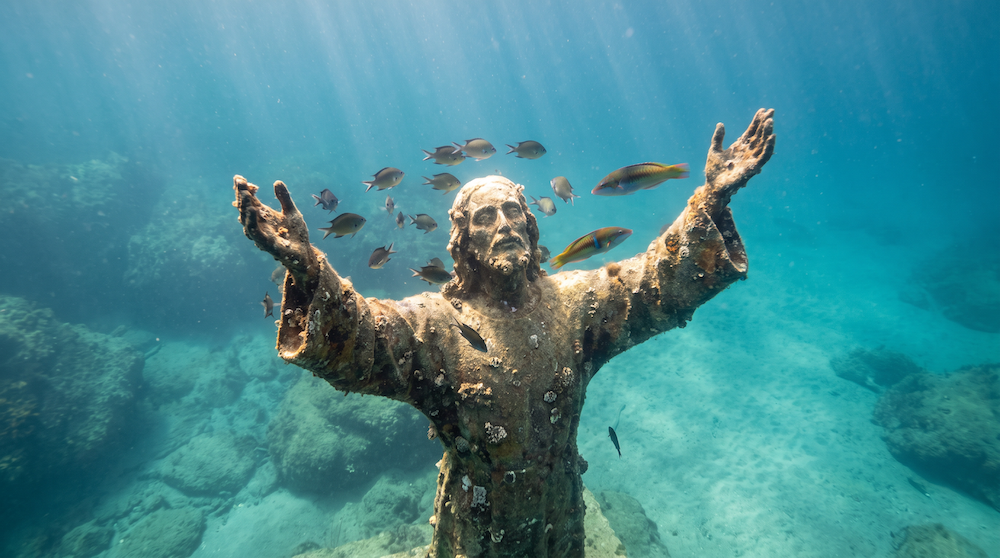
Christ of the Abyss. In a bay near San Fruttuoso, about 56 feet deep, a bronze figure of Christ stands about 8 feet tall, with his arms raised toward the light. The idea came from Duilio Marcante, one of the founders of Italian scuba diving, following on from the fact that his friend Dario Gonzatti, who is regarded as the first Italian to die while diving with an aqualung, had lost his life in these waters in 1947. The sculptor Guido Galletti made the statue from donated bronze, including ship bells, propellers, and medals from sailors and fallen soldiers. The Italian Navy lowered it into position in August 1954. Organizations run diving trips to the statue; on calm days, snorkelers can reach it. Who will appreciate this site: divers, snorkelers, and anyone touched by a memorial which most people will only see through a mask.
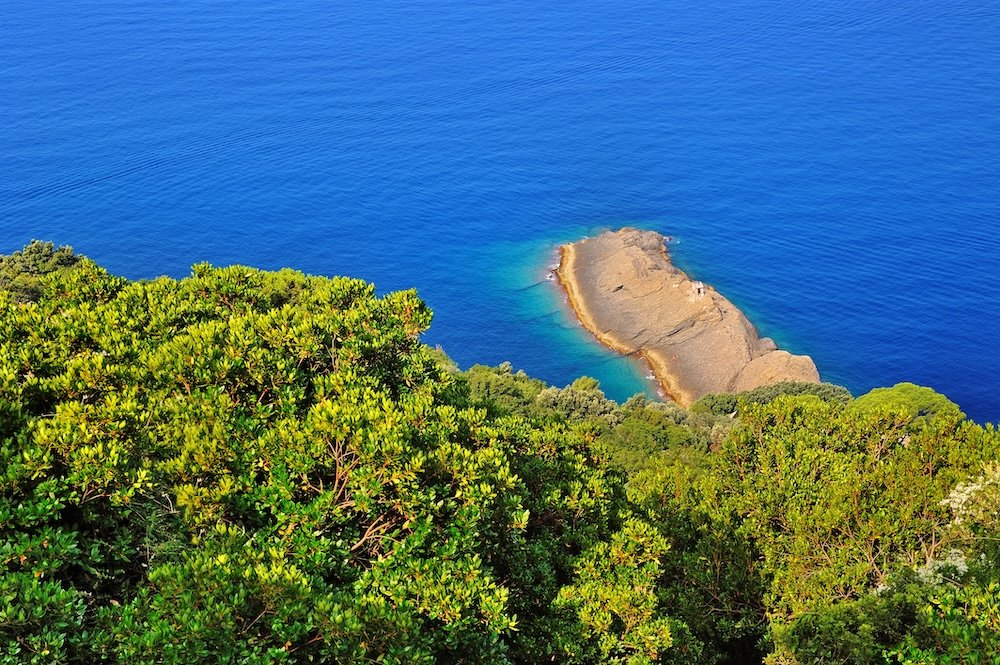
Punta Chiappa and the park trails. This long, flat outcrop of dark rock extends into the sea on the promontory’s western side. It is popular for swimming and sunbathing, with a mosaic altar dedicated to the Madonna as Stella Maris, “Star of the Sea”. Boats departing from Camogli go to the landing at Porto Pidocchio, a short walk away, for about €5.75 (approximately $7) one way. People walking the trail can go down through San Rocco and pass by San Nicolò di Capodimonte, a small Romanesque church located in the woods. The trails are free. Hikers, swimmers, and travelers who prefer rock to sand will enjoy this place.
The civic maritime museum at Camogli, the Museo Marinaro Gio Bono Ferrari, occupies two rooms and contains about 2,000 items, including 178 paintings of the town’s sailing ships, 146 ship models, as well as navigational instruments, logbooks, and letters relating to Giuseppe Garibaldi, the general who led the unification of Italy. Admission is free, and the museum is usually open in the mornings and closes on Mondays, so check the hours before you head up the hill.
Neighborhoods and Food
The town’s promenade runs along Via Garibaldi; behind it, Via della Repubblica is a pedestrian area with bakeries, wine bars, and shops. The hamlet of San Rocco di Camogli, situated above the town after a long ascent of stairs, overlooks the Golfo Paradiso, the “Gulf of Paradise”, and serves as the park’s starting point.
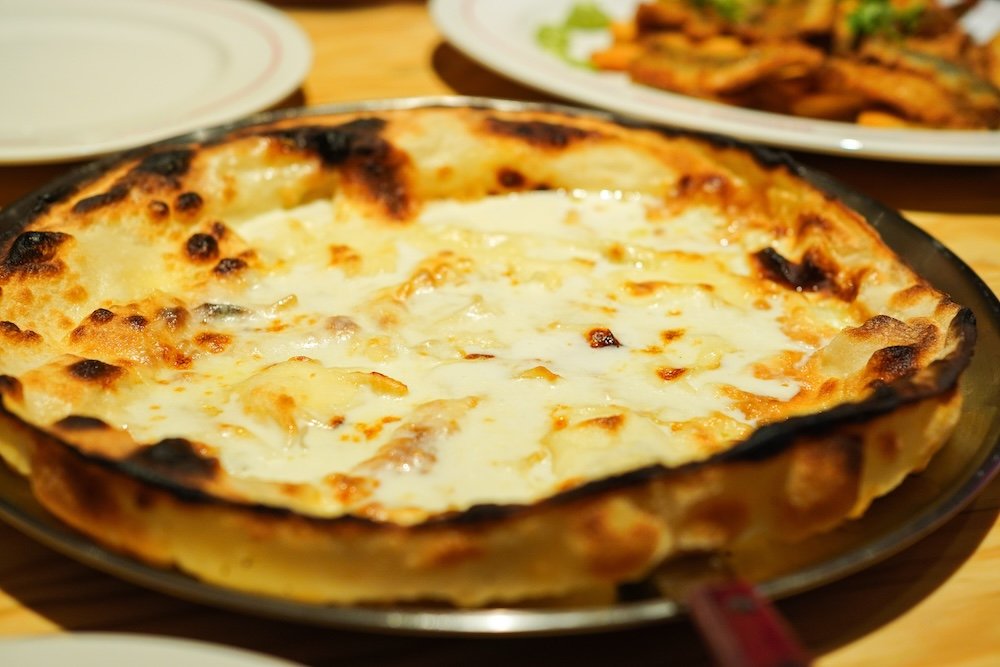
Focacceria Revello, on the seafront, has been run by the Revello family since 1964 and draws large crowds on weekends for two reasons. First, it serves focaccia di Recco col formaggio, a thin, crisp flatbread filled with soft, fresh cheese, whose name the European Union has protected since 2015 and which can be produced only in Recco and three other nearby towns, including Camogli.
The second reason is the camogliesi, small, chocolate-covered rum cakes made in the shop. Da Paolo, on Via San Fortunato in the alleyways behind the harbor, is a well-known seafood restaurant specializing in prepared, locally caught fish, including rossetti, tiny, transparent fish from the gulf. La Bossa di Mario, a wine bar with a kitchen on Via della Repubblica, has been a popular local spot for years, with a serious wine selection and by-the-glass service.
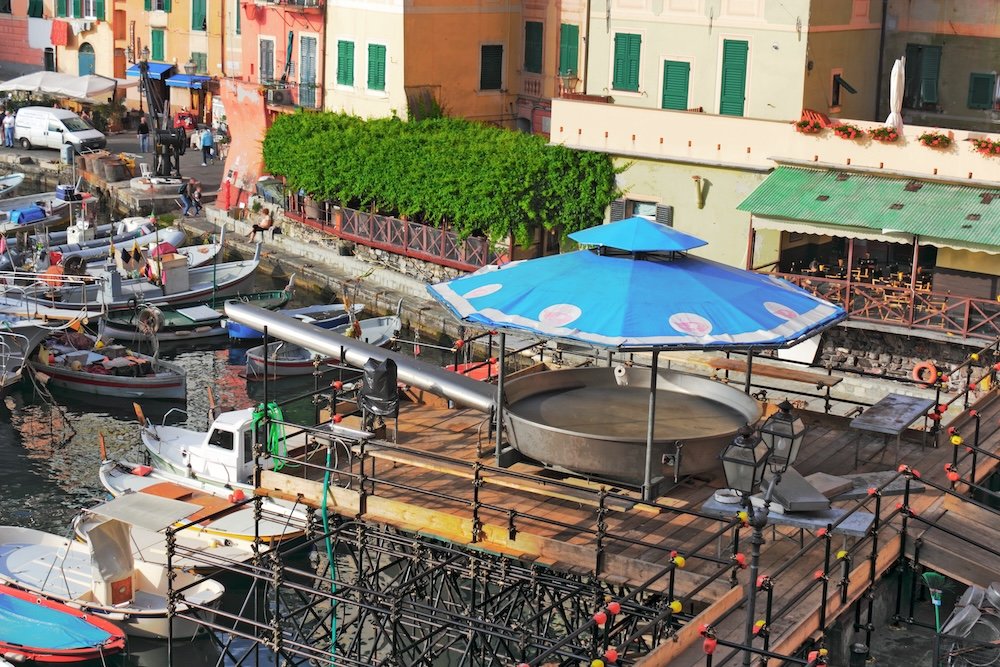
For dessert, try paciugo, a layered gelato sundae the town regards as its own. Toward the end of the promenade, one of the large frying pans used at the fish festival is on display and gets more photos than most cathedrals.
The Net That Is Spun Every Winter
A fishing trap known as the tonnarella, “little tuna trap,” has been placed in the waters between Camogli and Punta Chiappa since at least 1603. The nets stretch for more than a mile and descend to about 130 feet, guiding fish along a barrier into a final compartment. What is remarkable about it is the material used. Fishermen obtain the coconut fiber from India and, during the winter, spin it into yarn by hand, the same way they spin wool. They assemble the net on the pier in Camogli and lower it in early April. A team of eight people then pulls it up three times a day, at dawn, late morning, and in the afternoon, until late September. They release fish with no market value alive and, by the end of the season, the net has mostly biodegraded.
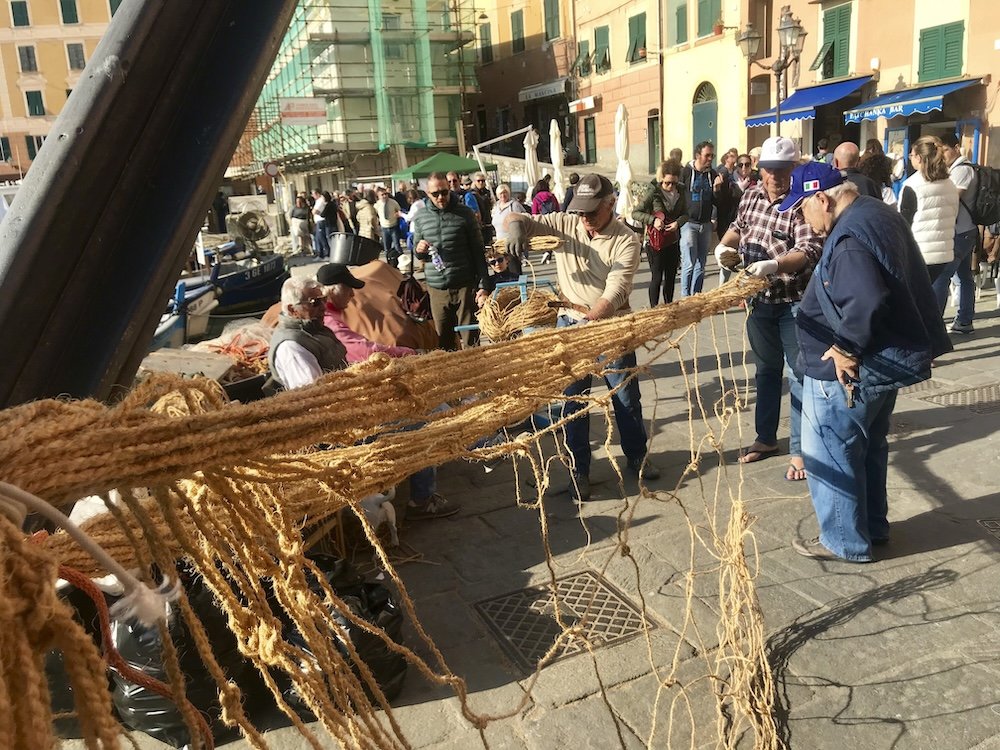
The fishermen’s co-operative of Camogli has managed the tonnarella since 1982, and Slow Food, the movement concerned with food heritage in Italy, includes it on its list of protected traditions. In August 2026, the co-operative opened a new shop on Via del Porto, in the alley once used for processing fish, and experienced fishermen have once again been salting the anchovies the traditional way. The range of products varies from year to year, so it is best to ask at the harbor what’s on offer.
Precautions Worth Taking
Americans don’t need a visa for a short visit to Italy. Since April 2026, the European Union’s Entry/Exit System has been fully operational, taking fingerprints and a facial image at the first Schengen border crossing, which has led to longer queues. At the time of writing, ETIAS, the independent pre-travel authorization, was not yet required; the EU has postponed its original target for late 2026 and has committed to announcing the start date several months in advance, so it is advisable to check the official EU website before leaving.
The rule visitors most often break concerns their clothing. In Camogli, people have been fined for walking around the town center and harbor area without a shirt, in swimwear or barefoot; the penalties set out in the latest regulations range from €25 to €500 (approximately $29 to $580); the problem can be solved by wearing a cover-up and sandals.
The well-known coastal path to San Fruttuoso via the Batterie, a group of World War II gun emplacements, has exposed sections with chains, and the mayor has closed the Passo del Bacio part of the route. The inland route is safer, and visitors should check the notices posted in town or in the park before going. In summer, when it’s hot, wear hiking shoes, take plenty of water, and leave early. Parking is limited, so taking the train is easier. On summer weekends and festival days, large numbers of day-trippers arrive, and you can see the town at its best only by staying overnight.
When to Go
From April to June, the trails turn green, wildflowers appear, and the sea remains cool. The second Sunday in May celebrates the Sagra del Pesce. This fish festival began in 1952, when about twenty fishermen fried fish all day to celebrate their patron, San Fortunato. Nowadays, volunteers fry the fish in a steel pan about 12½ feet across and weighing about 5,700 pounds, give out portions for a donation, and follow it with a Saturday night that includes fireworks and neighborhood bonfires on the beach.
In summer, temperatures reach the low 80s°F, the water is warm, and visitor numbers are at their highest. On the first Sunday in August, the Festa della Stella Maris features a procession of decorated boats, led by the Dragun, a galley built in 1968 by local craftsman Ido Battistone, which goes to an open-air Mass at Punta Chiappa. Then, in the evening, thousands of biodegradable floating candles are placed on the water.
September is the sweetest month, with the sea still at about 73°F and fewer visitors. In October, temperatures range from the lower 70s down to the 60s, and October and November are the wettest months of the year, as severe autumn storms can close the paths. Winter highs are in the mid-50s, and the town maintains its own routine, with boats to San Fruttuoso running whenever the sea permits.
Day Trips Worth the Detour
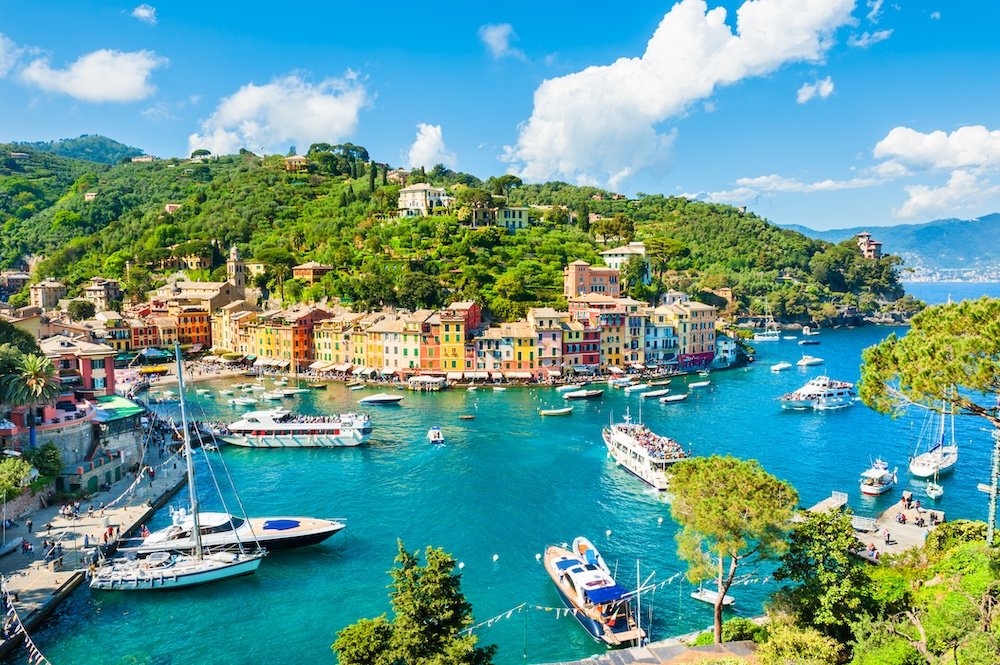
Portofino, the Riviera’s most photographed harbor, is surrounded by pastel-colored houses, shops, and superyachts, with the church of San Giorgio on the hill behind it. You can get there by train in about five minutes from Santa Margherita Ligure, then take the year-round Line 82 bus, which takes roughly 15 to 20 minutes to circle the bay. During the season, boats also connect Camogli to San Fruttuoso.
Recco—the next station to the west, reachable by train in a few minutes—is the home of focaccia col formaggio. The Panificio Moltedo, one of the town’s original bakeries from the late 19th century, still bakes. It’s ideal for food enthusiasts and anyone who treats lunch as a destination.
Genoa, about half an hour by regional train, is a port city with steep medieval streets known as caruggi, Renaissance palaces on Via Garibaldi listed on the UNESCO World Heritage List, and the Aquarium of Genoa at the old harbor. It suits history enthusiasts, families, and tourists who enjoy a touch of roughness alongside the grandeur.
By the sea lies Cinque Terre. In the summer, boats departing from Camogli’s harbor take full-day trips along the coast to the five cliffside villages to the southeast, stopping at Monterosso. Visitors include couples, first-time tourists, and anyone with tired knees.
By evening, the light along Via Garibaldi turns the color of apricot jam, and the boats come back in one by one. Up on the sixth floor, the woman’s real window is closed now, a lamp lit behind the glass. The painted shutters beside it are still half open, just as they were this morning.